
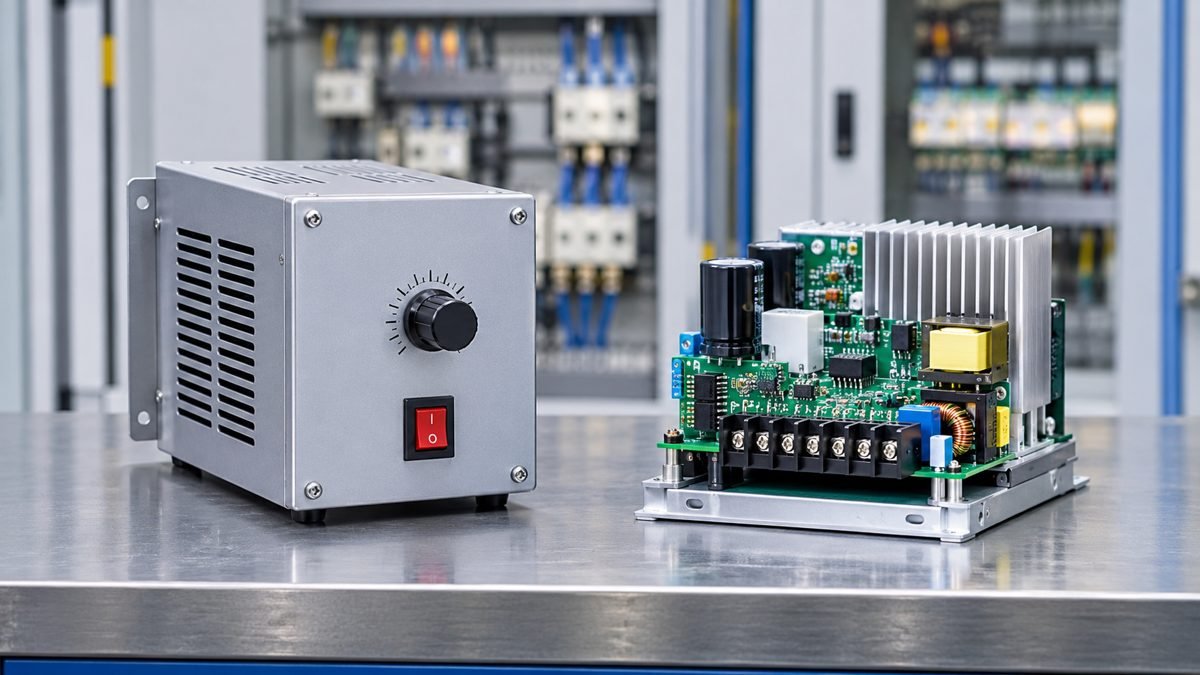
Picking up the right DC motor controller includes more than matching the controller’s current rating to the motor. Its physical construction, installation environment, control requirements, cooling arrangements, and maintenance accessibility all influence long-term performance. For UK industrial applications, one of the first decisions is whether to use an enclosed DC drive or an open-frame controller.
Both configurations provide effective DC motor speed control, but they are designed for different installation requirements. An enclosed controller offers a more integrated solution with essential operating components housed within a protective casing. An open-frame controller, by comparison, is designed for installation inside a suitable electrical enclosure or control panel, giving engineers greater flexibility when designing larger or more complex systems.
Products such as Sprint Electric enclosed DC drives provide a practical solution for applications that need straightforward installation and local operator control. However, open-frame alternatives may be more suitable where the controller needs to integrate with existing industrial automation equipment.
This guide examines the differences between two configurations, their technical considerations, and how to choose the correct solution for the application.
What Is an Enclosed DC Motor Controller?
An enclosed DC motor controller combines the drive electronics with a dedicated housing. Instead of requiring the installer to source a separate controller and arrange all the associated control components, the unit provides an integrated assembly.
The enclosure typically accommodates the controller, electrical connections, and selected operating components, depending on the model.
For example, Sprint Electric’s enclosed E-series controllers feature an aluminium enclosure with:
- Integrated mains on/off rocker switch
- Set-speed potentiometer with a graduated scale
- Integral AC supply fuse
- Dual-voltage supply compatibility
- IP40 enclosure protection
- Electronic motor speed and current control
These features make enclosed controllers particularly useful for standalone machinery and smaller industrial installations where a complete, accessible motor control arrangement is preferred.
The Sprint Electric E models are single-quadrant (1Q), non-isolated DC drives designed for forward-only motor operation. Reversing functionality is available through the corresponding ER models.
An important difference is that an IP40 enclosure provides protection against solid objects larger than 1 mm, but does not provide protection against water ingress. Therefore, enclosed does not automatically mean suitable for outdoor installation or washdown environments.
What Is an Open-Frame DC Motor Controller?
An open-frame DC motor controller consists mainly of the electronic drive assembly without a complete external protective enclosure.
It is intended to be installed within a designed electrical cabinet control panel or machinery enclosure. The installer is responsible for providing the necessary protection, mounting arrangements, electrical isolation where needed, and ventilation access control.
Open-frame controllers are commonly used in industrial environments where multiple drives, PLCs, relays, contactors, and other electrical components need to operate together.
Sprint Electric offers several open-chassis DC drive options, including its 370, 400, 800, 1200, 1600i, 3200i, and 3600XRi ranges.
Depending on the chosen model, these controllers provide different current ratings, control capabilities, and operating configurations. The wider range includes basic single-quadrant speed controllers as well as advanced four-quadrant regenerative drives.
For machinery manufacturers and control panel builders, this construction is very useful as it gives greater flexibility to develop an electrical system around the specific requirements of the application.
Enclosed vs. Open-Frame DC Drives: Main Differences
Although both configurations can control DC motor speed, their installation and integration requirements are considerably different.
| Comparison | Enclosed DC Controller | Open-Frame DC Controller |
| Construction | Supplied in a dedicated housing | Exposed drive assembly |
| Installation | Can be mounted as a standalone unit, subject to installation requirements | Needs a suitable electrical enclosure or panel |
| Protection | Defined enclosure protection, such as IP40 | Protection provided by the host enclosure |
| Wiring | Integrated control components simplify connections | Greater flexibility for customised wiring |
| Operator controls | May include an integral switch and speed potentiometer | External controls can be configured to suit the system |
| Integration | Suited to simpler motor control arrangements | Better suited to customised control panels |
| Space planning | Includes its own enclosure dimensions | Needs space for panel and suitable component clearances |
| Maintenance | Accessible integrated components | Easier access to individual panel components may be possible |
| Application | Standalone machinery and smaller installations | OEM machinery, industrial panels, and integrated systems |
However, the main difference is not necessarily the motor control technology itself. It is how the controller fits into the wider electrical installation.
An enclosed controller can reduce the amount of additional hardware that is needed for a straightforward application. An open-frame controller gives engineers more control over the panel design.
Sprint Electric E Range
For applications needing enclosed DC motor control, the Sprint Electric E range provides several controller ratings to accommodate different motor current and power requirements.
The range includes the 370E, 400E, and 1200E models. These are single-quadrant controllers designed for forward-only motor operation.
The following three models are particularly relevant when comparing controller capacity.
1. Sprint Electric 370E
The Sprint Electric 370E is a compact enclosed DC drive designed for smaller permanent magnet, shunt-wound, and suitable universal DC motor applications.
Its principal specifications include:
- Maximum continuous armature current: 3.7 A
- Typical nominal motor power: Up to 0.55 kW, depending on supply configuration
- AC input compatibility: 110-240 V
- Adjustable acceleration
- Adjustable current overload protection
- Armature voltage or tachogenerator speed feedback
- Integrated speed potentiometer and mains switch
The controller includes adjustable acceleration and IR compensation, allowing engineers to configure motor response according to the application.
It is worth considering for smaller machinery, feed mechanisms, compact conveyor systems, and other installations where a relatively modest DC motor needs controlled forward operation.
2. Sprint Electric 800E
The Sprint Electric 800E offers a higher current capacity for applications that need greater motor output. Its key specifications include:
- Maximum continuous armature current: 8A
- Typical nominal motor power: up to 1.1 kW, depending on supply configuration
- Dual-voltage AC supply compatibility
- Adjustable acceleration and deceleration
- Adjustable minimum and maximum motor speed
- Adjustable maximum motor current
- Selectable armature voltage or tachogenerator feedback
- Additional analogue input and output functionality
The 800E includes Sprint Electric’s micro analog processor, providing additional control functionality.
It also supports a torque control input for basic winding or tension control applications, with overspeed limiting.
This makes it worth evaluating for small-to-medium machinery where the speed of the motor needs to remain controlled under changing operating loads.
3. Sprint Electric 1200E
The Sprint Electric 1200E is the higher-current option among these three models. It is designed for applications that need up to 12 A continuous armature current.
Its main specifications include:
- Maximum continuous armature current: 12 A
- Typical nominal motor power: up to 1.8 kW, depending on the supply configuration
- Dual-voltage AC supply compatibility
- Adjustable acceleration and deceleration
- Adjustable minimum and maximum speed
- Adjustable current and stability settings
- Selectable tachogenerator or armature voltage feedback
- Torque control input and additional signal connections
The 1200E is suitable for machinery with higher motor current requirements, provided the motor’s electrical characteristics and operating conditions fall within the specifications of the drive.
Its additional current capacity makes it relevant to larger food systems, material handling equipment, and industrial machinery that needs controlled DC motor operation.
| Specification | 370E | 800E | 1200E |
| Maximum continuous armature current | 3.7 A | 8 A | 12 A |
| Typical maximum motor power | 0.55 kW | 1.1 kW | 1.8 kW |
| AC supply compatibility | 110-240 V | 110-240 V | 110-240 V |
| Control quadrant | 1Q | 1Q | 1Q |
| Motor direction | Forward | Forward | Forward |
| Enclosure protection | IP40 | IP40 | IP40 |
Power figures are typical maximum ratings, not universal motor compatibility limits. Actual suitability depends on the supply configuration, armature voltage, motor rating, and installation conditions. Thus, it is important to consult the relevant manufacturer datasheet and product manual before making a selection.
When To Choose an Enclosed DC Motor Controller?
An enclosed controller is generally the more practical choice when the application needs a straightforward motor control arrangement without extensive panel engineering.
Consider an enclosed DC drive in the following situations:
1. Standalone machinery
If the DC motor operates independently rather than forming part of a large integrated production system, an enclosed controller can simplify installation. Its integrated switch and speed potentiometer provide convenient local operation.
2. Limited control panel requirements
Smaller machinery installations may not need a dedicated electrical cabinet for an individual drive. An enclosed controller can reduce the number of separately sourced components, although appropriate mounting and electrical protection are still required.
3. Local speed adjustment
Applications that need an operator to adjust motor speed locally can benefit from an integrated potentiometer. This avoids the need to configure a separate speed reference interface for basic manual operation.
4. Straightforward forward-only operation
The E-series is designed for single-quadrant forward operation. Where the motor does not need controlled reverse operation, this arrangement can provide a suitable solution without specifying a more complex drive.
However, if an application needs reversing, the corresponding ER models should be considered instead.
When to Choose an Open-Frame DC Controller?
Open-frame controllers become more suitable when the installation involves several interconnected electrical components or specific control requirements.
1. Custom-built electrical panels
OEM manufacturers and industrial control panel builders generally prefer open-frame drives because they can integrate them into existing electrical components and assemblies.
2. Multiple motor control systems
Where various DC motors operate within one machine, an open-frame configuration can make it easier to organise drives, protection devices, control requirements, and wiring within a central cabinet.
3. Advanced control requirements
Some open-frame Sprint Electric models offer capabilities beyond basic speed control, including regenerative operation and more advanced torque control.
4. Greater installation flexibility
Open-frame controllers allow engineers to select the layout of the cabinet, cooling arrangements, external operator controls, and wiring configuration according to the requirements of the machine. This flexibility is particularly valuable in bespoke machinery and industrial automation projects.
Which DC Motor Controller You Should Choose?
The correct choice depends on the complexity of the machine, installation environment, and required motor control functions.
For a standalone machine that has relative forward-only speed control requirements, an enclosed controller such as the Sprint Electric 370E, 800E, or 1200E may be a practical option.
For a customised control panel, multiple motor installation, or applications requiring advanced regenerative functionality, an open-frame controller may provide better flexibility.
A useful selection approach is to start with the motor’s nameplate information, determine whether reversing or regenerative braking is required, and then assess the installation and other environmental requirements.
Choosing a controller based on these factors will surely help avoid oversizing, unsuitable operating conditions, and unnecessary installation complexity.
Get the Right DC Motor Controller For Your Application
Selecting between enclosed and open-frame controllers is ultimately a question of application requirements rather than one configuration being universally better than the other.
The Sprint Electric enclosed DC drives provide integrated motor control solutions for smaller machinery and standalone installations. Its 370E, 800E, and 1200E models offer distinctive current capacities. It allows engineers to select a controller that aligns with the specifications of the motor.
Open-frame controllers offer greater flexibility for custom-built motor control solutions for different industrial applications and it includes Sprint Electric products. If you are comparing enclosed and open-frame controllers, it is important to review the motor’s current, voltage, feedback, and operating requirements.
Explore the Sprint Electric range at Industrial Motor Warehouse to identify a DC motor controller that meets your application’s technical and installation requirements.
Author

khizarnisar367@gmail.com
Related Posts

Diesel Room Literacy for Dive Travelers: Reading the Engine That Carries Your Camera Rig
Every underwater photographer has a story about a trip that collapsed for mechanical reasons. A liveaboard limps back to port on one...
Read out all
Rolling Basecamps: How Dive Teams and Coral Restoration Projects Specify Purpose-Built Mobile Units
Most underwater projects are won or lost on land. The dive plan may be elegant, the camera rigs immaculate, but if the...
Read out all
Rigging at the Waterline: How Dive and Imaging Teams Move Heavy Gear Without Wrecking It
Most underwater photographers think about weight in terms of what they can swim with. But the hardest part of a serious project...
Read out all
Practical AI Tools That Support Classroom Teaching
- 0
- 1,879 word
Teachers have always been resourceful. Give an experienced educator a stack of paper, a few markers, and a room full of curious...
Read out all
How Many Solar Panels Does a Generator Need?
- 0
- 954 words
Panels are the part of a solar setup people buy by feel, usually after the generator has already arrived. The array is...
Read out all
How Do You Calculate Solar Generator Runtime?
- 0
- 916 words
Solar generator runtime is not simply the battery capacity divided by the largest appliance wattage. A useful estimate has to reflect how...
Read out all