
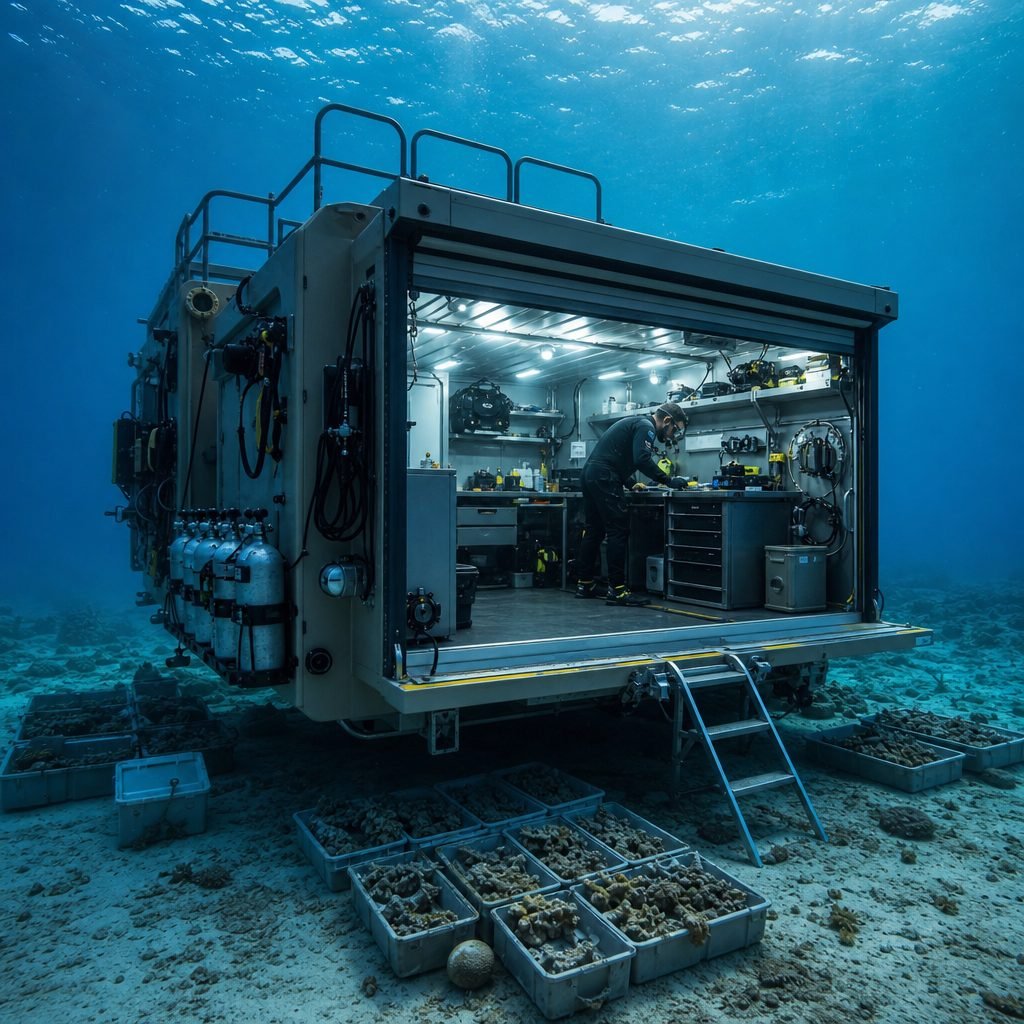
Most underwater projects are won or lost on land. The dive plan may be elegant, the camera rigs immaculate, but if the surface team is working off a folding table under a pop-up canopy, data gets lost, batteries go uncharged, hard drives cook in the heat and someone spends the afternoon driving to town for ice. Purpose-built mobile units — command trailers, kitchen trailers, film set trailers and the coaches that combine several of those functions — exist to solve exactly that problem. They are common in emergency response and in film production, and they are increasingly sensible for marine science, restoration programs and long-form expedition media. If you have never specified one, the process can feel opaque. Below is a practical walk-through of what these units actually do, which specification decisions matter most, and where the money goes.
Why a hard-sided mobile unit beats a tent and a pickup bed
A shoreside basecamp has four jobs: keep people working, keep equipment alive, keep data safe and keep decisions coordinated. Canopies and plastic bins handle none of them well in salt air, 90-degree heat or an afternoon squall. A fabricated trailer gives you a conditioned interior, a fixed electrical system, lockable storage with known load paths, and a layout that stays identical from one deployment to the next — which matters more than people expect, because repeatable layouts reduce errors when a team is tired on day nine. The use case is easy to picture in restoration work. Land-based coral nurseries and grow-out facilities, such as the Earthshot Prize-winning Coral Vita farm in the Bahamas, show how much shoreside infrastructure modern reef intervention actually requires: water handling, monitoring, sample processing, record keeping, visiting researchers and a steady stream of public interest. Projects that cannot build permanent structures — because they are seasonal, permit-limited, or working across several sites in one region — end up needing that same functionality on wheels.
Reading the specification: what actually matters
Power before anything else
Start by adding up your real electrical load, not your optimistic one. Count every charger: rebreather handsets, strobes, video lights, laptops, drone batteries, acoustic receivers, a chest freezer for samples, and the air conditioning that keeps all of it from overheating. Climate control is usually the largest single draw in a coastal deployment, and it is the one people forget. Then decide how that load is served — shore power when available, onboard generation when it is not, and battery storage for the quiet hours when a running generator would ruin an interview recording or a night dive briefing. Specify more circuits than you think you need and label them clearly; retrofitting outlets into a finished interior is tedious and expensive.
Slide-outs, layouts and the honest truth about floor area
Slide-out sections are the usual answer when a unit must tow narrow and work wide. A single slide can transform a cramped corridor into a room where six people can stand around a chart without shuffling. The trade-offs are real: slides add weight, add mechanical and seal maintenance, and they demand level, stable, reasonably firm ground — which is not always what a boat ramp or a beach access road offers. Consider whether the unit must stay functional with the slide retracted, because sooner or later you will arrive at a site where it cannot be deployed. Plan the interior around fixed workstations along one wall and a flexible zone elsewhere, rather than scattering small benches; continuous work surfaces are far more useful than the sum of their parts.
Connectivity and the quiet details
Satellite and cellular options change constantly, so the durable decision is infrastructure: roof penetrations and mounts in the right places, cable runs with spare capacity, a proper equipment rack with ventilation, and a cleanly grounded antenna mast. Add the small things that make a unit livable — exterior rinse connections, a dedicated wet-gear area separated from electronics, external lighting on separate switches, and awnings that give shade for surface intervals without becoming sails in wind.
Feeding and sheltering the crew
Crew welfare is operational safety, not luxury. Dehydrated, under-fed divers make poor decisions. On multi-week deployments far from restaurants, a commercial kitchen trailer or a built-in galley pays for itself in retained hours alone, and it gives you control over refrigeration for both food and samples. The same fabrication logic that produces custom food trailers for event operators — stainless surfaces, fresh and gray water tanks, ventilation, serving windows — adapts neatly to expedition catering, and a serving window becomes genuinely useful when the same unit hosts a community open day.
Where the budget goes
Build costs track complexity rather than square footage: chassis class and axle rating, slide-outs, generator and battery capacity, HVAC tonnage, the number of workstations wired and furnished, and the degree of custom cabinetry all move the figure more than overall length does. Working through a detailed functional brief with an experienced fabricator before asking for numbers is the single best way to avoid a painful second quote. Craftsmen Industries, a custom industrial fabrication company that designs and builds mobile command centers, command trailers, Class C command coaches, kitchen and stage trailers, film set trailers and promotional vehicles, publishes a useful breakdown of the variables behind mobile command center cost — worth reading before you write a funding request, because it frames the conversation around capability choices rather than a single headline figure.
The outreach dividend
There is a second reason conservation groups commission these units: they are the most persuasive outreach tool a marine program can own. A branded trailer parked at a harbor festival, with screens running reef footage and a scientist answering questions, reaches people who will never attend a lecture. The marketing discipline behind that is the same one profiled in Adweek's conversation on modernizing marketing inside a legacy industry: meet the audience where they already are, and make the story tangible. Stage trailers and experiential vehicles were built for precisely that job, and a dual-purpose specification — working command space on weekdays, public-facing platform on weekends — spreads the capital cost across two mandates, which funders tend to like.
A short pre-build checklist
- Write a day-in-the-life narrative of three typical deployments before drawing a floor plan.
- Total your electrical load, then add 30 percent headroom for equipment you will buy later.
- Confirm tow vehicle rating, hitch type and brake controller against the loaded weight, not the dry weight.
- Check access at your worst site: gate widths, turning radius, ramp grade, overhead branches.
- Decide what must still work with slides retracted and shore power unavailable.
- Separate wet, dry and electronic zones physically, with drainage designed in.
- Specify serviceable, replaceable components over bespoke parts wherever the function is identical.
- Budget for consumables and maintenance — seals, filters, generator service — as recurring line items.
Build for the tenth deployment, not the first
The units that still earn their keep after five seasons are rarely the most elaborate ones. They are the ones whose owners were honest early about ground conditions, power draw, crew habits and how often the trailer would really be towed. Specify conservatively, insist on serviceability, and treat the floor plan as an operational document that your team reviews together. Do that, and a mobile unit stops being an expensive box and becomes the reason your surface operation runs as well as your dive plan.
Author

khizarnisar367@gmail.com
Related Posts
Diesel Room Literacy for Dive Travelers: Reading the Engine That Carries Your Camera Rig
Every underwater photographer has a story about a trip that collapsed for mechanical reasons. A liveaboard limps back to port on one...
Read out all
Rigging at the Waterline: How Dive and Imaging Teams Move Heavy Gear Without Wrecking It
Most underwater photographers think about weight in terms of what they can swim with. But the hardest part of a serious project...
Read out all
Enclosed vs. Open-Frame DC Motor Controllers: Which Should You Choose?
Picking up the right DC motor controller includes more than matching the controller’s current rating to the motor. Its physical construction, installation...
Read out all
Practical AI Tools That Support Classroom Teaching
- 0
- 1,879 word
Teachers have always been resourceful. Give an experienced educator a stack of paper, a few markers, and a room full of curious...
Read out all
How Many Solar Panels Does a Generator Need?
- 0
- 954 words
Panels are the part of a solar setup people buy by feel, usually after the generator has already arrived. The array is...
Read out all
How Do You Calculate Solar Generator Runtime?
- 0
- 916 words
Solar generator runtime is not simply the battery capacity divided by the largest appliance wattage. A useful estimate has to reflect how...
Read out all