
- 0
- 1,201 word
If you have ever shipped a temperature-sensitive assay across three time zones, you already know the problem. Enzymes degrade, master mixes separate, and a cold-chain failure at a customs warehouse can write off an entire lot. For years the industry treated this as a logistics cost. Increasingly, it is being treated as a formulation problem instead, and the answer showing up in more and more kits is the freeze-dried bead.
This piece covers what reagent beads actually are, where they earn their keep, and the technical decisions that separate a bead that works on day one from one that still works eighteen months later.
What a reagent bead actually is
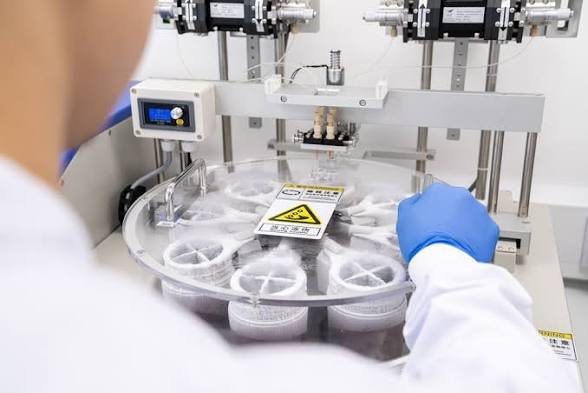
A lyophilized bead is a single, pre-measured dose of reagent that has been frozen into a small sphere and then dried under vacuum. The typical process dispenses precise droplets of a liquid formulation into a cryogenic medium such as liquid nitrogen, where each droplet freezes almost instantly into a uniform sphere. Those frozen spheres are then freeze-dried, which removes water by sublimation rather than evaporation, leaving a porous, glassy structure that holds the active components in a stable state.
Add buffer or sample, and the bead dissolves in seconds. No pipetting of the master mix, no thawing, no mixing step where a technician can introduce error.
The format sounds simple. The engineering underneath it is not.
Where beads earn their keep
The clearest wins are in molecular diagnostics. PCR, qPCR and isothermal methods like LAMP all depend on enzymes that are notoriously fragile in liquid form. Converting the full reaction mix into lyophilized reagent beads lets a manufacturer ship at ambient temperature, simplify the user workflow down to “add sample,” and build reagents directly into cartridges for point-of-care devices.
Immunoassays benefit in a similar way. Antibody conjugates, substrates and blocking agents can each be dried into discrete beads, which makes it easier to separate components that would otherwise react with each other in storage.
Then there are the practical advantages that rarely make the marketing slide but matter on the production floor:
- Dose accuracy. Each bead carries a defined amount of reagent, which tightens lot-to-lot consistency.
- Modularity. Different beads can be combined in one tube or well, so a single production line can support multiple assay configurations.
- Lower shipping and storage cost. Removing the cold chain changes the economics of serving remote clinics, field labs and emerging markets.
- Less operator error. Fewer liquid-handling steps mean fewer chances to get it wrong.
Beyond diagnostics: the format is spreading
The same logic, stabilise a sensitive active and deliver it as a precise single dose, applies well outside the lab. Cosmetic and personal-care formulators have started using freeze-dried spheres to protect ingredients that lose potency once they meet water, such as certain vitamins, peptides and botanical extracts. The consumer activates the bead right before use, which keeps the formula fresh without leaning on heavy preservative systems.
Most brands do not have cryogenic dispensing lines or production-scale freeze dryers in-house, nor should they build them for a first product. That is why many teams prototype and scale through freeze-dry beads contract manufacturing services instead, using a partner who already has the equipment, the cycle-development experience and the controlled-humidity filling environment the format demands.
Five technical decisions that make or break a bead
1. The excipient system
Water is doing structural work in a liquid formulation. Remove it, and something has to take its place. Sugars such as trehalose and sucrose are the usual lyoprotectants because they form an amorphous glass that immobilises proteins and protects them during both freezing and drying. Bulking agents give the bead mechanical strength so it survives handling. Getting this ratio wrong produces beads that are either too fragile to package or too dense to dissolve quickly.
2. Glass transition and collapse temperature
Every formulation has a temperature above which the frozen matrix softens and the structure collapses during primary drying. Characterising this (often expressed as Tg′ or the collapse temperature) is not optional. Run the cycle too warm and you get shrunken, sticky beads; run it too cold and the cycle takes far longer than it needs to, which drives up cost.
3. Droplet and bead uniformity
Bead size controls dose. Dispensing precision, nozzle design and the freezing medium all affect how consistent the spheres are. Inconsistent beads mean inconsistent assay performance, and regulators will notice.
4. Residual moisture
A freeze-dried bead is hygroscopic. It will pull moisture from the air the moment it gets the chance, and even a small increase in residual moisture can accelerate degradation. This is why filling and packaging typically happen in low-humidity environments, and why packaging choices (foil pouches, desiccants, sealed cartridges) belong in the formulation conversation rather than being bolted on at the end.
5. Reconstitution time
The end user expects the bead to dissolve almost instantly. Porosity, bead size and excipient choice all influence how fast that happens. A bead that takes thirty seconds to dissolve in a rapid test is a design flaw, not a quirk.
Stability testing: plan it early
The whole point of the bead format is shelf life, so stability data is the product. Accelerated studies at elevated temperature give early signals, but real-time data is what supports a label claim. Build the stability protocol at the same time as the formulation, not after it, and define upfront which performance metrics (activity, sensitivity, dissolution time, appearance) will count as failure.
The part nobody plans for: supporting the product after launch
Once beads are in the field, the questions start: How should unopened pouches be stored? What happens if a pouch is left open for an hour? Where is the certificate of analysis for this lot? Can the beads be used with a different instrument?
These are repetitive, documentation-heavy questions, and they tend to land on the same few technical support staff. Some reagent and kit suppliers now handle the first line of these queries with assistants trained on their own IFUs, stability data and CoA library, often built with outside help from AI chatbot development services teams, while escalating anything about assay failure or patient results to a human specialist. Done carefully, it frees scientists to work on the problems that genuinely need them. Done carelessly, it creates a compliance risk, so the guardrails matter as much as the tool.
Is the switch worth it?
Not always. If your assay ships domestically, has a short use window and sells in low volumes, the development cost of a lyophilised format may not pay back. The case gets strong when you are dealing with any of the following:
- Long or unpredictable supply chains
- Point-of-care or field use where refrigeration is unreliable
- Multi-component assays where operator error is a real failure mode
- Products where shelf life is a competitive differentiator
If two or more of those apply, beads deserve a serious feasibility study.
Final thought
Lyophilized beads are not a magic stability fix. They are a formulation discipline. The teams that succeed with them treat excipients, cycle design, moisture control and stability testing as one connected system rather than four separate tasks. Get that right, and you end up with a product that is easier to ship, easier to use and harder for competitors to match.
Author

hyderghumro3@gmail.com
Related Posts
Nancy Wheeler Jenkins: The Untold Story of Larry Ellison’s Former Wife
- 0
- 2,371 words
Nancy Wheeler Jenkins is a name that continues to attract curiosity among people interested in technology history, billionaire relationships, and the personal...
Read out all
Sylvia Ahí: Biography, Career, Marriage to Arnold Vosloo, and Life Away From the Spotlight
- 0
- 1,945 word
Sylvia Ahí is a name that has attracted attention among entertainment fans, particularly those interested in the personal lives of Hollywood actors....
Read out all
David Calhoun and David Zaslav: Leadership, Careers, Business Achievements, and Their Influence on Corporate America
- 0
- 2,976 words
The business world is shaped by influential executives who make important decisions, lead major organizations, and influence the direction of entire industries....
Read out all
Denika Kisty: Biography, Personal Life, Background, and Everything You Should Know
- 0
- 2,029 words
Introduction The internet has made it easier than ever to discover information about people whose names attract public curiosity. Some individuals become...
Read out all
Adda Quinn: The Untold Story of Larry Ellison’s First Wife and Her Life Beyond the Spotlight
- 0
- 2,410 words
Introduction The name Adda Quinn attracts attention because of its connection to one of the most successful technology entrepreneurs in the world,...
Read out all
Edward Roy McHale: Biography, Family Background, Early Life, and Personal Journey
- 0
- 2,700 words
When people search for Edward Roy McHale, they are often curious about his family background and his connection to Hollywood. As the...
Read out all