
- 0
- 1,765 word
Learning a language from a textbook and hearing it spoken in everyday conversation can feel like two entirely different experiences. Textbooks introduce vocabulary and grammar in an organised way, but real conversations rarely follow such predictable patterns. People interrupt each other, shorten sentences, use expressions that make little sense when translated literally and communicate through tone as much as words.
Movies and web series offer an interesting way to bridge that gap. They place language within recognisable situations, allowing viewers to observe how people express excitement, disagreement, affection or embarrassment. A familiar phrase becomes easier to remember when it is connected to an interesting character or a memorable conversation.
However, watching hours of foreign-language entertainment does not automatically lead to fluency. The real value comes from knowing what to watch, how to use subtitles and which expressions are worth bringing into everyday conversations. With a few thoughtful changes to viewing habits, entertainment can become an enjoyable addition to regular language learning.
The Language You Hear on Screen Is Different From Textbook Language
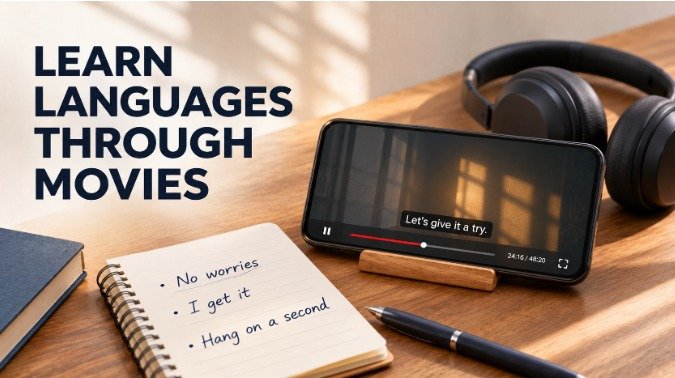
One of the first things learners notice when watching films in another language is how rarely characters speak in complete, carefully structured sentences. Someone might say “No idea” instead of “I do not know”, or “Hang on a second” rather than “Please wait a moment”. Both versions communicate similar ideas, but the shorter expressions often sound more natural in casual conversation. These differences help explain why someone with a good understanding of English grammar may still find ordinary conversations difficult to follow.
Films also reveal how much meaning depends on delivery. The word “Whatever” can express indifference, reluctant agreement or irritation, depending on the speaker’s tone and relationship with the other person. Similarly, “You’ve got a point” can acknowledge someone’s argument without necessarily agreeing with everything they have said. Learning these distinctions through a vocabulary list alone can be difficult because the surrounding circumstances are missing.
There is also value in noticing how characters change their language depending on whom they are speaking to. Conversations between close friends may contain slang and unfinished sentences, while discussions with employers or unfamiliar people tend to follow different social expectations. Recognising these changes helps learners understand that speaking naturally is not simply about choosing grammatically correct words. It is also about knowing which expressions belong in which situations.
Getting More Out of Subtitles Without Becoming Dependent on Them
Subtitles are among the most useful tools for learning a language through movies, but the best way to use them depends on how much of the language a viewer already understands. Beginners may benefit from subtitles in their native language because they can follow the story without becoming overwhelmed by unfamiliar vocabulary. At this stage, noticing repeated greetings, questions and everyday expressions is more realistic than trying to understand every sentence.
As listening skills improve, switching to subtitles in the language being studied can be particularly helpful. Someone learning English, for example, can watch an English-language series with English subtitles to connect unfamiliar pronunciations with their written forms. This is useful when characters speak quickly or combine words in ways that make individual sounds difficult to recognise. Subtitles do not always reproduce dialogue word for word, however, so occasional differences between the spoken and written versions are perfectly normal.
A practical exercise is to choose a short scene and watch it three times. Begin with subtitles that make the conversation understandable, switch to target-language subtitles to examine the expressions, and finally watch without subtitles to see how much of the dialogue remains recognisable. There is no need to repeat an entire episode this way. A two-minute conversation can provide plenty of material, particularly when it contains language that could be useful outside the fictional setting.
The aim is to gradually become more comfortable listening, rather than treating subtitles as something that must be eliminated as quickly as possible.
Different Genres Teach Different Kinds of Language
The most entertaining film is not necessarily the best choice for a language learner. A complicated historical drama may contain beautiful dialogue, but much of its vocabulary could be irrelevant to someone trying to become more comfortable with everyday conversations. Choosing entertainment according to a particular learning goal can make the experience considerably more useful.
Sitcoms are a good starting point for informal expressions because their stories frequently revolve around friendships, relationships and ordinary misunderstandings. Friends provides plenty of examples of casual American English, while The Office offers a mixture of workplace conversations, awkward social interactions and humour. For learners interested in Hindi, Panchayat presents a different linguistic environment, with conversations shaped by village life, local relationships and everyday responsibilities.
Crime thrillers can introduce more specialised vocabulary related to investigations, authority and reasoning, while documentaries are often useful for developing vocabulary around a particular subject. Romantic comedies may offer approachable social expressions, although their conversations can be more dramatic than those encountered in real life.
It is worth remembering that film dialogue is written to entertain. Sarcastic remarks that make a television character funny may sound rude when repeated in an actual workplace. Historical expressions may be outdated, and some slang belongs to very specific communities. Learning from entertainment therefore involves selecting useful language rather than copying everything a favourite character says.
Familiar Stories Make Unfamiliar Languages Easier to Understand
Rewatching a familiar film in another language can be surprisingly productive. When viewers already know the characters, relationships and major events, they do not need to devote as much attention to understanding the plot. Instead, they can concentrate on recognising words, following pronunciation and noticing how familiar ideas are expressed differently.
India’s multilingual entertainment culture offers plenty of opportunities to experiment with this approach. A Tamil-speaking viewer learning Hindi might revisit a familiar story through an available Hindi-dubbed edition. Someone interested in Malayalam could begin with a film they have previously watched with English subtitles. Knowing what is happening makes it easier to connect unfamiliar expressions with their likely meanings, even when every individual word is not immediately understood.
Language-based content browsing can also help viewers explore entertainment outside their usual preferences. The castle app offers content language preferences covering Hindi, English, Telugu, Tamil and Malayalam, giving audiences a way to browse according to their linguistic interests. For language learners, exploring entertainment in a different language can complement more structured practice, provided suitable content and language tracks are available.
Comparing original and dubbed versions can reveal interesting cultural differences as well. Humour, greetings and expressions of affection do not always translate directly between languages. Paying attention to those differences helps learners appreciate not only new vocabulary but also the cultural habits behind everyday communication.
From Recognising Movie Dialogue to Actually Speaking the Language
Understanding a conversation on screen is a rewarding milestone, but recognising an expression and using it independently are different skills. A learner may understand most of an English-language episode and still struggle to find the right words during a conversation. Films provide useful language input, but speaking requires opportunities to retrieve and adapt that language.
One technique worth trying is shadowing, which involves listening to a short piece of dialogue and attempting to reproduce its rhythm, pronunciation and pauses. Rather than repeating an entire conversation, learners can concentrate on one or two sentences at a time. The objective is not to imitate an actor’s accent perfectly, but to become more comfortable with the way words flow together during speech.
Another useful exercise is sentence adaptation. Consider the everyday expression “I didn’t mean to interrupt.” Instead of memorising it as a single fixed sentence, a learner can experiment with variations:
- I didn’t mean to upset you.
- I didn’t mean to sound rude.
- I didn’t mean to make things difficult.
These variations turn one familiar expression into a flexible sentence pattern that can be used in several situations. The same approach works with questions, requests and expressions of disagreement.
Retelling a story is another enjoyable way to practise. After watching an episode, learners can describe what happened, explain a character’s decision or share an opinion about the ending in the language they are studying. This encourages them to construct their own sentences rather than depend entirely on dialogue they have heard before.
Learning Without Turning Every Movie Into Homework
There is a danger in becoming too enthusiastic about learning through entertainment. Constantly pausing a film, looking up unfamiliar words and recording every interesting expression can make an enjoyable activity feel exhausting. Eventually, the effort required to watch an episode may become greater than the motivation to continue.
A more sustainable approach is to separate entertainment from focused practice. During ordinary viewing, learners can concentrate on the story and allow familiar expressions to stand out naturally. During a shorter practice session, they can return to a particularly useful conversation, examine its vocabulary and experiment with speaking. This balance leaves room for both enjoyment and deliberate learning without demanding that every film become a lesson.
Mobile entertainment makes this approach easier to fit around everyday routines. Android viewers exploring entertainment options through the castle apk resource can make language exposure part of their personal viewing habits by choosing suitable, legitimately available content in the languages they want to practise. Even a short episode or a familiar conversation can provide useful material without requiring an entire evening of study.
It is also worth being selective about which words to remember. An unfamiliar expression that appears repeatedly in everyday conversations is probably more valuable to a beginner than an unusual technical term heard once in a crime thriller. Keeping a small collection of useful phrases and revisiting them regularly can be more manageable than maintaining an enormous vocabulary list that rarely gets used.
Enjoy the Story and Let the Language Follow
Movies and web series offer something that traditional learning materials cannot always reproduce: language surrounded by personality, emotion and cultural context. They help learners notice how people speak, understand the differences between formal and informal expressions, and discover how familiar ideas are communicated across different languages.
Entertainment alone cannot replace grammar practice, real conversations or constructive feedback. However, thoughtful subtitle choices, repeated viewing and simple speaking exercises can turn an ordinary entertainment habit into a valuable learning opportunity.
Perhaps the most enjoyable part is that learning a language through films also introduces viewers to new stories, perspectives and cultural traditions. Progress does not have to be measured by how many unfamiliar words appear in a notebook. Sometimes, it is simply the satisfaction of understanding a conversation that would have seemed impossible a few months earlier.
Author

khizarnisar367@gmail.com
Related Posts

Martian Mallow: The Fascinating Story Behind the Vintage Lip Smacker and Its 1990s Nostalgia
- 0
- 2,440 words
Introduction Some products become memorable because of their quality, while others earn a special place in people’s memories through their unusual names,...
Read out all
Amcoder: A Complete Guide to the Software Engineering Practice Platform
- 0
- 2,354 words
Introduction Technology continues to transform the way people learn, work, and communicate. Programming has become one of the most valuable skills in...
Read out all
Finding Courage, Hope, and Strength in Uncertain Times
- 0
- 927 words
Life is full of unexpected moments. Some days bring happiness and new opportunities, while others challenge our patience and confidence. There are...
Read out all
Breakfast Burrito Near Me: How to Find the Perfect Breakfast Burrito for a Delicious Start to Your Day
- 0
- 2,178 words
Finding a delicious breakfast is one of the best ways to start the day. Whether you are heading to work, meeting friends,...
Read out all
Nearest Coffee Shop: How to Find the Perfect Place for Coffee, Comfort, and Convenience
- 0
- 2,315 words
Finding the nearest coffee shop can make an ordinary day feel a little more enjoyable. Whether you need a quick cup of...
Read out all
Little Ox Coffee: A Complete Guide to Its Coffee, Atmosphere, and Unique Café Experience
- 0
- 2,508 words
Coffee has become much more than a daily drink. For many people, it represents comfort, creativity, social connection, and a refreshing start...
Read out all