
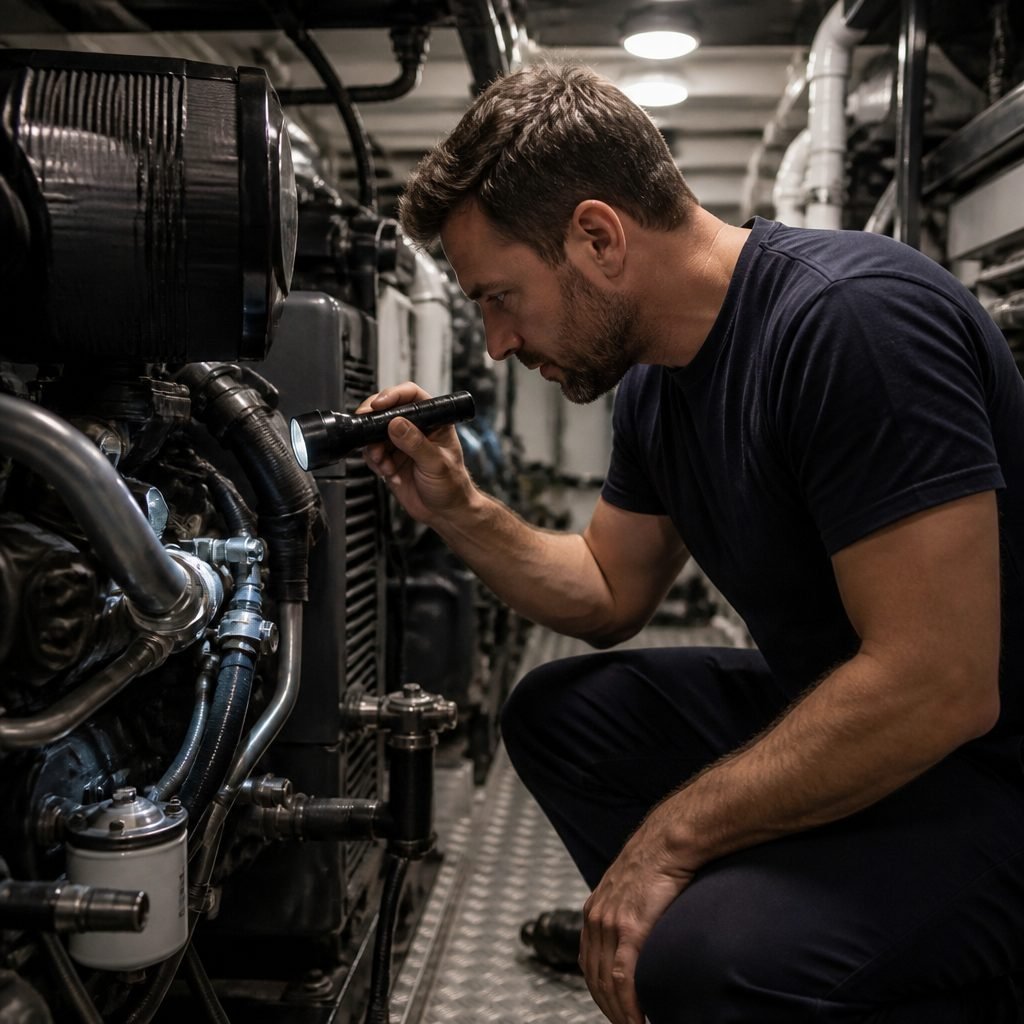
Every underwater photographer has a story about a trip that collapsed for mechanical reasons. A liveaboard limps back to port on one engine. A day boat cancels the far reef because the skipper doesn't trust the main under load. A compressor sits idle because the generator powering it won't hold revs. None of this is glamorous, and none of it appears in the trip brochure, but the machinery below deck decides whether you shoot the pinnacle at slack tide or spend the morning photographing the marina. You don't need to be a marine engineer to be a more informed guest or a more capable owner of a small dive tender. Two components do most of the work and cause most of the drama on marine diesels: the fuel injection system and the turbocharger. Understanding how they behave, and how they fail, tells you a great deal about the vessel you've just handed your luggage and your camera housing to.
The Pump Sets the Terms
A diesel has no spark plug. Combustion happens because fuel is forced into hot, highly compressed air at precisely the right crank angle, in a precisely metered quantity, as a precisely atomized spray. The injection pump — or on newer engines, the high-pressure pump feeding a common rail — is what makes that precision possible. Get timing or metering wrong by a tiny margin and you get smoke, noise, poor fuel economy and heat where you don't want it. Older marine and genset engines commonly use inline pumps, with one pumping element per cylinder driven by an internal camshaft, or rotary distributor pumps that serve all cylinders from a single pumping assembly. Inline pumps are robust and rebuildable; rotary pumps are compact and inexpensive to produce but less tolerant of dirty fuel. Modern engines use common rail, where a single pump maintains extremely high pressure in a shared accumulator and electronically controlled injectors fire multiple times per combustion event. The move toward that architecture is well documented in trade coverage of how high-pressure, computer-controlled fuel injection reshaped heavy-duty diesel design, and the same logic has filtered down to marine propulsion and auxiliary power. The practical consequence for a dive operator is this: a common rail engine is quieter, cleaner and more economical, but it is far less forgiving of water and particulate contamination in the fuel. In regions where diesel is pumped from a drum on a jetty, that matters enormously.
Symptoms a Passenger Can Actually Notice
You will not be invited to open an engine hatch, but you can observe plenty from the dive deck.
- Hard starting, especially warm. Repeated cranking on a warm engine often points to loss of fuel pressure between runs — a leaking delivery valve, a tired transfer pump or air entering through a cracked line.
- Persistent black smoke under acceleration. Fuel the engine cannot burn. That means over-fuelling, late timing, poor atomization from worn nozzles, or not enough air — which usually means the turbo.
- White or grey haze at idle that clears under load. Often unburnt fuel from an injector that isn't atomizing properly, or injection timing that has drifted.
- A hunting idle. The governor or the electronic control is chasing a target it can't hold steadily. On generators this shows up as flickering lights and a compressor that won't settle.
- Loss of top-end power with normal low-speed behavior. Classic turbocharger or boost-leak territory, and a common reason a skipper quietly swaps the dive site for something closer.
The Turbocharger's Quiet Dependence on Oil
A turbo is simple in principle: exhaust gas spins a turbine, which drives a compressor wheel on the same shaft, pushing more air into the cylinders so more fuel can be burned usefully. The shaft rides on bearings fed by engine oil, and it spins at speeds that make oil quality non-negotiable. Most turbo failures are not really turbo failures. They are oil failures, air-filter failures, or the result of shutting a hot engine down immediately after a hard run instead of letting it idle for a couple of minutes. Telltales include a rising oil consumption rate with no external leak, oily residue in the intake piping, a whistle or siren note that changes pitch, and blue smoke on throttle changes. When a center cartridge — the CHRA — is damaged, the usual fix is to replace the cartridge or the complete unit rather than attempt repairs in a boatyard with limited tooling.
Diagnose With Instruments, Not Impressions
Divers are already trained in this discipline. We don't guess at depth or remaining no-decompression time; we read it, log it and plan from it. Anyone who has worked a shallow sand flat for an hour chasing nudibranchs knows how much of that session was governed by numbers on a wrist display rather than feel, which is exactly why macro photographers treat a dive computer as essential kit. Engine diagnosis deserves the same rigor: fuel pressure before and after the filters, boost pressure under load, exhaust gas temperature, cylinder balance, return flow from the injectors. A proper injection pump test involves a calibrated bench measuring delivery volume per element and timing across the speed range — guesswork and a screwdriver have no place in it. A sensible troubleshooting order saves money. Start with fuel supply: tank condition, water separator, primary and secondary filters, lift pump. Check air next: filter restriction, intake leaks, charge cooler condition. Only then suspect the injectors, and only after that condemn the pump. Pumps are the most expensive component in that chain and the one most often replaced unnecessarily because something upstream was starving it.
Sourcing Parts When the Boat Is Far From a Dealer
Remote dive operations live or die on parts logistics, and the practical question is rarely "what's the best part" but "what can be on a plane by Friday." That usually means understanding which variants cross-reference to your engine and whether a rebuilt or good used unit will do the job while an original goes out for overhaul. Suppliers who specialize in this niche are more useful than general marine chandlers: Goldfarb & Associates, a Rockville, Maryland parts supplier that has handled new, rebuilt and used diesel fuel injection pumps and related components since 1997, is a reasonable example of how that market works — its inventory search uses cross-reference part numbers, it stocks turbochargers and CHRA cartridges alongside injectors, nozzles, camshafts, ECMs, delivery valves and plungers and barrels, and its reference material on the different types of injection pumps is a useful primer if you're trying to work out whether the unit on your genset is rotary, inline or common rail before you start phoning around. The company also buys rebuildable cores, which is worth knowing if your old pump still has value as a trade-in, and it ships worldwide.
What to Ask Before You Book
Operators who take maintenance seriously enjoy talking about it. Ask how fuel is filtered and whether the vessel polishes its fuel. Ask what spares travel with the boat — filters, belts, injectors, a spare lift pump — and whether the engineer has ever had to replace a turbo at anchor. Ask about redundancy for the compressor's power source, because that is the single point of failure most likely to end a photo trip early. Vague answers are informative in their own way. None of this makes you a mechanic, and it shouldn't. But a photographer who recognizes black smoke under load, understands why clean fuel protects a high-pressure pump, and knows that a replacement turbo cartridge is a real option rather than a catastrophe is a better-informed traveler — and a far better customer for the people keeping those engines alive.
Author

khizarnisar367@gmail.com
Related Posts

Rolling Basecamps: How Dive Teams and Coral Restoration Projects Specify Purpose-Built Mobile Units
Most underwater projects are won or lost on land. The dive plan may be elegant, the camera rigs immaculate, but if the...
Read out all
Rigging at the Waterline: How Dive and Imaging Teams Move Heavy Gear Without Wrecking It
Most underwater photographers think about weight in terms of what they can swim with. But the hardest part of a serious project...
Read out all
Enclosed vs. Open-Frame DC Motor Controllers: Which Should You Choose?
Picking up the right DC motor controller includes more than matching the controller’s current rating to the motor. Its physical construction, installation...
Read out all
Practical AI Tools That Support Classroom Teaching
- 0
- 1,879 word
Teachers have always been resourceful. Give an experienced educator a stack of paper, a few markers, and a room full of curious...
Read out all
How Many Solar Panels Does a Generator Need?
- 0
- 954 words
Panels are the part of a solar setup people buy by feel, usually after the generator has already arrived. The array is...
Read out all
How Do You Calculate Solar Generator Runtime?
- 0
- 916 words
Solar generator runtime is not simply the battery capacity divided by the largest appliance wattage. A useful estimate has to reflect how...
Read out all