
- 0
- 1,108 word
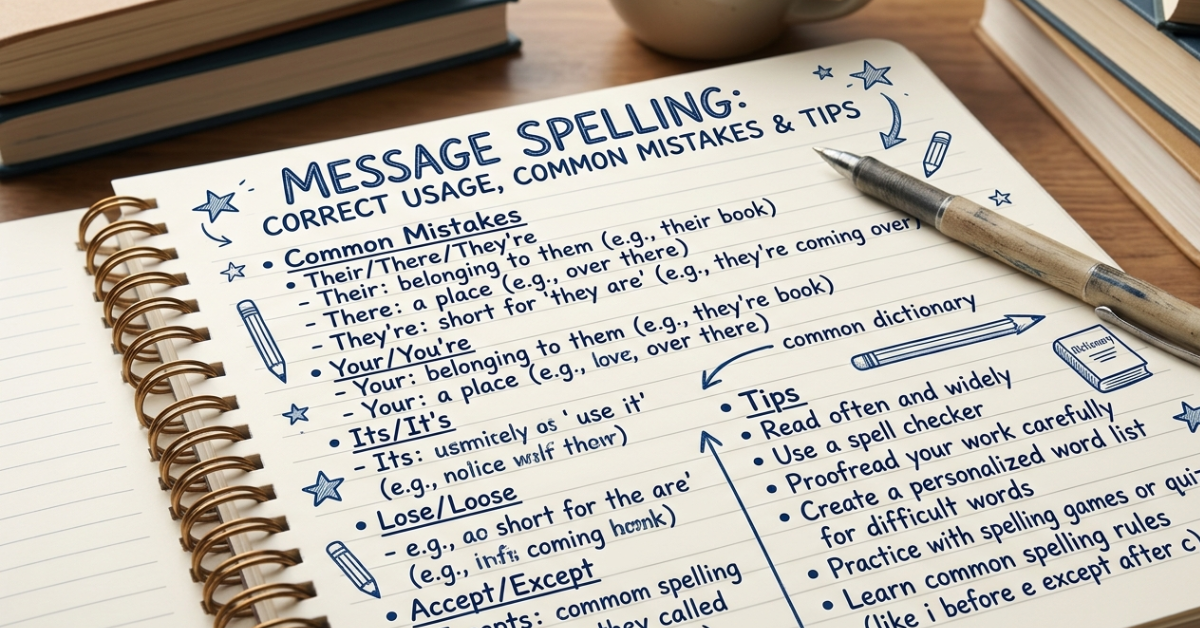
Have you ever paused while typing and wondered whether you spelled message correctly? You’re not alone. Despite being one of the most commonly used words in emails, texts, social media posts, and professional communication, message spelling is a frequent source of confusion for many writers.
Whether you’re sending a quick text, drafting a business email, or writing academic content, knowing the correct spelling and usage of “message” helps you communicate clearly and professionally. In this guide, you’ll learn the correct spelling, common mistakes, pronunciation tips, usage examples, memory tricks, and answers to frequently asked questions about this widely used word.
What Is the Correct Message Spelling?
The correct spelling is:
Message
M-E-S-S-A-G-E
It is a noun and a verb commonly used in English communication.
Examples
As a noun:
- I received an important message from my manager.
- Her message inspired the entire team.
As a verb:
- Please message me when you arrive.
- You can message customer support for assistance.
The word originates from Old French and has been part of the English language for centuries.
Why Do People Misspell “Message”?
The English language contains many words with silent letters, unusual letter combinations, and pronunciation patterns that don’t always match spelling.
With “message,” several factors contribute to confusion:
- Double “s” placement
- The soft “g” sound
- Similar-looking words
- Fast typing errors
- Autocorrect dependence
Many people know how the word sounds but struggle to remember its exact spelling structure.
Common Misspellings of Message
Here are some of the most frequently seen incorrect versions:
| Incorrect Spelling | Correct? |
| mesage | Incorrect |
| messsage | Incorrect |
| messege | Incorrect |
| messige | Incorrect |
| messeage | Incorrect |
| message | Correct |
Why These Mistakes Happen
Mesage
- Missing one of the two “s” letters.
Messege
- Replacing the “a” with an “e.”
Messige
- Confusing the middle vowel sound.
Messsage
- Adding an extra “s.”
Understanding these patterns can help you avoid repeating the same mistakes.
How to Remember the Correct Spelling
Memorization becomes easier when you use simple word patterns.
Trick 1: Break It Into Parts
Think of the word as:
Mess + age = Message
The first part, “mess,” already contains two “s” letters.
Trick 2: Visual Memory
Picture the word:
M E S S A G E
Notice that:
- There are two “s” letters.
- The letter “a” comes before “g.”
- The word ends with “age.”
Trick 3: Use It Frequently
Writing the word repeatedly in emails, notes, and messages helps reinforce correct spelling naturally.
Message Pronunciation Explained
The standard pronunciation is:
/ˈmes.ɪdʒ/
It sounds like:
MES-ij
The ending “ge” creates a soft “j” sound rather than a hard “g.”
Similar Words
The pronunciation pattern is similar to:
- Package
- Village
- Damage
- Manage
Recognizing these patterns can improve both spelling and pronunciation skills.
Message Meaning in Modern Communication
A message is information sent from one person, group, or system to another.
Today, the term is used across many forms of communication:
Personal Communication
Examples include:
- Text messages
- Voice messages
- Social media messages
Professional Communication
Examples include:
- Business emails
- Internal company notifications
- Customer service communication
Technology and Computing
In technology, a message may refer to:
- System alerts
- Error messages
- Chat notifications
- Automated responses
The widespread use of digital communication makes this word more relevant than ever.
Message vs Massage: A Common Confusion
One of the most common spelling mistakes occurs when people confuse “message” with “massage.”
Message
Meaning:
Information communicated to someone.
Example:
- I sent a message to my professor.
Massage
Meaning:
A therapeutic treatment involving the muscles and body.
Example:
- She booked a massage after work.
Although they look similar, their meanings are completely different.
| Word | Meaning |
| Message | Communication or information |
| Massage | Physical therapy treatment |
Using Message Correctly in Sentences
Here are practical examples of proper usage.
Formal Examples
- Your message has been received successfully.
- Thank you for your message regarding the project.
- We appreciate your detailed message.
Informal Examples
- Did you get my message?
- Send me a message later.
- I forgot to reply to your message.
Digital Communication Examples
- The app displayed an error message.
- I received a direct message on social media.
- The system generated a warning message.
Why Correct Spelling Matters
Accurate spelling improves communication quality and credibility.
Professional Benefits
Correct spelling:
- Creates a positive impression
- Demonstrates attention to detail
- Enhances workplace communication
- Reduces misunderstandings
Academic Benefits
Students who use correct spelling often:
- Produce clearer assignments
- Improve writing quality
- Build stronger language skills
Online Benefits
Correct spelling can:
- Increase readability
- Improve engagement
- Strengthen personal branding
- Enhance content professionalism
Even a small spelling error can sometimes affect how readers perceive your message.
Quick Ways to Improve Your Spelling Skills
If you frequently make spelling mistakes, these strategies can help.
Read More
Regular reading exposes you to correct word forms naturally.
Use Spell Check Carefully
Spell-check tools are useful, but they should support—not replace—your knowledge.
Create Personal Word Lists
Keep track of words you often misspell and review them regularly.
Practice Active Writing
The more you write, the stronger your spelling memory becomes.
Learn Word Patterns
Recognizing common endings such as:
- -age
- -tion
- -ment
- -able
can improve overall spelling accuracy.
Key Takeaways
- The correct message spelling is message.
- The word contains two “s” letters and ends with “age.”
- Common mistakes include “mesage” and “messege.”
- Message refers to information communicated between people or systems.
- It should not be confused with “massage.”
- Consistent reading and writing help strengthen spelling accuracy.
Frequently Asked Questions (FAQs)
What is the correct message spelling?
The correct spelling is message. It contains two “s” letters and ends with the letters “age.”
Is “mesage” a correct spelling?
No. “Mesage” is a common misspelling because it omits one of the two required “s” letters.
Why do people confuse message and massage?
The words look similar and differ by only one letter. However, “message” refers to communication, while “massage” refers to a body treatment.
How do you pronounce message?
Message is pronounced as MES-ij (/ˈmes.ɪdʒ/), with a soft “j” sound at the end.
Can message be used as a verb?
Yes. Modern English commonly uses message as a verb, such as “Please message me later.”
How can I remember the correct spelling of message?
A helpful trick is to think of it as mess + age. Remembering the double “s” makes the word easier to spell correctly.
Conclusion
Understanding the correct message spelling is a small but valuable part of effective communication. Because the word appears so frequently in everyday conversations, emails, business correspondence, and digital platforms, spelling it correctly helps maintain clarity and professionalism.
By learning common mistakes, pronunciation patterns, and simple memory tricks, you can use the word confidently in any situation. Keep practicing accurate spelling in your daily writing, and you’ll strengthen your overall communication skills one word at a time.
Author

linguaezone.com@gmail.com
Related Posts

Kill Two Birds With One Stone Alternative: 50 Better Options
- 0
- 1,569 word
Have you ever paused before saying “kill two birds with one stone” because it sounded too violent or simply didn’t fit the...
Read out all
Happy Sabbath Meaning: A Complete Guide to Its Significance
- 0
- 1,632 word
Have you ever received the message “Happy Sabbath” and wondered what it truly means? Is it simply another way of saying “have...
Read out all
I’m So Proud of You in Other Words: 120+ Heartfelt Alternatives
- 0
- 1,562 word
Have you ever wanted to tell someone you’re proud of them but felt like saying “I’m so proud of you” sounded repetitive?...
Read out all
How Do You Spell Happy Anniversary? Correct Spelling Guide
- 0
- 1,221 word
Have you ever paused before writing an anniversary card and wondered, “How do you spell happy anniversary?” You’re not alone. Whether you’re...
Read out all
Waiting for Your Response Email: Best Examples & Tips
- 0
- 1,483 word
Have you ever sent an important email and found yourself wondering whether you should follow up or simply wait? Whether you’re communicating...
Read out all
Great Asset to the Team: Meaning, Examples & Tips
- 0
- 1,494 word
Have you ever wanted to compliment a coworker but struggled to find words that sound professional and sincere? One of the most...
Read out all