- 0
- 1,364 word
Have you ever paused while writing a sentence and wondered whether you should say “married to” or “married with”? You’re not alone. It’s one of the most common English grammar questions, especially for non-native speakers.
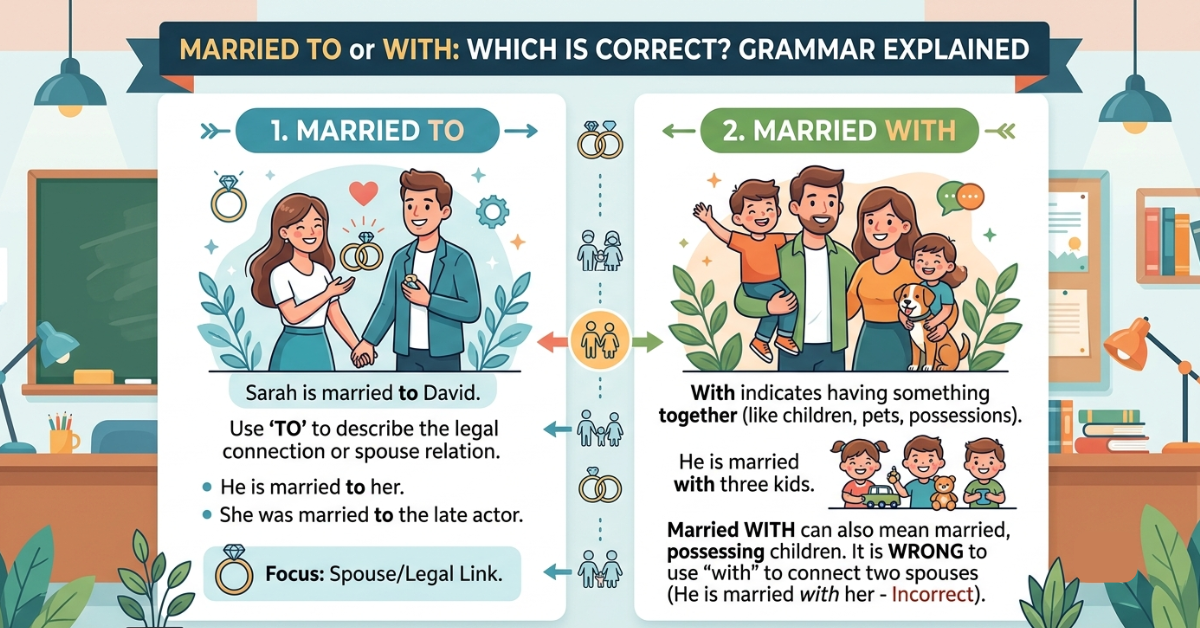
The short answer is simple: “married to” is the correct phrase when referring to a spouse. However, “married with” appears in certain contexts, which is why the confusion exists. In this guide, you’ll learn the difference between married to or with, understand why one is correct in most situations, explore real-life examples, and avoid common grammar mistakes with confidence.
Understanding “Married to or With”
The confusion usually comes from the fact that both prepositions—to and with—can appear after the word married. However, they don’t have the same meaning.
Here’s the basic rule:
- Married to = Used to identify the person someone is married to.
- Married with = Used only to describe someone who is married and has something else, most commonly children.
This distinction is accepted across both British and American English.
Why “Married To” Is the Correct Expression
When talking about a husband, wife, or spouse, English uses the preposition to.
Correct Examples
- She is married to a doctor.
- James is married to Emily.
- They’ve been married to each other for fifteen years.
- Are you married to him?
- My sister is married to an engineer.
In every example, to connects one spouse to another.
Why “To” Works
The adjective married naturally takes the preposition to when referring to the relationship between two people. This pattern has been established in English for centuries and appears consistently in dictionaries, grammar books, and everyday conversation.
When Is “Married With” Correct?
Although many people think married with is always incorrect, that’s not entirely true.
It becomes correct when describing someone who is married and also has children or another accompanying characteristic.
Common Examples
- She is married with two children.
- He’s married with a successful career.
- They are married with three pets.
- A married couple with young children recently moved next door.
Notice that with does not introduce the spouse—it introduces an additional feature.
“Married To” vs. “Married With”: Quick Comparison
| Phrase | Meaning | Correct Usage |
| Married to | Identifies a spouse | Yes |
| Married with children | Indicates family status | Yes |
| Married with Sarah | Refers to spouse | Incorrect |
| Married to two children | Refers to children | Incorrect |
The difference becomes much clearer when you focus on what follows the preposition.
Examples Side by Side
Consider these sentences:
Correct
- Emma is married to David.
- Michael is married to his college sweetheart.
- They’re happily married to each other.
Also Correct
- Emma is married with two children.
- Michael is married with a baby boy.
- They’re married with three dogs.
Incorrect
- Emma is married with David.
- Michael is married with his wife.
- Sarah got married with John.
Whenever the word after the preposition is the spouse, use to, not with.
What About “Get Married To” and “Get Married With”?
The same grammar rule applies when using the verb phrase get married.
Correct
- She got married to Alex last summer.
- They got married in June.
- I’m getting married to my fiancé next year.
Incorrect
- She got married with Alex.
- They got married with each other.
The exception is when with introduces something accompanying the marriage.
Example:
- They got married with their families present.
Here, with means “accompanied by,” not “married to.”
Why Do People Say “Married With”?
There are several reasons this mistake is common.
1. Direct Translation
Many languages use a preposition equivalent to with when talking about marriage. When translated directly into English, the result becomes:
- Incorrect: I am married with my husband.
Instead, English requires:
- Correct: I am married to my husband.
2. Confusion with Other Expressions
People hear phrases such as:
- Married with children
- Living with someone
- Working with someone
As a result, they mistakenly assume with always fits after married.
3. Influence of Informal Speech
Some learners pick up incorrect expressions from social media, online forums, or casual conversations where grammar isn’t always accurate.
British English vs. American English
One common question is whether British and American English use different grammar.
The answer is no.
Both varieties prefer:
- Married to someone
- Married with children
You’ll find this usage in newspapers, books, academic writing, and everyday conversation across English-speaking countries.
Common Grammar Mistakes
Avoid these frequent errors.
Incorrect
- I’m married with my wife.
- She is married with an actor.
- He’s married with Emma.
- Are you married with her?
Correct
- I’m married to my wife.
- She is married to an actor.
- He’s married to Emma.
- Are you married to her?
Easy Trick to Remember
Ask yourself one question:
What comes after the preposition?
If it’s your spouse, use to.
- Married to Lisa
- Married to my husband
- Married to her
If it’s children, pets, responsibilities, or another characteristic, use with.
- Married with two children
- Married with a large family
- Married with three cats
This simple rule works almost every time.
Everyday Conversation Examples
Here are some natural sentences you may hear.
- My parents have been married to each other for thirty years.
- She’s happily married to her high school sweetheart.
- They’re married with three wonderful children.
- Is your brother married yet?
- I’m getting married next spring.
- He’s married to a teacher.
- They’re a married couple with twins.
These examples reflect how native English speakers naturally use the language.
Similar Grammar Patterns
Understanding similar expressions can reinforce the rule.
| Expression | Correct Form |
| Engaged | Engaged to someone |
| Related | Related to someone |
| Connected | Connected to something |
| Married | Married to someone |
Many relationship-related adjectives pair naturally with to rather than with.
Practical Tips for Remembering the Rule
Keep these simple tips in mind whenever you write or speak.
- Use married to when naming a husband or wife.
- Use married with only when mentioning children or another additional characteristic.
- Read complete example sentences instead of memorizing isolated rules.
- Listen to native speakers in interviews, podcasts, and movies.
- Practice by writing your own examples using both expressions correctly.
The more you see the pattern, the more natural it becomes.
Key Takeaways
- Married to is the correct expression when referring to a spouse.
- Married with is correct only when introducing children or another accompanying feature.
- Both British and American English follow the same rule.
- Avoid saying “married with someone” when talking about a husband or wife.
- Remember: spouse = to, children or additional information = with.
Frequently Asked Questions
Is “married to or with” a common grammar mistake?
Yes. Many English learners confuse the two because other languages often use a preposition similar to “with.” In standard English, married to is the correct choice when referring to a spouse.
Can I say “I’m married with my husband”?
No. The correct sentence is “I’m married to my husband.” The phrase married with is only used for additional information, such as children.
Why do people say “married with children”?
Because with describes something accompanying the marriage. It means the couple is married and has children, not that they are married to their children.
Is “married with someone” ever correct?
No. Native English speakers do not use married with someone to identify a spouse. Always use married to someone.
Does “married to” work in formal and informal English?
Yes. Married to is the standard expression in academic writing, business communication, journalism, and everyday conversations.
Is there any difference between American and British English?
No. Both varieties consistently use married to for spouses and married with only when referring to children or another accompanying detail.
Conclusion
Understanding the difference between married to or with is easier than it first appears. Whenever you’re referring to a husband or wife, the correct expression is married to. Reserve married with for situations where you’re describing additional details, such as children or other accompanying characteristics.
Mastering this small grammar point makes your English sound more natural, accurate, and fluent. The next time you’re writing or speaking, remember the simple rule: people are married to each other, but they may be married with children. Applying this distinction consistently will help you communicate with confidence in both everyday conversations and professional writing.
Author

linguaezone.com@gmail.com
Related Posts
Kill Two Birds With One Stone Alternative: 50 Better Options
- 0
- 1,569 word
Have you ever paused before saying “kill two birds with one stone” because it sounded too violent or simply didn’t fit the...
Read out all
Happy Sabbath Meaning: A Complete Guide to Its Significance
- 0
- 1,632 word
Have you ever received the message “Happy Sabbath” and wondered what it truly means? Is it simply another way of saying “have...
Read out all
I’m So Proud of You in Other Words: 120+ Heartfelt Alternatives
- 0
- 1,562 word
Have you ever wanted to tell someone you’re proud of them but felt like saying “I’m so proud of you” sounded repetitive?...
Read out all
How Do You Spell Happy Anniversary? Correct Spelling Guide
- 0
- 1,221 word
Have you ever paused before writing an anniversary card and wondered, “How do you spell happy anniversary?” You’re not alone. Whether you’re...
Read out all
Waiting for Your Response Email: Best Examples & Tips
- 0
- 1,483 word
Have you ever sent an important email and found yourself wondering whether you should follow up or simply wait? Whether you’re communicating...
Read out all
Great Asset to the Team: Meaning, Examples & Tips
- 0
- 1,494 word
Have you ever wanted to compliment a coworker but struggled to find words that sound professional and sincere? One of the most...
Read out all