
- 0
- 1,454 word
Have you ever received an important email, invoice, document, or payment and wondered how to acknowledge it professionally? A simple response can make a big difference in business communication, yet many people are unsure whether phrases sound polite, outdated, or appropriate.
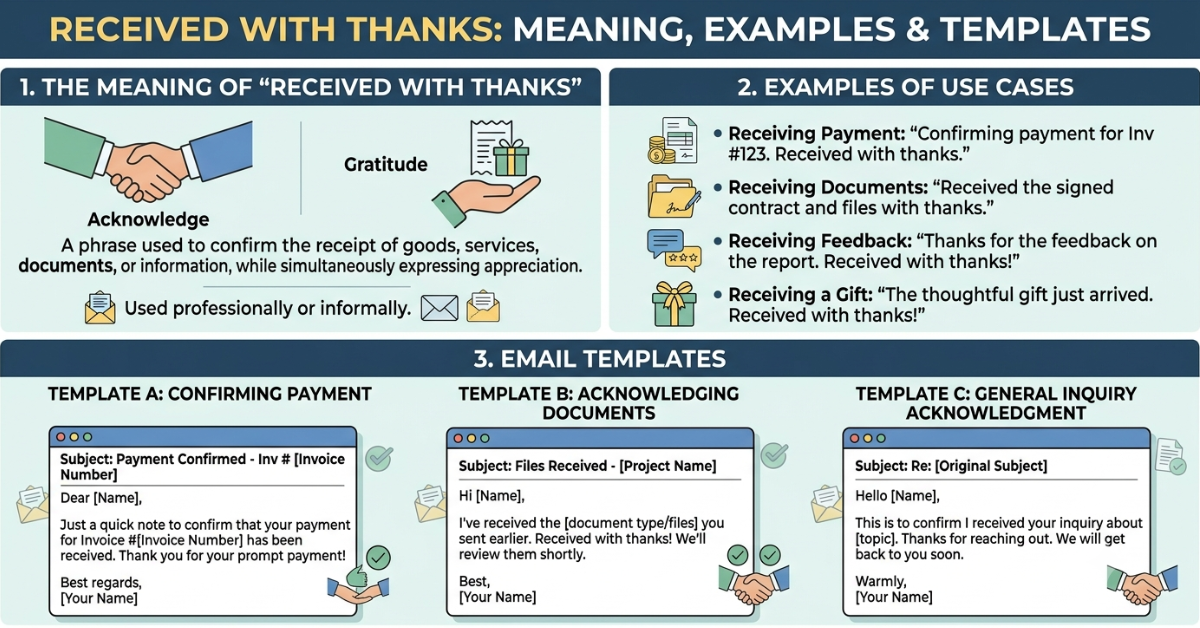
In professional communication, received with thanks remains one of the most common acknowledgment phrases. Whether you’re confirming an email, acknowledging a payment, or responding to an important document, knowing when and how to use this expression helps you appear courteous, reliable, and professional. This guide explains, explores common scenarios, shares ready-to-use templates, and highlights better alternatives for modern business communication.
What Does “Received With Thanks” Mean?
The phrase simply means:
“I have successfully received what you sent, and I appreciate it.”
It serves two purposes:
- Confirms receipt
- Expresses gratitude
The phrase is widely used in:
- Business emails
- Customer service
- Financial transactions
- Office communication
- Academic correspondence
- Vendor and supplier communication
It assures the sender that their message, file, payment, or package arrived safely.
Received With Thanks Meaning in Different Contexts
The exact meaning depends on what has been received.
Documents
“I have received the document and thank you for sending it.”
Example:
Received with thanks. I’ll review the contract today.
Payments
“I confirm your payment has been received. Thank you.”
Example:
Payment received with thanks.
Emails
“I have received your email and appreciate your message.”
Example:
Email received with thanks. I’ll respond shortly.
Parcels or Deliveries
“I have received the package in good condition.”
Example:
Your shipment has been received with thanks.
Is “Received With Thanks” Grammatically Correct?
Yes.
The phrase is grammatically correct, although it is an abbreviated expression rather than a complete sentence.
Instead of saying:
I have received your email with thanks.
Many professionals simply write:
Received with thanks.
This shortened version is common in business correspondence because it is brief while remaining polite.
When Should You Use “Received With Thanks”?
This phrase is appropriate whenever you want to acknowledge receipt without writing a lengthy reply.
Common situations include:
- Receiving business emails
- Confirming invoices
- Acknowledging purchase orders
- Accepting quotations
- Confirming payment
- Receiving contracts
- Receiving reports
- Confirming applications
- Acknowledging files
- Customer support responses
When Should You Avoid It?
Although professional, it may sound slightly formal in casual conversations.
Avoid using it when:
- Chatting with close friends
- Sending informal text messages
- Responding on social media
- Speaking casually with coworkers
Instead, use conversational alternatives like:
- Got it, thanks!
- Thanks, I received it.
- Thanks for sending this.
- Appreciate it.
Well Received With Thanks: What Does It Mean?
The phrase means:
“I have received it successfully and appreciate it.”
However, many English experts consider it slightly awkward because “well received” usually describes how something is accepted rather than simply delivered.
For example:
Your proposal was well received by the management team.
But in emails, people often write:
Well received with thanks.
Although common in international business communication, more natural alternatives include:
- Thank you. I have received it.
- Thank you, I’ve received your email.
- Received, thank you.
- Thanks, everything arrived safely.
Email Received With Thanks: Professional Examples
Acknowledging emails promptly shows professionalism.
Example 1
Subject: Re: Project Documents
Dear Sarah,
Email received with thanks.
I’ll review the documents this afternoon and get back to you by tomorrow.
Best regards,
David
Example 2
Dear Team,
Received with thanks.
I appreciate the updated report and will include it in today’s presentation.
Regards,
Emily
Example 3
Hello Michael,
Thank you.
Your email has been received successfully. I’ll follow up once I complete the review.
Kind regards,
Lisa
Payment Received With Thanks
Businesses frequently send payment acknowledgments to reassure customers that funds have arrived.
Using it builds trust and provides confirmation.
Typical situations include:
- Invoice payments
- Membership fees
- Tuition fees
- Online purchases
- Freelance payments
- Deposit confirmations
Payment Received With Thanks Template
Here are ready-to-use templates.
Template 1: Formal
Dear [Customer Name],
Payment received with thanks.
We confirm that your payment of [Amount] has been successfully received on [Date].
Thank you for your prompt payment.
Kind regards,
[Company Name]
Template 2: Friendly Business
Hello [Name],
Thank you.
We’ve received your payment successfully.
Your account has now been updated.
Have a wonderful day!
Template 3: Invoice Confirmation
Dear Customer,
This is to confirm that your payment has been received with thanks.
Your invoice is now marked as paid.
Thank you for doing business with us.
Best regards,
Accounts Department
Template 4: Freelance Client
Hi [Client Name],
Thank you!
Payment received with thanks.
I appreciate your prompt payment and look forward to working together again.
Best,
[Your Name]
Alternatives to “Received With Thanks”
Modern business communication often favors more conversational wording.
Some excellent alternatives include:
| Phrase | Best For |
| Thank you, I’ve received it. | Professional emails |
| Thanks for sending this. | Casual business |
| I’ve received your email. | Formal communication |
| Received, thank you. | Quick replies |
| Thanks, everything arrived safely. | Deliveries |
| I confirm receipt. | Legal documents |
| Your payment has been received. | Finance |
| I’ve received the attached file. | Attachments |
| Thank you for your submission. | Applications |
| Much appreciated. | Friendly workplace |
Why Acknowledgment Emails Matter
Acknowledging receipt may seem small, but it improves communication significantly.
Benefits include:
- Builds trust
- Prevents misunderstandings
- Reduces unnecessary follow-up emails
- Demonstrates professionalism
- Improves customer experience
- Confirms successful delivery
- Creates a written record
In remote work environments, quick acknowledgment messages have become an important communication habit.
Tips for Writing Better Acknowledgment Emails
Instead of sending only:
Received with thanks.
Consider adding one more helpful sentence.
For example:
- I’ll review it today.
- I’ll get back to you tomorrow.
- Your payment has been processed.
- We’ll begin work immediately.
- Your request is being reviewed.
- Your order is now confirmed.
These additions provide clarity and reassure the sender about the next step.
Common Mistakes to Avoid
Using it without context
Instead of:
Received with thanks.
Write:
Received with thanks. I’ll review the proposal this afternoon.
Using it repeatedly
If every email begins with the exact same phrase, communication feels robotic.
Mix in alternatives to sound more natural.
Forgetting to mention next steps
A confirmation becomes much more useful when it tells the sender what happens next.
Using overly formal language
Modern workplaces often appreciate simple and friendly communication over excessively formal expressions.
Examples for Different Situations
Receiving a Job Application
Dear Applicant,
Thank you for your application.
Your documents have been received with thanks. We’ll contact shortlisted candidates shortly.
Receiving Project Files
Hi James,
Received with thanks.
I’ll begin reviewing the design files this afternoon.
Receiving an Invoice
Dear Supplier,
Invoice received with thanks.
Our finance department will process it according to the agreed payment schedule.
Customer Payment Confirmation
Dear Customer,
Payment received with thanks.
Your order has now been confirmed and will be processed shortly.
Key Takeaways
- Received with thanks confirms receipt while expressing appreciation.
- It works well for emails, documents, files, invoices, and payments.
- The phrase remains professional but can sound formal in casual settings.
- Well received with thanks is common but isn’t always the most natural choice.
- Adding a brief next step makes acknowledgment emails more useful.
- Rotating between similar expressions creates warmer and more engaging communication.
Frequently Asked Questions
What is the received with thanks meaning?
It means you have successfully received something—such as an email, payment, or document—and you are expressing appreciation to the sender.
Is “received with thanks” professional?
Yes. It is widely accepted in professional and business communication, especially when acknowledging emails, documents, invoices, and official correspondence.
Is “well received with thanks” correct?
While commonly used in international business communication, it can sound slightly unnatural to native English speakers. Alternatives like “Thank you, I’ve received it” or “Received, thank you” often sound smoother.
How do I acknowledge a payment professionally?
You can write:
Payment received with thanks. We appreciate your prompt payment and confirm that your account has been updated.
This is clear, professional, and reassuring.
Can I use “received with thanks” in an email?
Absolutely. It is appropriate for confirming receipt of emails, attachments, contracts, invoices, reports, and other professional correspondence.
What is a good payment received with thanks template?
A simple template is:
Dear [Name],
Payment received with thanks. We confirm receipt of your payment and appreciate your prompt settlement. Your account has been updated accordingly. Thank you for your business.
Conclusion
Using it is a simple yet effective way to acknowledge emails, documents, files, and payments professionally. Whether you’re confirming an attachment, sending a payment received with thanks message, or looking for a payment received with thanks template, the key is to be clear, polite, and, whenever possible, include the next step. By varying your wording and keeping your acknowledgments concise, you can make your communication more professional, trustworthy, and engaging. Apply these examples and templates to your daily correspondence to create smoother, more confident interactions.
Author

linguaezone.com@gmail.com
Related Posts
Kill Two Birds With One Stone Alternative: 50 Better Options
- 0
- 1,569 word
Have you ever paused before saying “kill two birds with one stone” because it sounded too violent or simply didn’t fit the...
Read out all
Happy Sabbath Meaning: A Complete Guide to Its Significance
- 0
- 1,632 word
Have you ever received the message “Happy Sabbath” and wondered what it truly means? Is it simply another way of saying “have...
Read out all
I’m So Proud of You in Other Words: 120+ Heartfelt Alternatives
- 0
- 1,562 word
Have you ever wanted to tell someone you’re proud of them but felt like saying “I’m so proud of you” sounded repetitive?...
Read out all
How Do You Spell Happy Anniversary? Correct Spelling Guide
- 0
- 1,221 word
Have you ever paused before writing an anniversary card and wondered, “How do you spell happy anniversary?” You’re not alone. Whether you’re...
Read out all
Waiting for Your Response Email: Best Examples & Tips
- 0
- 1,483 word
Have you ever sent an important email and found yourself wondering whether you should follow up or simply wait? Whether you’re communicating...
Read out all
Great Asset to the Team: Meaning, Examples & Tips
- 0
- 1,494 word
Have you ever wanted to compliment a coworker but struggled to find words that sound professional and sincere? One of the most...
Read out all