
×
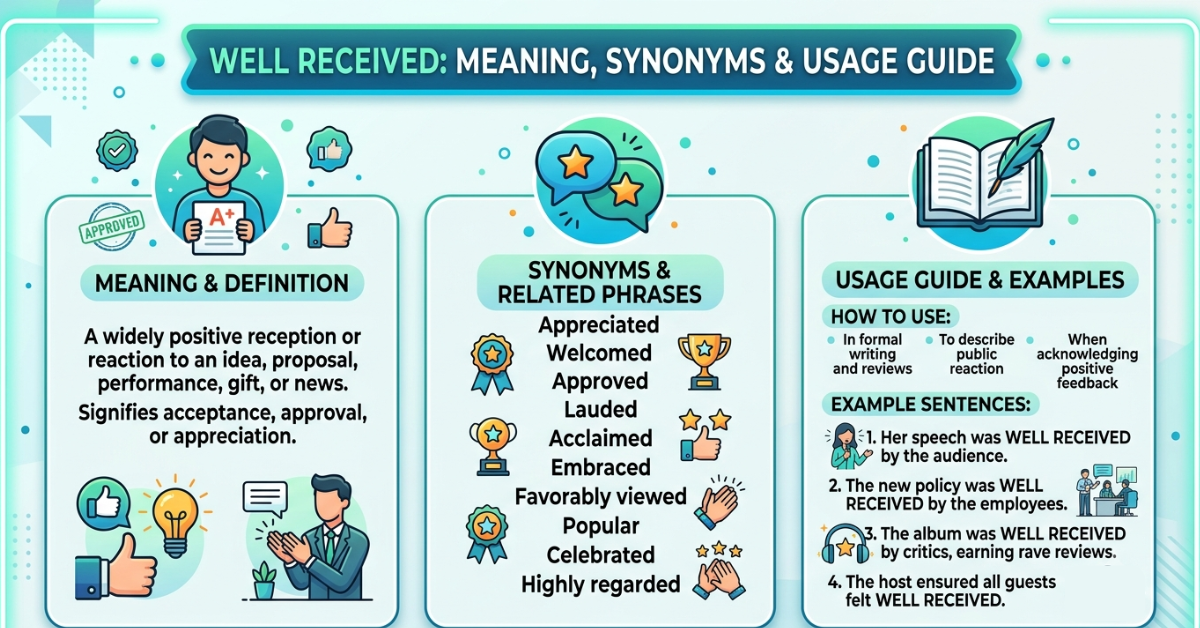
Well Received Meaning, Synonyms & Usage Guide
In

Have you ever read the phrase “well received” in an email and wondered what it really means? In professional communication, people often use short expressions like this to acknowledge messages quickly.

The phrase well received meaning refers to a formal way of confirming that someone has successfully received and acknowledged information. In this article, you will learn its meaning, proper usage, synonyms, and when to use alternatives like “well received with thanks.”

Additionally, you will discover how this phrase works in emails, customer service, and business communication so you can use it confidently and correctly.

What Does Well Received Mean?

The phrase well received means that someone has accepted, acknowledged, or positively responded to information.

In simple words:

  • It confirms receipt of a message
  • It shows acknowledgment in a formal way
  • Sometimes, it also reflects positive acceptance

For example:

  • “Your proposal has been well received by the team.”

Moreover, professionals use it because it keeps communication short and polite.

How “Well Received” Works in Communication

1. Business Communication

In business emails, people often use this phrase to acknowledge documents or updates.

For example:

  • “Your feedback has been well received and reviewed.”

As a result, communication becomes faster and more formal.

2. Customer Service Use

Customer service teams frequently rely on this phrase to confirm requests. In fact, when users submit tickets, systems often respond instantly.

For instance:

  • “Your complaint has been well received and will be processed shortly.”

Therefore, it helps build trust and clarity between customers and support teams.

3. Academic and Formal Contexts

In academic writing or institutional communication, people use it to acknowledge submissions.

For example:

  • “Your research paper has been well received by the committee.”

However, in detailed responses, writers usually expand the message for clarity.

Well Received Synonym and Alternatives

Instead of repeating the same phrase, you can use several natural alternatives.

Formal Alternatives

  • Acknowledged
  • Noted
  • Duly received
  • Confirmed receipt

Natural Email Alternatives

  • “Thank you for your message”
  • “We have received your email”
  • “Your submission has been reviewed”
  • “Received and noted with thanks”

In addition, using varied expressions improves clarity and makes communication sound more human.

Well Received With Thanks – Meaning

The phrase well received with thanks combines acknowledgment with gratitude.

Meaning:

  • It confirms receipt
  • It adds politeness
  • It shows appreciation

Example:

  • “Your updated document has been well received with thanks.”

Furthermore, this phrase is widely used in formal emails, office communication, and academic responses because it maintains a respectful tone.

When Should You Use “Well Received”?

You should use this phrase when:

  • You want a short formal acknowledgment
  • You respond to business emails
  • You confirm receipt of documents or requests

However, avoid using it when:

  • A detailed explanation is required
  • Emotional tone is important
  • Informal conversation is happening

Instead, choose a more natural response in those situations.

Common Mistakes to Avoid

Many people misuse this phrase in writing. Therefore, understanding common errors is important.

1. Using it alone

Incorrect:  “Well received.”
Correct: “Your email has been well received and is under review.”

2. Repeating it too often

If you overuse it, communication may sound robotic.

3. Wrong tone usage

In casual or emotional messages, it may sound too formal or distant.

Practical Tips for Better Usage

To improve your communication, follow these tips:

  • First, always use full sentences for clarity
  • Next, vary your vocabulary with synonyms
  • Additionally, match tone with your audience
  • Moreover, add gratitude when appropriate
  • Finally, avoid overusing the same phrase repeatedly

As a result, your emails will sound more natural and professional.

Key Takeaways

  • “Well received” means acknowledgment or acceptance
  • It is commonly used in formal communication
  • Synonyms help improve writing variety
  • “Well received with thanks” adds politeness
  • Overuse can reduce clarity and natural tone

FAQs

1. What does well received mean in emails?

It means your email or document has been acknowledged successfully and understood.

2. Is well received professional?

Yes, it is widely used in business and formal communication.

3. What is a better synonym for well received?

You can use “acknowledged,” “noted,” or “received with thanks.”

4. Can I say well received with thanks?

Yes, it is a polite and formal way to confirm receipt of information.

5. Is well received enough as a reply?

In most cases, no. It works better when included in a full sentence.

Conclusion

In conclusion, understanding helps you communicate more effectively in professional settings. While the phrase works well for quick acknowledgment, using synonyms and full sentences improves clarity and tone.

Therefore, instead of repeating the same phrase, try varying your expressions and matching your tone to the situation. Ultimately, this will make your communication more natural, clear, and professional.

Leave a Reply

Your email address will not be published. Required fields are marked *

Author

britsx85@gmail.com

Related Posts

Benefited or Benefitted: Which Spelling Is Correct?
In

Benefited or Benefitted: Which Spelling Is Correct?

Have you ever paused mid-sentence and wondered whether to write benefited or benefitted? You are not alone. This is one of those...

Read out all
Dialogue Spelling: Correct Usage, Meaning & Examples
In

Dialogue Spelling: Correct Usage, Meaning & Examples

Have you ever stopped while writing and wondered whether it’s dialogue or dialog? You’re not alone. It’s one of the most common...

Read out all
Cacoon or Cocoon: Which Spelling Is Correct?
In

Cacoon or Cocoon: Which Spelling Is Correct?

Have you ever typed cacoon or cocoon into a search bar and wondered which spelling is actually correct? You’re not alone. It’s...

Read out all
Proportion vs Portion: Meaning, Differences & Easy Examples
In

Proportion vs Portion: Meaning, Differences & Easy Examples

Have you ever paused mid-sentence and wondered whether to write portion or proportion? It happens more often than you might think. Although...

Read out all
Favourite or Favorite: Which Spelling Is Correct?
In

Favourite or Favorite: Which Spelling Is Correct?

Have you ever paused while writing an email or social media post and wondered, “is it favourite or favorite?” You’re not alone....

Read out all
Aswell or As Well: Which One Is Correct?
In

Aswell or As Well: Which One Is Correct?

Have you ever paused while typing and wondered whether you should write aswell or as well? You’re not alone. It’s one of...

Read out all