
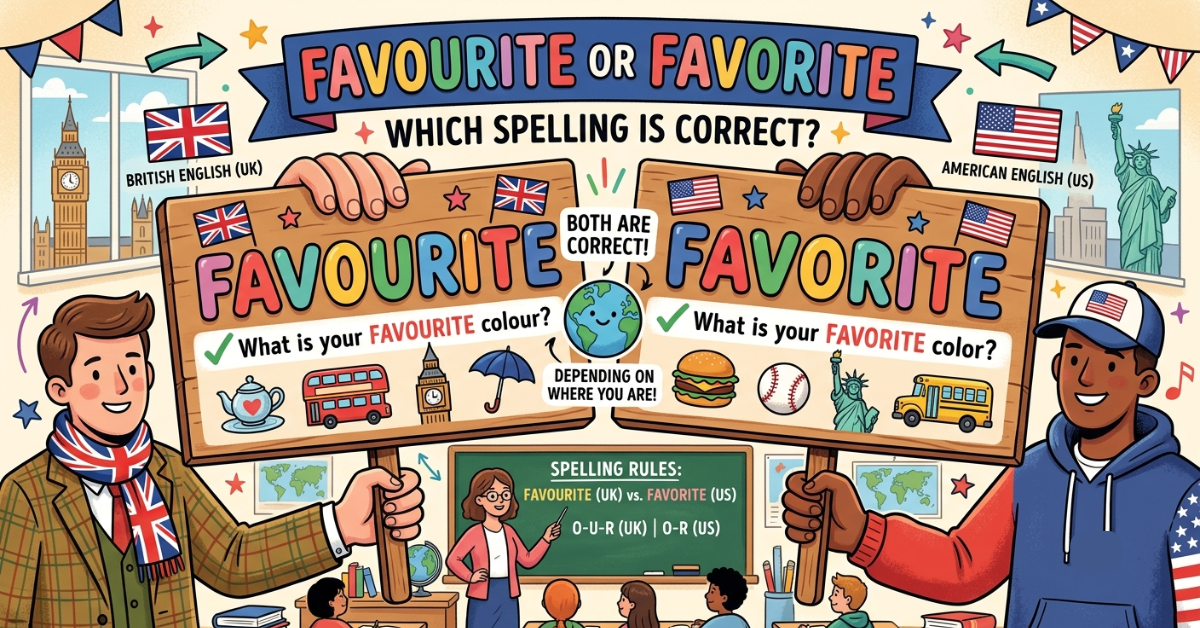
Favourite or Favorite: Which Spelling Is Correct?
- 0
- 1,308 word
Have you ever paused while writing an email or social media post and wondered, “is it favourite or favorite?” You’re not alone. It’s one of the most common spelling questions in English, especially for learners, writers, and professionals who communicate with people worldwide.
The good news is that favourite or favorite are both correct. The difference isn’t about right versus wrong—it’s about which variety of English you’re using. In this guide, you’ll learn why the spellings differ, where each is used, how to choose the right one, and practical tips to stay consistent in your writing.
What Is the Difference Between Favourite and Favorite?
The only difference between favourite and favorite is the spelling.
- Favourite is the standard spelling in British English.
- Favorite is the standard spelling in American English.
Both words have exactly the same meaning. They refer to something or someone that is preferred above all others.
Examples:
- My favourite book is Harry Potter. (British English)
- My favorite book is Harry Potter. (American English)
The pronunciation remains virtually identical regardless of spelling.
Is Favourite or Favorite Correct?
Yes—both are correct.
The appropriate spelling depends on the audience you’re writing for.
| Audience | Correct Spelling |
| United Kingdom | Favourite |
| United States | Favorite |
| Canada | Both are used, but “favourite” is more common |
| Australia | Favourite |
| New Zealand | Favourite |
| International business | Choose one style and remain consistent |
If you’re still asking, is it favourite or favorite, the answer is simple:
- Writing for Americans? Use favorite.
- Writing for British or Commonwealth readers? Use favourite.
Consistency matters more than the spelling itself.
Why Do the Spellings Differ?
The difference goes back more than two centuries.
The British Spelling
British English preserved many spellings influenced by French, including words ending in -our, such as:
- colour
- honour
- neighbour
- favourite
These spellings became standard throughout Britain and many Commonwealth countries.
The American Spelling
In the early 1800s, American lexicographer Noah Webster promoted simplified spellings to create a distinct American English.
He recommended removing the silent “u” from many words:
- colour → color
- honour → honor
- favourite → favorite
Today, these simplified spellings are standard throughout the United States.
Where Is Each Spelling Used?
Countries That Use “Favourite”
The spelling favourite is standard in:
- United Kingdom
- Australia
- New Zealand
- Ireland
- South Africa
- Most Commonwealth countries
Example:
My favourite holiday destination is Scotland.
Countries That Use “Favorite”
The spelling favorite is standard in:
- United States
- American businesses
- Most American schools
- U.S.-based publications
Example:
Pizza is my favorite weekend meal.
Canada: A Special Case
Canada often blends British and American English.
Although favourite is generally preferred in formal Canadian writing, you’ll also see favorite, especially in marketing, technology, and American-influenced media.
Meaning of Favourite and Favorite
Both spellings share the same definitions.
As a noun, it means:
A person or thing preferred above others.
Example:
- Chocolate is my favourite dessert.
As an adjective, it means:
Most liked or preferred.
Example:
- That’s my favorite movie of all time.
Examples in Everyday Sentences
Using “Favourite”
- What’s your favourite season?
- She’s my favourite teacher.
- This is my favourite restaurant.
- His favourite hobby is painting.
Using “Favorite”
- What’s your favorite color?
- That’s my favorite song.
- My favorite vacation was in Hawaii.
- She is everyone’s favorite coach.
Favourite vs Favorite: Quick Comparison
| Feature | Favourite | Favorite |
| English Variety | British | American |
| Meaning | Same | Same |
| Pronunciation | Same | Same |
| Grammar | Same | Same |
| Accepted Internationally | Yes | Yes |
Other Words That Follow the Same Rule
The favourite/favorite difference isn’t unique.
Many English words lose the “u” in American English.
| British English | American English |
| Colour | Color |
| Honour | Honor |
| Favourite | Favorite |
| Neighbour | Neighbor |
| Labour | Labor |
| Harbour | Harbor |
| Humour | Humor |
Recognizing this pattern makes it easier to switch between British and American English.
When Should You Use Favourite?
Choose favourite if you’re writing:
- Academic papers using British English
- UK-based websites
- Australian publications
- British clients
- Commonwealth audiences
It also suits organizations that follow British style guides.
When Should You Use Favorite?
Choose favorite when writing for:
- American companies
- U.S. universities
- American readers
- U.S.-focused websites
- American marketing campaigns
If your target audience is primarily American, this spelling feels more natural.
How to Stay Consistent in Your Writing
One of the biggest mistakes writers make is mixing both spellings in the same document.
For example:
Incorrect: My favourite movie is my favorite comedy.
Instead, write:
Correct: My favourite movie is my favourite comedy.
or
Correct: My favorite movie is my favorite comedy.
Tips for consistency
- Choose British or American English before you begin writing.
- Set your word processor’s language accordingly.
- Use spelling and grammar tools to catch inconsistencies.
- Consider your audience first.
Common Mistakes to Avoid
Mixing British and American Spellings
Avoid combining:
- favourite + color
- favorite + colour
Stick to one language style.
Assuming One Is Incorrect
Many people think one spelling is a mistake.
In reality, both are officially recognized.
Ignoring Your Audience
If you’re writing for an American business, “favorite” looks more natural.
If you’re publishing in the UK, “favourite” is expected.
Which Spelling Is Better for SEO?
There isn’t a universally “better” spelling.
The best choice depends on your target audience.
For example:
If your website targets:
- American readers → use favorite
- British readers → use favourite
- Global readers → choose one version and remain consistent
Search engines understand both spellings and recognize them as regional variations.
Favourite or Favorite in Digital Communication
Whether you’re posting on social media, writing blogs, sending emails, or publishing online content, consistency builds professionalism.
For example:
- A UK fashion brand should consistently use favourite.
- A U.S. travel blog should consistently use favorite.
This helps readers feel the content matches their language expectations.
Practical Tips for Choosing the Right Spelling
- Know where your audience lives.
- Match the style guide you’re following.
- Don’t switch spellings halfway through an article.
- Let your spell checker use the correct regional dictionary.
- Remember that meaning never changes—only the spelling does.
Key Takeaways
- Both favourite and favorite are correct.
- The difference is regional, not grammatical.
- British English uses favourite.
- American English uses favorite.
- The pronunciation and meaning are identical.
- Consistency is more important than choosing one over the other.
- Always write with your audience in mind.
Frequently Asked Questions
Is it favourite or favorite?
Both are correct. Favourite is used in British English, while favorite is the standard American English spelling.
Why does American English remove the “u”?
American English adopted simplified spellings largely because of the influence of lexicographer Noah Webster, who promoted shorter, more consistent spellings.
Which spelling should I use in school assignments?
Use whichever spelling matches your school’s required language style. If your institution follows British English, write favourite; if it follows American English, use favorite.
Is favourite more formal than favorite?
No. Neither spelling is more formal. They simply belong to different regional versions of English.
Can I use both spellings in the same article?
It’s best not to. Mixing favourite and favorite can appear inconsistent and may confuse readers. Choose one style and use it throughout.
Does Google recognize both spellings?
Yes. Search engines understand that favourite and favorite are regional spelling variations. Use the version that best matches your target audience and maintain consistency across your content.
Conclusion
Choosing between favourite or favorite doesn’t have to be confusing. Both spellings are correct, widely accepted, and share the exact same meaning. The only difference lies in regional English conventions: British English uses favourite, while American English uses favorite.
If you’ve ever wondered is it favourite or favorite, the answer comes down to who you’re writing for. Pick the spelling that suits your audience, stay consistent throughout your writing, and you’ll communicate clearly and professionally. Whether you’re creating content, writing emails, or publishing online, understanding this simple distinction helps you write with greater confidence and credibility.
Author
britsx85@gmail.com
Related Posts
Benefited or Benefitted: Which Spelling Is Correct?
- 0
- 997 words
Have you ever paused mid-sentence and wondered whether to write benefited or benefitted? You are not alone. This is one of those...
Read out all
Dialogue Spelling: Correct Usage, Meaning & Examples
- 0
- 1,316 word
Have you ever stopped while writing and wondered whether it’s dialogue or dialog? You’re not alone. It’s one of the most common...
Read out all
Cacoon or Cocoon: Which Spelling Is Correct?
- 0
- 1,243 word
Have you ever typed cacoon or cocoon into a search bar and wondered which spelling is actually correct? You’re not alone. It’s...
Read out all
Proportion vs Portion: Meaning, Differences & Easy Examples
- 0
- 1,136 word
Have you ever paused mid-sentence and wondered whether to write portion or proportion? It happens more often than you might think. Although...
Read out all
Aswell or As Well: Which One Is Correct?
- 0
- 1,345 word
Have you ever paused while typing and wondered whether you should write aswell or as well? You’re not alone. It’s one of...
Read out all
Phoenix or Pheonix: Which Spelling Is Correct?
- 0
- 1,209 word
Have you ever stopped while typing phoenix and wondered whether it should actually be spelled pheonix? You’re definitely not alone. Thousands of...
Read out all