
- 0
- 1,316 word
Have you ever stopped while writing and wondered whether it’s dialogue or dialog? You’re not alone. It’s one of the most common spelling questions among students, writers, bloggers, and professionals.
Understanding the correct dialogue spelling is important because the word appears frequently in novels, scripts, essays, business communication, and even software design. While both spellings exist, they aren’t always interchangeable. In this guide, you’ll learn the correct spelling, regional differences, pronunciation, grammar rules, examples, and practical tips to help you use the word confidently.
What Is Dialogue?
Dialogue is a noun that refers to a conversation between two or more people. It can also describe discussions between groups, governments, organizations, or characters in literature.
Simple definition
Dialogue means:
- A spoken conversation
- An exchange of ideas
- Written conversations in stories, plays, or movies
- Communication aimed at solving problems
Examples
- The teacher encouraged open dialogue in the classroom.
- The novel contains realistic dialogue between the characters.
- The two companies began a productive dialogue about future cooperation.
Is “Dialogue” the Correct Spelling?
Yes. Dialogue is the standard spelling used in most English dictionaries worldwide.
You’ll commonly see dialogue in:
- Books
- Newspapers
- Academic writing
- Business communication
- Literature
- Journalism
Most English teachers and style guides recommend using dialogue unless a specific industry or software context prefers another spelling.
Dialogue vs Dialog: What’s the Difference?
This is where many people become confused.
| Dialogue | Dialog |
| Traditional spelling | Simplified spelling |
| Preferred in general English | Common in computing and software |
| Used in books and writing | Often used in technology |
| Standard in British English | Occasionally used in American software terminology |
Dialogue
This is the spelling you’ll find in:
- Novels
- Articles
- Essays
- Magazines
- Educational material
- Newspapers
Example:
The dialogue between the characters felt natural.
Dialog
“Dialog” is mostly used in computing and user interface terminology.
Examples include:
- Dialog box
- Save dialog
- Settings dialog
- Error dialog
Outside technology, many editors still prefer dialogue.
Why Are There Two Spellings?
The shorter spelling dialog became popular in the computer industry because developers often favored shorter words in software interfaces.
Meanwhile, traditional English continued using dialogue, which comes from historical spelling conventions dating back centuries.
Today:
- Writers generally use dialogue
- Software developers may use dialog
Both are recognized, but their contexts differ.
Dialogue Spelling in British English
In British English, dialogue is considered the standard and correct spelling.
Examples:
- political dialogue
- classroom dialogue
- dialogue writing
- dialogue between nations
You’ll rarely see “dialog” in everyday British writing.
Dialogue Spelling in American English
American English also primarily uses dialogue for regular writing.
However, you’ll sometimes notice dialog in:
- Programming documentation
- Computer applications
- User interface design
- Technical manuals
For essays, articles, and books, American publishers usually prefer dialogue.
Origin of the Word Dialogue
The word comes from the Greek word dialogos, meaning “conversation.”
It later entered Latin as dialogus, then French as dialogue, before becoming part of Modern English.
Its history explains why the traditional spelling includes the “-ue” ending.
How to Pronounce Dialogue
The pronunciation is:
DYE-uh-log
Phonetic pronunciation:
/ˈdaɪ.ə.lɒɡ/ (British)
/ˈdaɪ.ə.lɑːɡ/ (American)
Although the spelling ends with “-ue,” the pronunciation does not.
Dialogue Meaning in Different Contexts
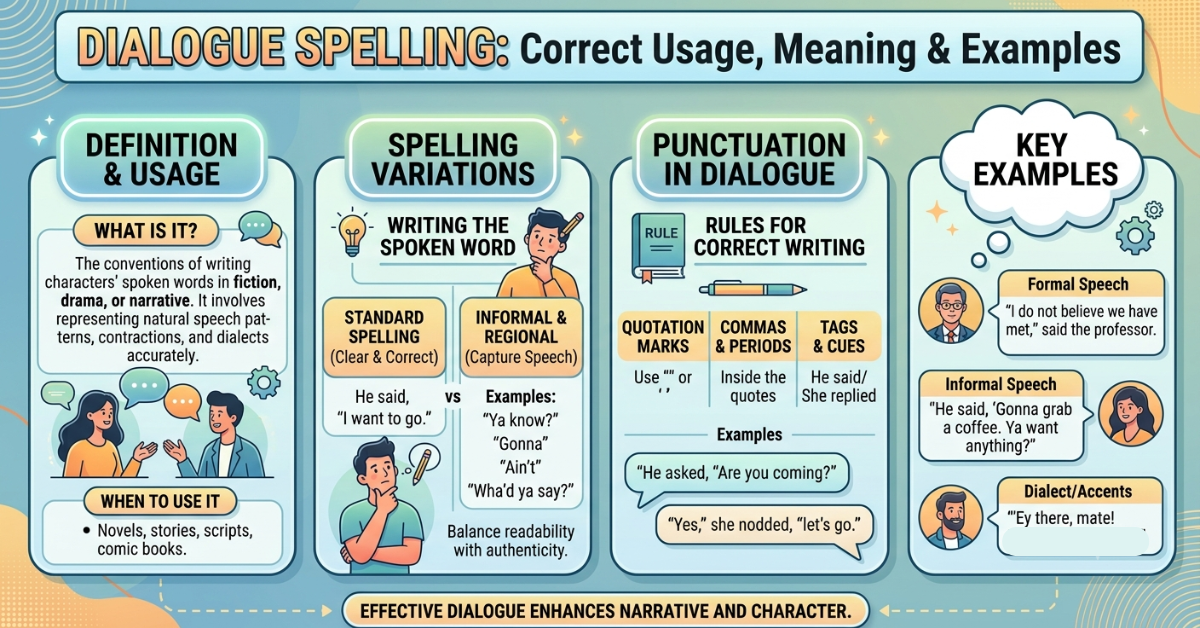
In Literature
Dialogue refers to conversations between fictional characters.
Example:
“Where are you going?” Sarah asked.
“I’m heading home,” Mark replied.
Everything spoken between the characters is dialogue.
In Business
Dialogue refers to meaningful communication between employees, clients, or organizations.
Example:
- Constructive dialogue improves teamwork.
In Politics
Governments often use dialogue to solve conflicts peacefully.
Example:
- Peace dialogue continued for several weeks.
In Education
Teachers encourage dialogue to improve learning and critical thinking.
Example:
- Classroom dialogue helps students understand different perspectives.
In Everyday Life
Dialogue simply means healthy conversation.
Example:
- Honest dialogue strengthens relationships.
Dialogue as a Literary Device
Writers use dialogue to:
- Reveal personality
- Move the plot forward
- Build suspense
- Show emotions
- Create realistic interactions
- Develop relationships
Good dialogue sounds natural while still serving the story.
Examples of Dialogue in Sentences
Here are practical examples.
Everyday conversation
- Healthy dialogue solves many misunderstandings.
- Open dialogue builds trust.
Literature
- The author’s dialogue sounded authentic.
- Every dialogue scene revealed something important.
Workplace
- Management encouraged dialogue with employees.
- Better dialogue reduced workplace conflict.
School
- Students practiced dialogue writing in English class.
- The teacher praised the realistic dialogue.
Dialogue vs Conversation
Many people use these words interchangeably, but there is a slight difference.
| Dialogue | Conversation |
| Can be written or spoken | Usually spoken |
| Often purposeful | May be casual |
| Common in literature | Common in everyday life |
| May involve structured communication | Can be informal |
Every dialogue is a conversation, but not every conversation is considered formal dialogue.
Dialogue vs Monologue
These words are often confused.
Dialogue
Two or more people speak.
Example:
Anna: “Are you coming?”
Ben: “Yes.”
Monologue
One person speaks continuously.
Example:
A character gives a five-minute speech without interruption.
Dialogue vs Dialect
These words look similar but mean different things.
Dialogue
Conversation.
Example:
The dialogue was emotional.
Dialect
A regional form of language.
Example:
The character spoke in a Scottish dialect.
Common Mistakes with Dialogue Spelling
Here are mistakes people frequently make.
1. Using “dialog” in school essays
Unless instructed otherwise, use dialogue.
2. Mixing spellings
Avoid switching between dialogue and dialog in the same document.
Stay consistent.
3. Confusing dialogue with quotation marks
Dialogue is the conversation itself.
Quotation marks simply show where someone is speaking.
4. Misspelling the word
Incorrect:
- Dialouge
- Dialauge
- Dialoge
- Dialoug
Correct:
- Dialogue
How to Remember the Correct Spelling
A simple memory trick:
Think of catalogue, another word ending in “-ue.”
Both follow similar spelling patterns.
Or remember:
Books use dialogue. Computers sometimes use dialog.
This rule works in most situations.
Tips for Using Dialogue Correctly
To write professionally:
- Use dialogue in essays and articles.
- Keep your spelling consistent.
- Use “dialog” only if you’re referring to software terminology.
- Proofread before publishing.
- Follow the preferred spelling guide for your audience.
Why Correct Spelling Matters
Correct spelling helps you:
- Build credibility
- Improve readability
- Avoid confusion
- Score better in academic writing
- Look more professional
Even small spelling choices can influence how readers perceive your work.
Key Takeaways
- Dialogue is the standard spelling in general English.
- Dialog is mainly used in computing and software.
- British English strongly prefers dialogue.
- American English also commonly uses dialogue outside technical contexts.
- Dialogue refers to conversations between people, whether spoken or written.
- Consistency is more important than mixing spellings.
Frequently Asked Questions
Is dialogue the correct spelling?
Yes. Dialogue is the standard spelling used in books, education, journalism, and most professional writing. It is accepted in both British and American English.
Why do some people write dialog instead of dialogue?
“Dialog” became popular in the software and technology industry because it’s shorter. Outside technical contexts, dialogue is generally preferred.
Is dialogue British or American spelling?
Both British and American English widely use dialogue. British English almost always uses this spelling, while American English occasionally uses “dialog” in computing.
What does dialogue mean?
Dialogue refers to a conversation between two or more people. It can describe spoken communication, written conversations in stories, or discussions between organizations and governments.
How do you spell dialogue in English?
The standard spelling is dialogue with the letters -gue at the end.
Is dialog wrong?
Not necessarily. “Dialog” is acceptable in many technology-related contexts, such as software documentation and user interface design. For general writing, dialogue is the safer and more widely accepted choice.
Conclusion
The correct dialogue spelling for most writing is dialogue. While dialog has become common in software and technical fields, the traditional spelling remains the preferred choice for books, education, journalism, business writing, and everyday English.
Knowing when to use each version helps you write with confidence and professionalism. Whether you’re drafting a novel, completing an assignment, or publishing online content, using the appropriate spelling for your audience ensures clarity and credibility. Keep these distinctions in mind, and you’ll avoid one of the most common English spelling mistakes with ease.
Author

linguaezone.com@gmail.com
Related Posts

Kill Two Birds With One Stone Alternative: 50 Better Options
- 0
- 1,569 word
Have you ever paused before saying “kill two birds with one stone” because it sounded too violent or simply didn’t fit the...
Read out all
Happy Sabbath Meaning: A Complete Guide to Its Significance
- 0
- 1,632 word
Have you ever received the message “Happy Sabbath” and wondered what it truly means? Is it simply another way of saying “have...
Read out all
I’m So Proud of You in Other Words: 120+ Heartfelt Alternatives
- 0
- 1,562 word
Have you ever wanted to tell someone you’re proud of them but felt like saying “I’m so proud of you” sounded repetitive?...
Read out all
How Do You Spell Happy Anniversary? Correct Spelling Guide
- 0
- 1,221 word
Have you ever paused before writing an anniversary card and wondered, “How do you spell happy anniversary?” You’re not alone. Whether you’re...
Read out all
Waiting for Your Response Email: Best Examples & Tips
- 0
- 1,483 word
Have you ever sent an important email and found yourself wondering whether you should follow up or simply wait? Whether you’re communicating...
Read out all
Great Asset to the Team: Meaning, Examples & Tips
- 0
- 1,494 word
Have you ever wanted to compliment a coworker but struggled to find words that sound professional and sincere? One of the most...
Read out all