

- 0
- 1,064 word
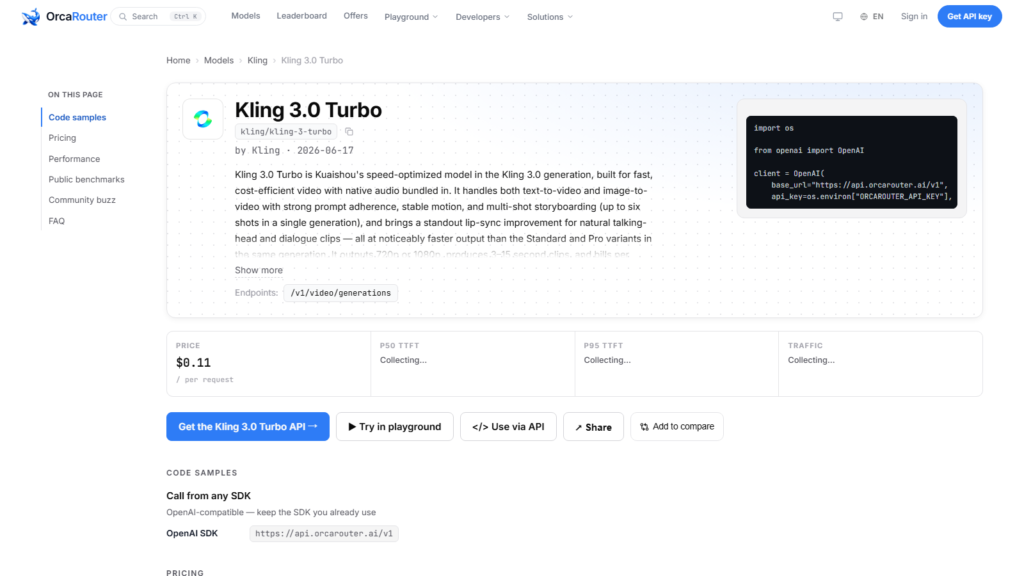
On OrcaRouter we host the Kling 3.0 Turbo model — the accelerated tier of Kling’s video line, shipped on June 17, 2026, priced at $0.11 per request, with no context window and no token-based rate card: a video model is not priced per token, and this one is billed per generated clip instead. Its vendor describes it as the fast tier of the family, and the list price is the vendor’s own — eleven cents per request, which the vendor lists and this article reports as vendor-stated. It has no Artificial Analysis score, because the board does not run text tasks on video models. It is carried at list price on the same key as every other Kling model, with the card and the current rate on the linked page.
Eleven cents per video request is a price that reads like a rounding error — and this article is about whether that price is the whole story or just the first line of it.
The eleven-cent request, priced
The number is $0.11 per request, and it is the vendor’s own list price — not our telemetry, and not an independent reading. The article will not dress it up: the vendor lists the Turbo tier at eleven cents a request, and that is the source of the figure. What the price buys is a clip from a text prompt through the Turbo tier of the Kling line, billed per generation rather than by duration or resolution ladder. At eleven cents, the arithmetic of iteration changes: a team can run a batch of a hundred prompt variations for eleven dollars and keep only the clips worth keeping.
The honest caveat is that a per-request price carries the least information of any billing unit in this lineup — the cost of a job depends on how many requests the job needs, and this article will not invent a per-minute equivalent the vendor does not state. The price is a real and verified number; the translation to a final project cost is something each workflow must size for itself.
The media lineup, billed three ways
| card | kind | billing unit | rate | latency | 7-day usage |
| Kling 3.0 Turbo | video | per request | $0.11 / req | not listed | not listed |
| OrcaDub 1.0 | dubbing | per minute | $0.60 / min | p95 18.00 s | not listed |
| MiniMax-H3 | speech | per second | $0.08 / s | p50 406 ms | 100.6K |
Rates and billing units are what the linked pages list; the row for Kling 3.0 Turbo states the vendor’s own per-request price, and the latency and usage columns are left as the records list them rather than filled from elsewhere. The table is the fleet’s media row, and it shows three media workloads priced three different ways: video by the request at eleven cents, dubbing by the minute at sixty cents, and speech by the second at eight cents. Each unit matches how the job is bought — a video job is a series of clip attempts, a dubbing job is a known runtime, a speech job is continuous output — and Kling 3.0 Turbo’s unit is the one built for iteration, where the cost of trying a new prompt is a rounding error.

What the price buys, and what it does not
What eleven cents buys is iteration, and iteration is what video generation actually needs. Text-to-video is a try-it-and-see medium: the first prompt rarely ships, and the workflow is a loop of adjusting, regenerating, and keeping the clip that works. A per-request price of $0.11 makes that loop cheap enough to run honestly — a ten-take sequence costs $1.10, and the number of takes is limited by judgment, not by budget. That is the strongest argument the card has, and it is the vendor’s own argument, priced into the rate.
What the price does not buy is a finished project. The vendor lists the per-request rate and no per-minute or per-project equivalent, and this article will not invent one. A real video job — a script, several scenes, multiple takes — is a pile of requests, and the pile is sized by the workflow. The honest framing is the same as the card’s: eleven cents is the price of trying, and the price of shipping is whatever the tries add up to.
The accelerated tier in the family
The vendor positions the Turbo tier as the fast one in the Kling line, and that positioning is the context the rate sits inside: the accelerated tier is the one to reach for when a clip needs to be quick to generate, at a per-request price set for repeated use. The article reports the positioning as the vendor’s own — a “Turbo” tier is the vendor’s naming, not our telemetry — and the practical reading is a tier built for high-volume iteration rather than for a single careful render.
The record is honestly thin around the edges, and this article says so. No Artificial Analysis score applies, because the board’s text tasks do not run on video models; our own model page carries the card and the rate; and the vendor homepage is the authoritative source for what the product is. For a team that needs cheap attempts in a fast tier, the card’s case is short and legible: eleven cents per request, vendor-listed, hosted here at list price — and the cost of a full project is whatever the tries add up to.
The takeaway
Kling 3.0 Turbo is the accelerated tier of Kling’s video line: $0.11 per request, a per-request billing unit with no context window and no token-based rate card, and no Artificial Analysis score because the board does not run text tasks on video models. The eleven-cent rate is the vendor’s own list price, reported here as vendor-stated. It is a card priced for iteration — cheap enough that the number of takes is limited by judgment rather than budget — with the honest caveat that a finished project’s cost depends on how many requests it needs. If your workflow is text-to-video at scale, this is the fast, cheap tier — live at list price, with the card on the linked page.
Sourcing note: release date, the “Turbo” tier naming, the $0.11 per-request rate and the per-request billing unit are what Kling’s own entry and homepage list as of 2026-10-08 and have not been independently reproduced; no per-minute or per-project equivalent is stated, and none is implied. No Artificial Analysis score is cited because the board does not run text tasks on video models. The card’s presence at list price is on the linked OrcaRouter page. All checked 2026-10-08.
Author

khizarnisar367@gmail.com
Related Posts

TechNewsOutlets.com USA: A Complete Guide to Technology News and Digital Media
- 0
- 1,754 word
Introduction to TechNewsOutlets.com USA Technology has become an essential part of everyday life. From smartphones and laptops to artificial intelligence, cybersecurity, and...
Read out all
Building a Smarter and More Secure Home With Connected Technology
- 0
- 2,282 words
Protecting a home today involves much more than relying on traditional locks and basic alarms. Modern connected technology gives homeowners more ways...
Read out all
GrammarVista.com USA: A Practical Guide to Better English Writing
- 0
- 1,595 word
Clear communication has become more important than ever. Whether someone is writing a school assignment, preparing a professional email, publishing an article,...
Read out all
Insnoop: A Practical Guide to Understanding the Term and Its Online Context
- 0
- 1,713 word
The internet is full of unusual names, unfamiliar platforms, and terms that appear suddenly in search results. Insnoop is one of those...
Read out all
Create Engaging Videos from Images
- 0
- 786 words
Creating video content does not always require a camera, expensive equipment, or advanced editing knowledge. With the development of artificial intelligence, a...
Read out all
iTop VPN: A Practical Guide to Using a VPN Free Service
- 0
- 1,044 word
Internet use has become part of everyday life, whether people are browsing websites, watching videos, using public Wi-Fi, or accessing online services....
Read out all