
- 0
- 1,225 word
Have you ever searched for hight meaning and wondered whether it was simply another spelling of “height”? You’re not alone. Thousands of people type “hight” into search engines every month, assuming it’s the correct spelling or an alternative form. In reality, the answer is a bit more interesting.
In this guide, you’ll discover the true meaning of hight, how it differs from height, why the confusion exists, where the word originated, and when—if ever—you should use it. By the end, you’ll know exactly which word belongs in modern English and which one belongs mostly to history.
What Is the Hight Meaning?
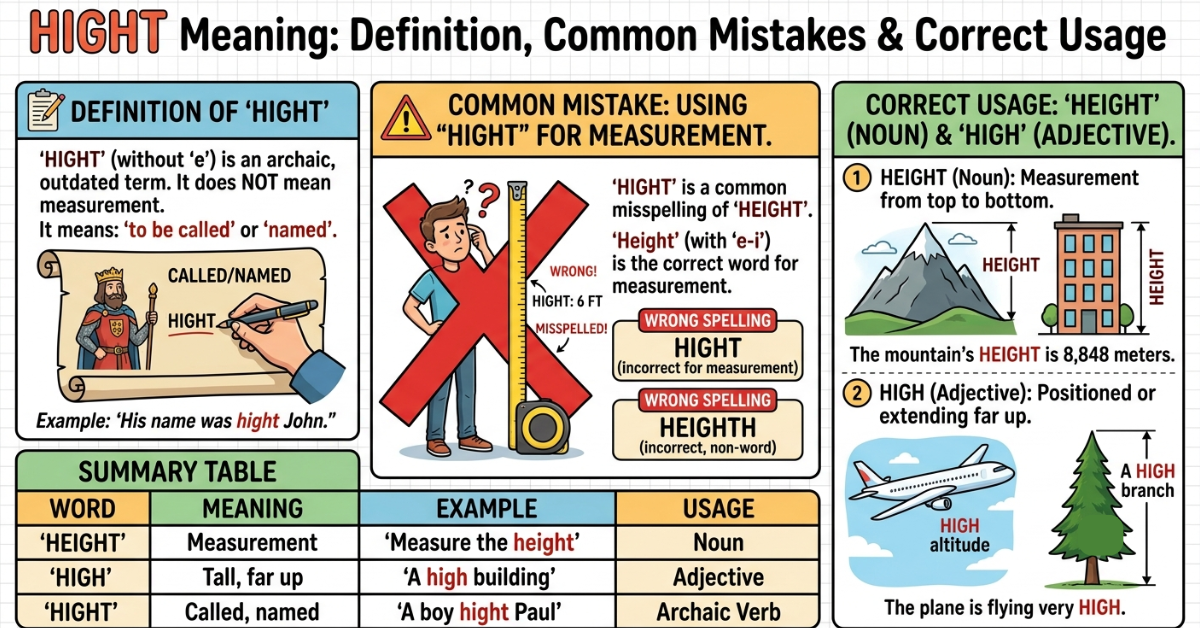
The hight meaning refers to an old English word that means to be called, to be named, or to be known as.
Unlike height, which measures how tall someone or something is, hight is an archaic verb that appears mainly in historical texts, old literature, and poetry.
Simple definition:
Hight (verb): To be named or called.
Example:
- “The knight was hight Sir Gareth.”
- Meaning: The knight was named Sir Gareth.
Today, this usage is extremely rare in everyday English.
Is “Hight” the Same as “Height”?
No.
This is the biggest misunderstanding surrounding the term.
| Hight | Height |
| Old English verb | Modern noun |
| Means “named” or “called” | Means how tall something is |
| Rarely used today | Used every day |
| Found in old literature | Used in education, science, architecture, sports, and daily life |
Example:
Correct:
- My height is 170 cm.
Incorrect:
- My hight is 170 cm.
The second sentence contains a spelling mistake.
Why Do People Search for “Hight Meaning”?
There are several reasons this search term is so common.
1. Typing Error
Many people accidentally spell height as hight because English spelling isn’t always intuitive.
2. Pronunciation Confusion
The pronunciation of height sounds similar to how many learners expect it to be spelled.
3. English Learners
People learning English often search for unfamiliar spellings to confirm whether they are correct.
4. Historical Literature
Readers sometimes encounter hight in older books and want to understand its meaning.
The Origin of the Word “Hight”
The word hight comes from Old English and is related to the verb meaning to call or name.
It appeared frequently in medieval writing and later became popular in poetic works.
During the Middle English period, authors used it naturally in storytelling, especially when introducing characters.
For example:
“A lady was hight Elaine.”
This simply means:
“A lady was named Elaine.”
As English evolved, the word gradually disappeared from everyday speech.
Where Is “Hight” Used Today?
Although uncommon, hight still appears in certain contexts.
Historical Literature
Older English texts often include the word.
Examples include:
- Medieval romances
- Historical chronicles
- Ancient poems
Poetry
Some poets intentionally use archaic language to create a traditional or dramatic tone.
Academic Studies
Students studying:
- Old English
- Medieval literature
- Historical linguistics
may encounter the word while reading original texts.
Height vs. Hight: Understanding the Difference
Because these words look similar, they’re frequently confused.
Height
Height refers to vertical measurement.
Examples:
- The building has a height of 200 meters.
- She measured her height.
- Mountain height affects climate.
Common fields using “height”:
- Construction
- Engineering
- Interior design
- Aviation
- Medicine
- Sports
Hight
Hight refers to someone’s name.
Examples:
- The warrior was hight Arthur.
- A maiden hight Isabel entered the castle.
Outside historical writing, you will almost never hear native English speakers use this word.
Examples of Correct Usage
Using “Height”
What is your height?
The tree’s height surprised everyone.
The ceiling height is three meters.
Using “Hight”
The prince was hight Edward.
A noble lady hight Eleanor appeared.
These examples imitate older styles of English rather than modern conversation.
Common Mistakes People Make
Many learners accidentally replace height with hight.
Here are some common errors.
Incorrect
- My hight is 5 feet.
- What is your hight?
- The mountain hight is impressive.
Correct
- My height is 5 feet.
- What is your height?
- The mountain height is impressive.
Remember:
If you’re talking about measurement, the correct word is always height.
How to Remember the Difference
A few memory tricks can help.
Think About Measurement
If you’re discussing:
- Tall people
- Buildings
- Trees
- Mountains
Use height.
Think About Names
If you’re reading an old poem where someone is “called” something, the word may be hight.
Is “Hight” a Correct English Word?
Yes.
However, it’s considered archaic, meaning it belongs to an older stage of the English language.
Modern dictionaries still recognize it, but it isn’t used in normal conversation, business writing, education, or journalism.
In nearly every everyday situation, you should use height instead.
Why English Has Words Like “Hight”
English has evolved over more than a thousand years.
Many words that were once common gradually disappeared as grammar and vocabulary changed.
Examples include:
- Thou
- Thee
- Hath
- Hither
- Hight
These words survive mainly because classic literature continues to preserve them.
Real-World Relevance
Understanding the difference between hight and height can help you:
- Improve your spelling
- Avoid embarrassing writing mistakes
- Better understand historical books
- Score higher in English exams
- Write more professionally
- Communicate more accurately
Whether you’re a student, writer, or English learner, recognizing this distinction strengthens your language skills.
Practical Tips to Avoid Confusion
Keep these simple tips in mind:
- Use height whenever talking about measurement.
- Treat hight as a historical word.
- Double-check spelling in essays and professional documents.
- Don’t rely solely on pronunciation when spelling English words.
- Remember that spell-check tools often catch “hight” when you meant “height.”
Key Takeaways
- Hight means “named” or “called.”
- It is an archaic English verb.
- Height refers to how tall someone or something is.
- Most searches for hight meaning actually relate to the modern word height.
- In everyday English, height is almost always the correct choice.
Frequently Asked Questions
What is the hight meaning in English?
The word hight means “named” or “called.” It is an archaic English verb found mainly in historical literature and poetry.
Is “hight” a spelling mistake?
Usually, yes. Most people who write “hight” actually mean height, which refers to vertical measurement. However, hight is also a genuine historical English word.
Is hight used in modern English?
Rarely. Modern English speakers almost never use hight except when quoting old literature or writing in an intentionally archaic style.
Why do people confuse hight and height?
The confusion comes from similar pronunciation and spelling. Many English learners assume “hight” is the correct spelling of height.
What is the difference between hight and height?
Hight means “named” or “called,” while height measures how tall a person, object, or structure is. They have completely different meanings despite their similar appearance.
Should I use hight in professional writing?
No. Unless you’re quoting historical texts or discussing older forms of English, you should use height when referring to measurement.
Conclusion
The hight meaning is rooted in the history of the English language, where it simply meant to be named or called. Although it remains a legitimate word, it has largely disappeared from modern usage and survives mainly in literature and historical works. By contrast, height is the standard word used today whenever discussing how tall a person, object, or structure is.
Knowing the difference helps you avoid common spelling mistakes, improves your writing accuracy, and deepens your understanding of English vocabulary. The next time you come across “hight,” you’ll recognize it as a fascinating piece of linguistic history rather than a modern alternative to “height.”
Author

linguaezone.com@gmail.com
Related Posts

I’m Patient: Understanding the Meaning, Mindset, and Power of Patience
- 0
- 1,816 word
I’m Patient: What Does It Really Mean? Have you ever found yourself waiting for something important and realized that getting frustrated will...
Read out all
Do and Not: Understanding the Difference and Using Both Correctly
- 0
- 2,303 words
Introduction: Why “Do and Not” Matters in Everyday Communication Have you ever written a sentence and wondered whether you should use “do,”...
Read out all
Proscribed: Meaning, Definition, Examples, and Correct Usage
- 0
- 2,338 words
Introduction: What Does “Proscribed” Mean? Have you ever come across the word proscribed and wondered what it actually means? It is one...
Read out all
Imput: Meaning, Common Usage, and Why People Often Use It Instead of Input
- 0
- 1,592 word
What Does Imput Mean? Have you ever typed “imput” instead of “input” and wondered whether you made a mistake? You are certainly...
Read out all
Emaculate vs Demasculate: Understanding the Difference and Correct Usage
- 0
- 2,156 words
Introduction: Emaculate vs Demasculate Have you ever come across the words emasculate and demasculate and wondered whether they mean the same thing?...
Read out all
What Does LYK Mean in Text? Simple Guide
- 0
- 1,029 word
Ever received a message that says “LYK” and paused for a second? You are not alone. If you have been wondering what...
Read out all