Have you ever received a message saying, “Happy to help!” after someone answered your question or solved a problem? It’s one of the most common expressions in everyday conversations, customer service, and professional emails—but what does it really mean?
Understanding the happy to help meaning can improve your communication skills and help you sound more polite, approachable, and professional. Whether you’ve seen phrases like i’m happy to help meaning, always happy to help meaning, or i am happy to help meaning, this guide explains their meanings, differences, appropriate usage, examples, and better alternatives for different situations.
What Does “Happy to Help” Mean?
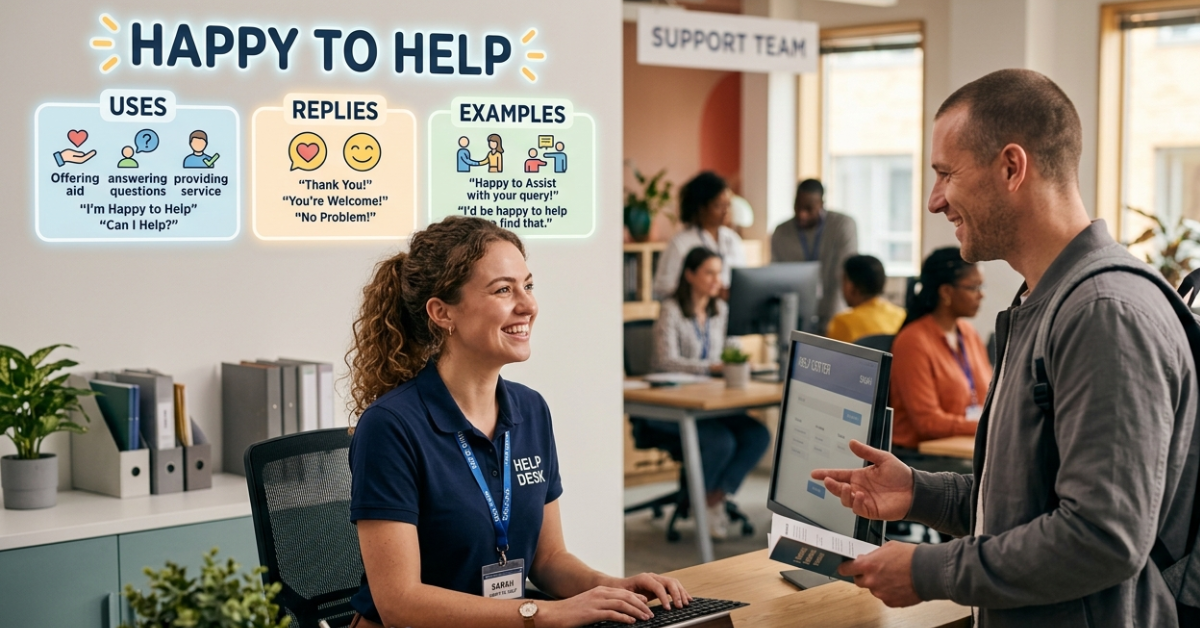
The phrase “happy to help” means that someone is pleased or willing to provide assistance without feeling inconvenienced. It communicates friendliness, kindness, and a genuine willingness to support another person.
Rather than simply saying “you’re welcome,” the speaker emphasizes that helping was enjoyable or no trouble at all.
Simple Definition
Happy to help means “I’m glad I could assist you” or “It was my pleasure to help.”
The phrase reassures the other person that their request was welcome.
Happy to Help Meaning in Everyday English
In everyday conversations, “happy to help” is a warm and positive response after assisting someone.
For example:
- “Thanks for showing me how to use the software.”
- “Happy to help!”
Here, the speaker is saying they were genuinely glad to assist.
It creates a friendlier interaction than simply replying with “No problem.”
I’m Happy to Help Meaning
The i’m happy to help meaning is slightly more personal because the speaker directly expresses their feelings.
It means:
“I genuinely enjoy helping you.”
This version often sounds warmer and more sincere than the shorter phrase “Happy to help.”
Examples
- “If you have any more questions, I’m happy to help.”
- “I’m happy to help with your project anytime.”
- “I’m happy to help you prepare for your interview.”
This expression is common among:
- Teachers
- Friends
- Managers
- Mentors
- Customer support representatives
I Am Happy to Help Meaning
The i am happy to help meaning is essentially identical to “I’m happy to help.”
The only difference is tone.
“I am happy to help” sounds:
- Slightly more formal
- More deliberate
- Suitable for professional writing
- Appropriate in speeches or presentations
Example
“I am happy to help if you need additional information.”
Because the full form sounds polished, it frequently appears in business communication.
Always Happy to Help Meaning
The always happy to help meaning goes one step further.
It suggests that helping isn’t a one-time event—it’s something the speaker is consistently willing to do.
In other words, it means:
“You can count on me whenever you need assistance.”
Examples
- “Always happy to help with your assignments.”
- “We’re always happy to help our customers.”
- “Always happy to help if you have more questions.”
This phrase builds trust because it shows ongoing support.
Why People Say “Happy to Help”
People use this expression for several reasons.
It Shows Kindness
Instead of making someone feel guilty for asking, it reassures them that helping was welcome.
It Builds Positive Relationships
Friendly language strengthens personal and professional connections.
It Demonstrates Professionalism
Businesses often use it because it leaves customers with a positive impression.
It Encourages Future Communication
It tells the other person they can ask for help again if needed.
When Should You Use “Happy to Help”?
The expression works well in many situations.
At Work
- Helping a coworker
- Responding to client questions
- Finishing a team project
- Providing technical support
Example:
“Happy to help! Let me know if anything else comes up.”
With Friends
Example:
“Happy to help you move this weekend.”
In School
Students and teachers often use it after explaining homework or assignments.
Example:
“I’m happy to help you understand the chapter.”
Customer Service
Many companies use this phrase because it sounds polite and reassuring.
Example:
“Happy to help! Feel free to contact us anytime.”
Situations Where “Happy to Help” Fits Best
This phrase works naturally after:
- Answering someone’s question
- Solving a problem
- Giving directions
- Offering advice
- Completing a favor
- Sharing information
- Teaching someone a skill
Professional Examples
Here are examples suitable for emails and workplace communication.
Example 1
Thank you for reaching out.
Happy to help with your request. Please let me know if you need anything else.
Example 2
I’m happy to help review your presentation before tomorrow’s meeting.
Example 3
I am happy to help answer any additional questions.
Example 4
Always happy to help our clients achieve the best results.
Casual Conversation Examples
Friend:
Thanks for picking me up.
You:
Happy to help!
Friend:
Thanks for explaining the game.
You:
I’m happy to help.
Neighbor:
Thanks for watering my plants.
You:
Always happy to help.
Email Examples
Formal
Thank you for your message.
I am happy to help with any further information you may require.
Kind regards,
Semi-formal
Glad everything worked out.
I’m happy to help anytime.
Customer Support
Thank you for contacting us.
We’re always happy to help if you need additional assistance.
Is “Happy to Help” Professional?
Yes.
It is considered professional, polite, and friendly.
Many organizations encourage employees to use it because it:
- Sounds welcoming
- Improves customer experience
- Creates a positive tone
- Shows willingness to assist
However, in very formal legal or academic writing, alternatives like “It was my pleasure” or “Please don’t hesitate to contact me” may be more appropriate.
Alternatives to “Happy to Help”
Using different expressions keeps your communication natural.
| Expression |
Best Used For |
| You’re welcome |
Everyday conversation |
| My pleasure |
Professional settings |
| Glad I could help |
Friendly interactions |
| Anytime |
Casual conversations |
| No problem |
Informal situations |
| It was my pleasure |
Formal communication |
| Don’t hesitate to ask |
Business emails |
| Feel free to reach out |
Professional communication |
| Happy to assist |
Customer service |
| Delighted to help |
Formal customer relations |
Common Mistakes to Avoid
Using It Before Helping
Incorrect:
“Happy to help” before offering assistance.
Better:
“I’m happy to help if you need anything.”
Overusing It
Repeating the phrase multiple times in one email can sound repetitive.
Instead, vary your language with alternatives.
Using It in Serious Situations
When discussing sensitive issues, a more empathetic response may be appropriate.
For example:
“I’m sorry you’re experiencing this. I’ll do everything I can to help.”
How to Respond When Someone Says “Happy to Help”
Here are polite responses:
- Thank you!
- I really appreciate it.
- Thanks for your support.
- That’s very kind of you.
- You’ve been incredibly helpful.
- I appreciate your time.
- Thanks again for your assistance.
Happy to Help vs You’re Welcome
| Happy to Help |
You’re Welcome |
| Shows enthusiasm |
Acknowledges thanks |
| Sounds warmer |
More neutral |
| Common in customer service |
Universal response |
| Encourages future questions |
Ends the conversation politely |
Why Businesses Love This Phrase
Companies frequently use “happy to help” because it:
- Creates a positive customer experience
- Shows willingness to assist
- Sounds approachable
- Builds customer loyalty
- Reinforces a helpful brand image
That’s why you’ll often see it in customer support emails, live chats, and service interactions.
Practical Tips for Using “Happy to Help”
To make the phrase sound natural:
- Match the tone to the situation.
- Use “I’m happy to help” for a warmer, personal feel.
- Choose “I am happy to help” in formal emails or presentations.
- Say “Always happy to help” only when you genuinely want to offer ongoing support.
- Pair it with an invitation for future questions when appropriate.
Key Takeaways
- “Happy to help” means you were glad to assist someone.
- “I’m happy to help” sounds warm and personal.
- “I am happy to help” is slightly more formal.
- “Always happy to help” expresses ongoing willingness to assist.
- The phrase is suitable for personal, professional, and customer service communication.
- Using alternatives occasionally keeps your writing natural and engaging.
Frequently Asked Questions
What is the happy to help meaning?
The happy to help meaning is that someone is pleased to provide assistance and does not view helping as an inconvenience. It expresses friendliness, kindness, and willingness.
What is the difference between “I’m happy to help” and “I am happy to help”?
The i’m happy to help meaning and i am happy to help meaning are the same. The contraction “I’m” sounds more conversational, while “I am” is slightly more formal.
What does “always happy to help” mean?
The always happy to help meaning is that the speaker is consistently willing to assist whenever needed. It conveys reliability and ongoing support.
Is “happy to help” professional?
Yes. It is widely accepted in workplaces, customer service, business emails, and professional conversations because it sounds courteous and approachable.
Can I use “happy to help” in emails?
Absolutely. It works well in professional and semi-formal emails, especially when responding to requests, answering questions, or assisting clients and colleagues.
What can I say instead of “happy to help”?
Some excellent alternatives include “My pleasure,” “Glad I could help,” “Happy to assist,” “You’re welcome,” “Feel free to reach out,” and “Don’t hesitate to ask.”
Conclusion
Understanding the happy to help meaning allows you to communicate with greater confidence and warmth. Whether you choose I’m happy to help, I am happy to help, or always happy to help, each expression conveys a positive attitude and a genuine willingness to assist.
Using these phrases appropriately can strengthen professional relationships, improve customer interactions, and make everyday conversations feel more welcoming. By understanding the subtle differences between each variation and knowing when to use them, you’ll communicate more naturally and leave a positive impression wherever you interact.