
- 0
- 1,266 word
Have you ever paused while writing and wondered whether you should use entwined or intertwined? At first glance, the two words seem interchangeable. Both describe things that are twisted or connected together. However, subtle differences in meaning, tone, and usage can make one a better choice than the other depending on the context.
In this guide to entwined vs intertwined, you’ll learn the exact meaning of each word, how they differ, when to use them, common mistakes to avoid, and practical examples that make the distinction easy to remember. Whether you’re a student, writer, editor, or English learner, this comparison will help you choose the right word with confidence.
Understanding the Basics
Before comparing the two words, it’s helpful to understand what each one means individually.
What Does “Entwined” Mean?
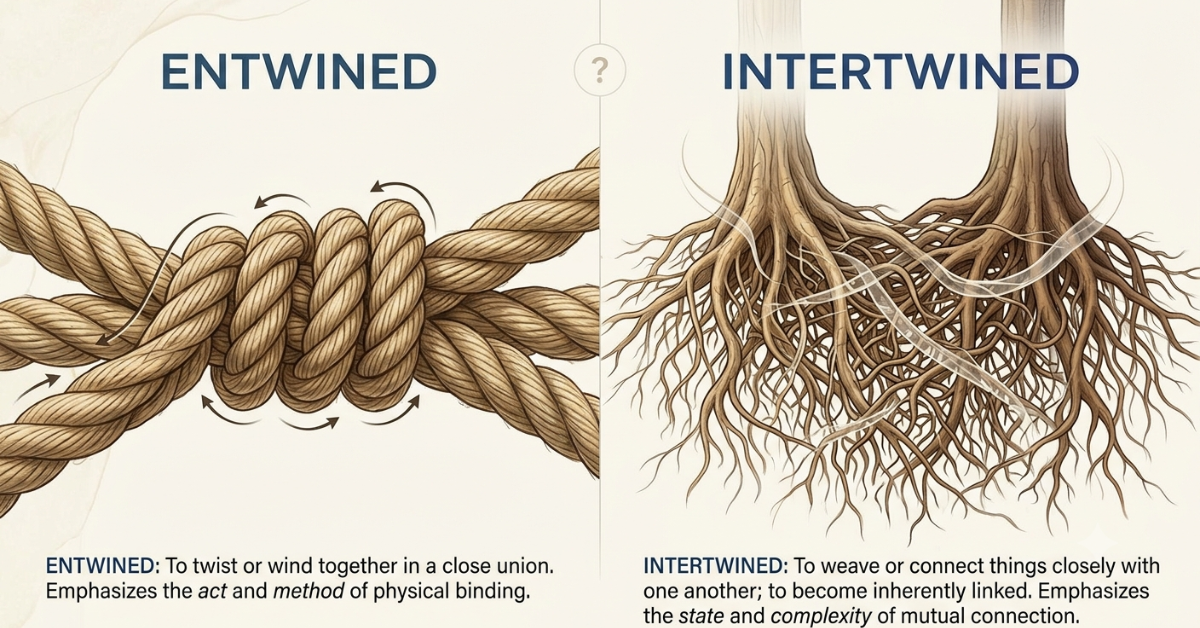
Entwined means wrapped, twisted, or coiled around something else. It often emphasizes closeness, attachment, or an elegant wrapping together.
The word is commonly used in:
- Romantic writing
- Poetry
- Nature descriptions
- Symbolic or emotional contexts
Examples
- The vines were entwined around the old fence.
- Their fingers remained entwined throughout the ceremony.
- The couple’s lives became deeply entwined over the years.
In many cases, “entwined” suggests a graceful or intimate connection.
What Does “Intertwined” Mean?
Intertwined means twisted, woven, or connected together in a complex way, often involving multiple parts or layers.
Unlike “entwined,” this word frequently emphasizes complexity rather than intimacy.
It’s commonly used in:
- Relationships
- Business
- History
- Technology
- Politics
- Science
Examples
- The branches became intertwined after years of growth.
- Economics and politics are closely intertwined.
- Multiple storylines are intertwined throughout the novel.
The emphasis is often on interconnected systems rather than simple wrapping.
Entwined vs Intertwined: Side-by-Side Comparison
| Feature | Entwined | Intertwined |
| Main meaning | Wrapped closely together | Connected or woven together in multiple ways |
| Tone | Emotional, elegant, poetic | Complex, structural, analytical |
| Common use | Relationships, vines, hands | Systems, ideas, branches, histories |
| Complexity | Usually simpler connection | Often multiple overlapping connections |
| Formality | Slightly literary | Common in both formal and everyday writing |
The Main Difference Between Entwined and Intertwined
Although both words involve things being twisted together, the difference lies in how they’re connected.
Use “Entwined” when:
- Two things wrap around each other.
- You want to emphasize closeness.
- The image feels graceful or emotional.
Examples:
- Two lovers walking with entwined hands.
- Roses entwined around a garden arch.
- Memories entwined with childhood experiences.
Use “Intertwined” when:
- Several things are connected.
- Relationships are complex.
- Ideas overlap or influence one another.
Examples:
- Climate and agriculture are intertwined.
- Multiple cables became intertwined.
- Family histories were intertwined over generations.
Etymology: Where Do These Words Come From?
Both words originate from the verb twine, meaning “to twist together.”
The prefixes change the meaning slightly:
- En- generally means “to cause to be within or around.”
- Inter- means “between” or “among.”
This explains why:
- Entwined focuses on wrapping.
- Intertwined focuses on mutual connections.
Understanding these prefixes makes remembering the difference much easier.
When Should You Use Entwined?
Choose entwined if you’re describing:
Physical Objects
- Flowers around a fence
- Fingers holding each other
- Hair wrapped together
- Decorative vines
Emotional Connections
- Love
- Friendship
- Shared memories
- Personal bonds
Literary Writing
Many novelists prefer “entwined” because it creates softer, more romantic imagery.
Example:
Their destinies remained forever entwined.
When Should You Use Intertwined?
Choose intertwined when discussing broader relationships.
Ideas
- Science and technology
- Culture and language
- History and politics
Physical Objects
- Rope
- Electrical wires
- Tree roots
- Branches
Storytelling
Authors often describe:
- Intertwined plots
- Intertwined character arcs
- Intertwined timelines
These examples involve multiple layers of connection rather than simple wrapping.
Examples in Everyday English
Here are practical examples that highlight the difference.
Entwined
- Their arms were entwined during the walk.
- Ivy became entwined around the gate.
- Her dreams were entwined with hope.
- The necklace chain was lightly entwined.
Intertwined
- Their business interests are intertwined.
- The roads became intertwined through the city.
- Music and culture are intertwined.
- The two investigations became intertwined.
Notice how “intertwined” usually describes broader or more complicated relationships.
Which Word Is More Common?
In modern English, intertwined appears more frequently in:
- Journalism
- Academic writing
- News reports
- Business articles
- Scientific discussions
Meanwhile, entwined is more common in:
- Fiction
- Romance novels
- Poetry
- Creative writing
Both are correct—it simply depends on your intended meaning.
Common Mistakes to Avoid
Many writers accidentally use these words interchangeably without considering nuance.
Avoid these common errors:
Mistake 1: Using “Entwined” for Complex Systems
Incorrect: Politics and economics are entwined.
Better:
Correct: Politics and economics are intertwined.
Mistake 2: Using “Intertwined” for Romantic Imagery
Incorrect: Their fingers were intertwined.
While this is grammatically correct, “entwined” often creates a softer and more poetic image.
Better:
Correct: Their fingers were entwined.
Mistake 3: Assuming One Is More Correct
Neither word is more “correct.”
The better choice depends entirely on context.
Practical Tips for Choosing the Right Word
If you’re unsure which word fits, ask yourself these questions:
Is it mainly about closeness?
Choose entwined.
Is it about multiple connected parts?
Choose intertwined.
Is the tone emotional or poetic?
Choose entwined.
Is the topic analytical or complex?
Choose intertwined.
This quick decision process works in most situations.
Why the Difference Matters
Using the precise word strengthens your writing.
For example:
Their lives were entwined.
This suggests intimacy and emotional closeness.
Compare it with:
Their careers were intertwined.
This suggests overlapping professional paths rather than emotional attachment.
Small word choices like these improve clarity, tone, and reader understanding.
Similar Words Worth Knowing
If you’re exploring related vocabulary, these words are also useful:
- Interwoven
- Twisted
- Braided
- Wrapped
- Bound
- Connected
- Linked
- Joined
- Woven together
- Interconnected
Each has its own subtle nuance, making it valuable for precise writing.
Key Takeaways
- Entwined emphasizes closeness, wrapping, and emotional connection.
- Intertwined emphasizes complex, overlapping relationships.
- Both originate from the verb “twine.”
- Neither word is universally better—the context determines the correct choice.
- Writers often prefer “entwined” for poetry and romance, while “intertwined” is more common in academic and professional writing.
Frequently Asked Questions
Is there a difference between entwined and intertwined?
Yes. While both describe things twisted together, entwined usually highlights closeness or graceful wrapping, whereas intertwined emphasizes multiple or complex connections.
Can entwined and intertwined be used interchangeably?
Sometimes. In physical descriptions like vines or branches, either word may work. However, for abstract relationships, choosing the more appropriate term improves clarity and tone.
Which is more formal: entwined or intertwined?
Neither word is inherently more formal. However, intertwined appears more often in academic, business, and technical writing, while entwined is more common in literary and creative works.
Is “their lives were intertwined” correct?
Yes. This phrase suggests that two people’s lives became connected through shared experiences, circumstances, or relationships over time.
Why do authors often use “entwined” in romance novels?
Because entwined creates a softer, more intimate image. It naturally conveys emotional closeness, affection, and physical connection, making it especially effective in romantic writing.
How can I remember the difference between entwined vs intertwined?
Think of entwined as two things wrapped closely together, like hands or vines. Think of intertwined as many connections woven together, like ideas, histories, or systems.
Conclusion
Understanding entwined vs intertwined isn’t just about choosing between two similar words—it’s about selecting the expression that best captures your intended meaning. While entwined conveys intimacy, elegance, and close attachment, intertwined highlights complexity, interconnectedness, and layered relationships.
By recognizing these subtle distinctions, you can write with greater precision, create stronger imagery, and communicate more effectively. The next time you’re deciding between these two words, consider the nature of the connection you’re describing, and you’ll be able to choose the perfect fit with confidence.
Author

linguaezone.com@gmail.com
Related Posts
Kill Two Birds With One Stone Alternative: 50 Better Options
- 0
- 1,569 word
Have you ever paused before saying “kill two birds with one stone” because it sounded too violent or simply didn’t fit the...
Read out all
Happy Sabbath Meaning: A Complete Guide to Its Significance
- 0
- 1,632 word
Have you ever received the message “Happy Sabbath” and wondered what it truly means? Is it simply another way of saying “have...
Read out all
I’m So Proud of You in Other Words: 120+ Heartfelt Alternatives
- 0
- 1,562 word
Have you ever wanted to tell someone you’re proud of them but felt like saying “I’m so proud of you” sounded repetitive?...
Read out all
How Do You Spell Happy Anniversary? Correct Spelling Guide
- 0
- 1,221 word
Have you ever paused before writing an anniversary card and wondered, “How do you spell happy anniversary?” You’re not alone. Whether you’re...
Read out all
Waiting for Your Response Email: Best Examples & Tips
- 0
- 1,483 word
Have you ever sent an important email and found yourself wondering whether you should follow up or simply wait? Whether you’re communicating...
Read out all
Great Asset to the Team: Meaning, Examples & Tips
- 0
- 1,494 word
Have you ever wanted to compliment a coworker but struggled to find words that sound professional and sincere? One of the most...
Read out all