
- 0
- 1,592 word
What Does Imput Mean?
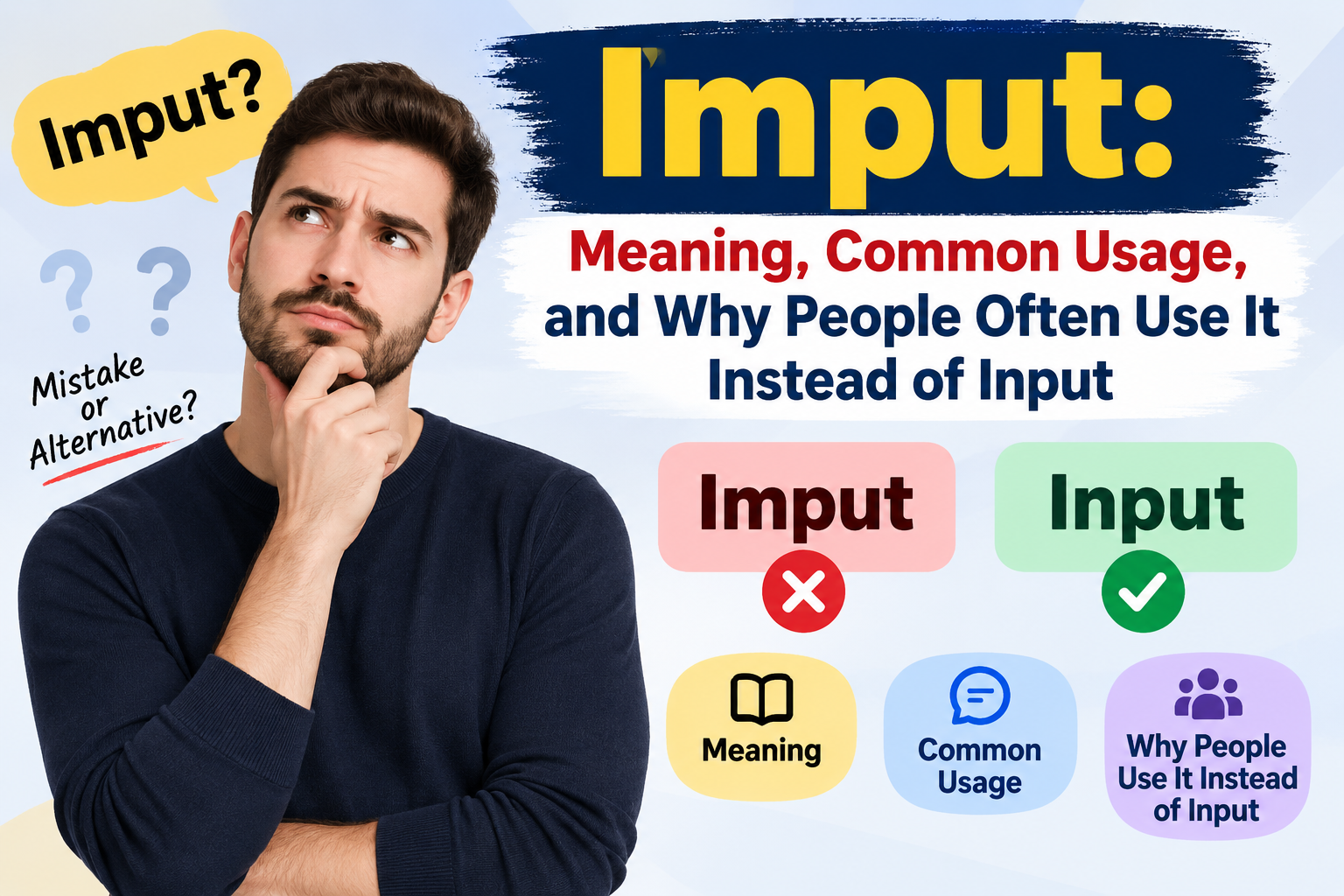
Have you ever typed “imput” instead of “input” and wondered whether you made a mistake? You are certainly not alone. The word “imput” appears frequently in online searches, messages, comments, documents, and even informal conversations. Although many people recognize what the writer is trying to say, “imput” is generally considered a misspelling of the word “input.”
The correct English spelling is “input.” It can function as both a noun and a verb. As a noun, input usually refers to information, ideas, opinions, or data provided to a person or system. For example, someone might ask for your input before making an important decision. In technology, input can refer to information entered into a computer, application, machine, or other device.
The spelling “imput” is usually created because of the way the word is pronounced. When people say “input” quickly, the final sound can make the word seem as though it should be spelled with an “m.” This is especially understandable because English contains many words where pronunciation does not perfectly reveal spelling. As a result, people sometimes write “imput” even though they mean “input.”
It is worth remembering that “imput” is not normally accepted as the standard spelling in formal English. If you are writing an email, article, school assignment, business document, website, or professional report, use “input” instead. Knowing this small distinction can make your writing appear more polished and accurate.
Why Do People Spell Input as Imput?
One of the biggest reasons people write “imput” is pronunciation. English spelling can be confusing, and the pronunciation of “input” can lead people to hear an “m” sound. When a person speaks quickly, the transition between sounds can make the word seem different from its written form.
Another reason is repetition. If someone has seen “imput” used by other people online, they may naturally assume that it is an accepted spelling. The internet has made this particularly common because informal writing spreads quickly. A spelling mistake can appear in a social media post, forum, comment section, or message and then be repeated by hundreds of other people.
Typing habits can also contribute to the problem. On phones and computers, people often type quickly and depend on memory rather than checking every word. If someone already believes that “imput” is correct, autocorrect may not always fix it, especially if the word appears in a context where the software cannot confidently identify the intended word.
There is also a broader issue with English spelling. Many English words do not follow simple pronunciation rules, so people often spell unfamiliar words according to how they sound. This is perfectly understandable during casual writing. However, when accuracy matters, it is useful to remember that the standard spelling is “input,” not “imput.”
What Is the Correct Spelling: Imput or Input?
If you are deciding between “imput” and “input,” the answer is straightforward: input is the correct standard spelling. Whether you are talking about information, advice, data, or the action of entering something into a system, “input” is the word you should normally use.
For example, you could say, “I would appreciate your input on this project.” Here, input means an opinion, suggestion, or contribution. You might also say, “Please input your password into the required field.” In this case, input is being used as a verb describing the action of entering information.
The word “imput” does not normally serve as an alternative spelling in standard modern English. Someone may understand what you mean when you use it, but that does not make it grammatically or orthographically correct. In professional communication, using the standard spelling helps avoid unnecessary mistakes and gives your writing a more credible appearance.
A simple way to remember the difference is to associate input with information going “in.” The word itself can be understood as something that goes into a system, discussion, process, or decision. Keeping this idea in mind can make it easier to remember the correct spelling whenever you are unsure.
How Is Input Used in Everyday English?
The word input is surprisingly versatile. In everyday conversations, people often use it when asking for another person’s opinion or advice. For example, a manager might say, “I’d like your input before we finalize the plan.” In this situation, the manager is asking for ideas or feedback.
Friends can use the word in a similar way. Someone planning a trip might ask, “Can I get your input on where we should go?” The person is not necessarily asking for a formal answer. They simply want another perspective before making a decision.
Input is also common in workplaces. Teams frequently share input during meetings, planning sessions, reviews, and brainstorming discussions. A designer may ask a client for input on a draft. A manager may request employee input about a new policy. A developer may collect user input before improving an application.
Because of these different uses, input is a useful word for both casual and professional communication. If you have been writing “imput,” replacing it with “input” is an easy improvement that can immediately make your writing more accurate.
Input in Technology and Computing
In technology, input has a more specific meaning. It generally refers to information, commands, signals, or data provided to a computer or electronic system. Whenever you type something on a keyboard, click a button, speak into a microphone, or touch a screen, you are providing some form of input.
For example, when you enter your name into an online registration form, your name is input data. When you type a search term into a search engine, that search term is also an input. The system processes the information and produces an output based on what you provided.
The relationship between input and output is especially important in computing. A system receives input, processes it, and then produces an output. A calculator is a simple example. You enter numbers and an operation as input, the calculator performs the calculation, and the resulting number becomes the output.
This technical meaning explains why the word input appears so often in software, websites, programming, electronics, and artificial intelligence. You may see phrases such as “user input,” “input field,” “input data,” or “input device.” In all of these cases, the correct spelling remains input, not imput.
Common Examples of Input
There are many everyday examples of input, even if you do not normally think about them that way. Your keyboard provides input to your computer. A touchscreen allows you to provide input by tapping or swiping. A microphone receives spoken input, while a camera can capture visual information for a device or application.
Outside technology, input can mean feedback or contribution. Imagine a company developing a new product. The design team may ask customers for input about features they would like to see. Their responses can help the company understand what users actually want.
Students also provide and receive input. During a group project, every student might contribute ideas. Those ideas represent input that helps the group develop its final presentation or assignment. A teacher may also ask students for input about how a lesson could be improved.
These examples show why input is such a flexible term. It can describe something as simple as typing a word into a form or something as complex as contributing professional knowledge to a major business decision.
Imput vs. Input: A Simple Comparison
The easiest way to understand imput vs. input is to remember that one is generally a spelling mistake while the other is the standard English word. If you are writing something that needs to be correct, choose input.
Consider the sentence, “We need your imput before making a decision.” The intended meaning is clear, but the spelling is incorrect. The corrected version is, “We need your input before making a decision.”
Similarly, “Enter your imput in the box” should be written as “Enter your input in the box.” This distinction matters more in professional settings because spelling errors can affect how readers perceive the quality of your communication.
The good news is that this is an easy mistake to fix. Once you know that input is the correct spelling, you can quickly recognize and replace imput whenever it appears in your writing.
How to Avoid Using Imput by Mistake
The first step is simply to memorize the correct spelling: input. Writing the word several times can help reinforce its appearance. You can also connect it with its meaning. Information goes “in,” so think of input as something that goes into a system, process, or conversation.
Another useful strategy is to use spell-checking tools. Most modern word processors and browsers can identify common spelling mistakes. However, you should not depend entirely on automatic correction. Spell-checkers can miss errors, especially when a misspelled word resembles a word that exists in another context.
Reading regularly can also improve spelling naturally. When you repeatedly encounter the correct form input in books, websites, articles, and professional documents, the spelling becomes more familiar. Over time, the incorrect form may start to look obviously unusual.
Finally, slow down when writing important content. A quick review before sending an email or publishing an article can catch simple mistakes like “imput.” Taking a few extra seconds to proofread can make a noticeable difference in the overall quality of your writing.
Final Thoughts on Imput
The keyword “imput” is commonly encountered online, but in standard English, the correct spelling is “input.” The mistake is understandable because pronunciation, typing habits, and exposure to informal online writing can all influence how people spell the word.
Author

linguaezone.com@gmail.com
Related Posts

I’m Patient: Understanding the Meaning, Mindset, and Power of Patience
- 0
- 1,816 word
I’m Patient: What Does It Really Mean? Have you ever found yourself waiting for something important and realized that getting frustrated will...
Read out all
Do and Not: Understanding the Difference and Using Both Correctly
- 0
- 2,303 words
Introduction: Why “Do and Not” Matters in Everyday Communication Have you ever written a sentence and wondered whether you should use “do,”...
Read out all
Proscribed: Meaning, Definition, Examples, and Correct Usage
- 0
- 2,338 words
Introduction: What Does “Proscribed” Mean? Have you ever come across the word proscribed and wondered what it actually means? It is one...
Read out all
Emaculate vs Demasculate: Understanding the Difference and Correct Usage
- 0
- 2,156 words
Introduction: Emaculate vs Demasculate Have you ever come across the words emasculate and demasculate and wondered whether they mean the same thing?...
Read out all
What Does LYK Mean in Text? Simple Guide
- 0
- 1,029 word
Ever received a message that says “LYK” and paused for a second? You are not alone. If you have been wondering what...
Read out all
Thank You for Your Prompt Response Meaning Explained
- 0
- 1,172 word
Have you ever received a quick reply and wanted to sound polite, professional, and appreciative in return? That is exactly where thank...
Read out all