
- 0
- 2,303 words
Introduction: Why “Do and Not” Matters in Everyday Communication
Have you ever written a sentence and wondered whether you should use “do,” “do not,” “don’t,” or simply “not”? These small words may look simple, but they play an important role in English grammar. They can change the meaning of a sentence, create instructions, show disagreement, or tell someone what should or should not happen. Because of this, understanding how they work can make everyday English much clearer and more natural.
The keyword “do and not” is especially interesting because people often encounter these words together in phrases such as “do this and do not do that.” At first glance, the construction can seem repetitive. However, English frequently uses this structure when giving rules, instructions, advice, warnings, or comparisons. Knowing why the structure works helps writers avoid awkward sentences and communicate their ideas with confidence.
In casual conversations, native speakers often shorten “do not” to “don’t.” For example, someone might say, “Don’t worry,” “Don’t touch that,” or “I don’t know.” In formal writing, however, “do not” can sound more deliberate and professional. The choice depends on the situation, the audience, and the tone a writer wants to create.
Learning do and not is therefore more than memorizing a grammar rule. It is about understanding how English expresses positive and negative actions. Once the basic pattern becomes familiar, it becomes much easier to form questions, negative statements, instructions, and emphatic sentences correctly.
What Does “Do and Not” Mean?
The word “do” has several jobs in English. It can function as a main verb, as in “I do my homework,” or as an auxiliary verb, as in “Do you like coffee?” When combined with “not,” it can help create a negative statement. For example, “I do not understand” means that the speaker does not have an understanding of something.
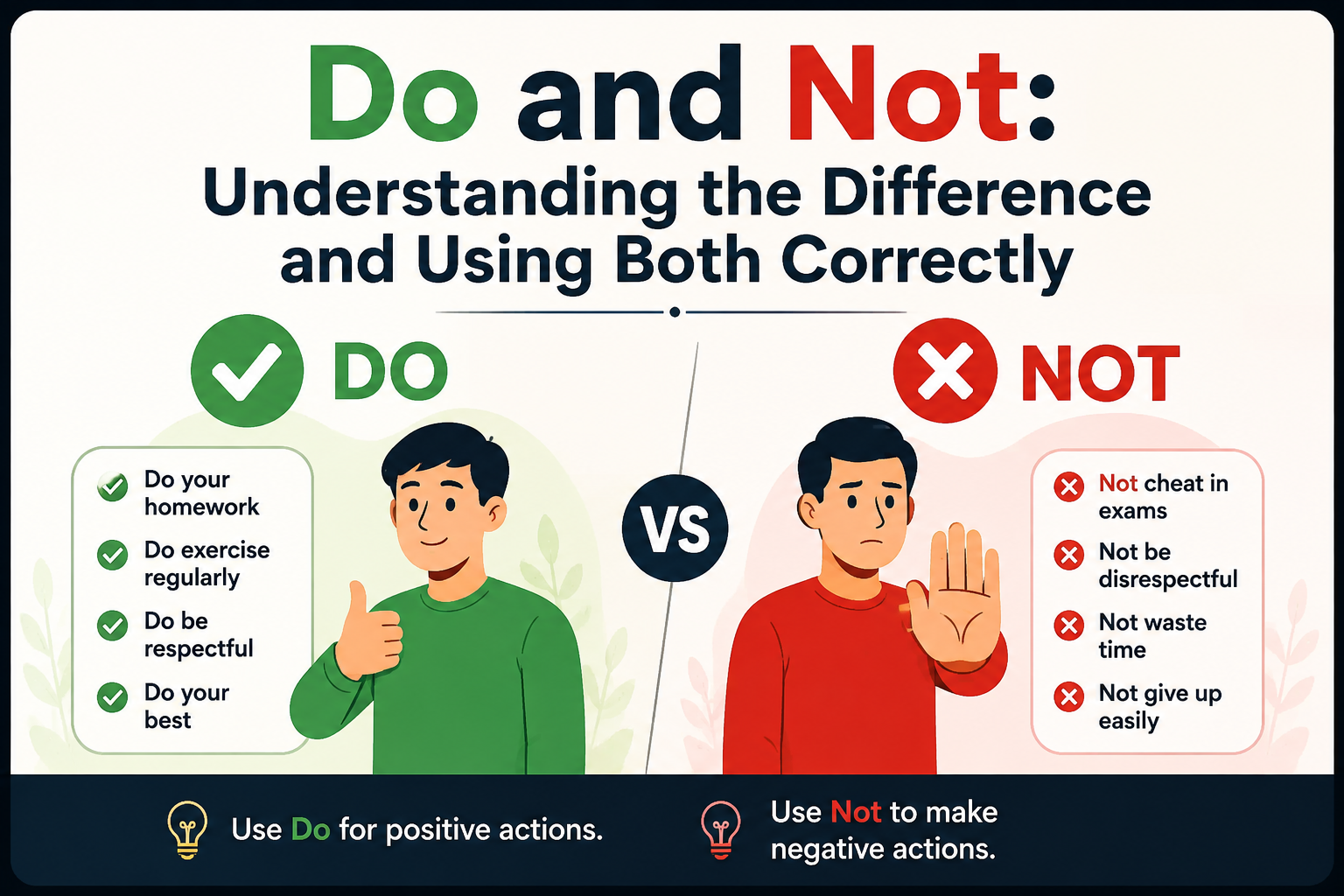
When people use do and not together, they are often contrasting an action that should happen with one that should not happen. A simple example is, “Do speak clearly and do not rush.” Here, “do” introduces the recommended action, while “do not” introduces the action that should be avoided.
The phrase can also appear in lists of instructions. Consider a workplace notice that says, “Do keep your password private and do not share it with others.” The structure makes the two instructions easy to compare. One tells the reader what to do, while the other tells the reader what not to do.
It is also useful to understand that “do not” is not always used as part of the exact phrase “do and not.” In everyday English, you may encounter related constructions such as “do’s and don’ts.” This expression refers to recommended behaviors and behaviors that should be avoided. For example, a guide about job interviews might include a list of interview do’s and don’ts.
How “Do” Works in English Sentences
“Do” is one of the most useful auxiliary verbs in English. It helps form questions and negative statements in the simple present tense. For example, “Do you work here?” uses “do” to create a question. Similarly, “I do not work here” uses “do not” to create a negative statement.
As a main verb, “do” has a different function. It can mean to perform, complete, or carry out an activity. Someone might say, “I do my work every morning.” In this sentence, “do” carries the main meaning of the action. It is not simply helping another verb.
English learners sometimes confuse these two uses. A helpful way to distinguish them is to look at what follows “do.” When “do” is an auxiliary, another base-form verb usually follows it. For example, “I do understand,” “Do you know?” and “They do not agree.” When “do” is the main verb, it can stand on its own, as in “I do my chores.”
The auxiliary use becomes particularly important when forming negatives. With most ordinary verbs in the simple present, English uses “do not” or “does not.” We say, “I do not like it,” but “She does not like it.” We do not normally say, “She not likes it.” The auxiliary verb carries the negative construction, while the main verb stays in its base form.
How “Do Not” Creates Negative Meaning
“Do not” is one of the standard ways to make a sentence negative in English. It tells the reader or listener that an action does not happen, should not happen, or is being rejected. For example, “I do not understand the question” describes a lack of understanding, while “Do not enter” gives a direct instruction.
The important grammar rule is that when “do not” is used as an auxiliary construction, the verb that follows remains in its base form. We say, “I do not know,” not “I do not knows.” Likewise, “They do not play” is correct, while “They do not plays” is incorrect.
The form changes depending on the subject. With “I,” “you,” “we,” and “they,” we generally use “do not.” With “he,” “she,” and “it,” we use “does not.” For example, “They do not agree” is correct, while “He does not agree” is correct for a singular third-person subject.
In conversation, “do not” is often shortened to “don’t,” and “does not” becomes “doesn’t.” These contractions are completely normal in casual speech. However, the full form can be useful when emphasizing a point or writing something formal. Compare “I don’t want that” with “I do not want that.” The second can sound more firm or deliberate.
The Difference Between “Do,” “Does,” “Did,” and “Do Not”
Understanding do and not becomes much easier when you also understand its related forms. “Do” is generally used with I, you, we, and they in the simple present. “Does” is used with he, she, and it. For the simple past, “did” is used with all subjects.
For example, we say, “Do you like music?” and “Does she like music?” Notice that the main verb remains “like” in both sentences. We do not say, “Does she likes music?” because “does” already carries the grammatical marking required for the third-person singular.
In negative sentences, the same pattern applies. We say, “I do not understand,” “They do not agree,” and “She does not understand.” In the past tense, we use “did not,” as in “I did not understand” or “They did not agree.”
A common mistake is adding an unnecessary ending to the main verb after “does” or “did.” For example, “She does not likes coffee” is incorrect. The correct version is “She does not like coffee.” Similarly, “He did not went home” should be “He did not go home.” Once “does” or “did” takes the grammatical role, the following verb returns to its base form.
When to Use “Do and Not” in Instructions
One of the clearest uses of do and not is in instructions. Rules often need to explain both acceptable and unacceptable behavior. Using parallel structures makes these instructions easier to understand.
For example, a teacher might say, “Do raise your hand before speaking, and do not interrupt others.” A safety guide could say, “Do wear protective equipment and do not operate the machine without training.” These sentences are direct because the reader immediately knows which action is encouraged and which action is prohibited.
The structure is especially useful when there are several rules. A website might provide a list such as “Do use strong passwords” and “Do not reuse the same password everywhere.” The contrast creates a simple visual and grammatical pattern that readers can scan quickly.
However, good instructions should not become unnecessarily complicated. If a short sentence communicates the idea more naturally, there is no need to force the words “do and not” into it. For example, “Do not touch the controls” is perfectly clear by itself. The paired construction is most useful when you genuinely want to contrast two behaviors.
“Do’s and Don’ts” in Everyday English
A closely related expression is “do’s and don’ts.” This phrase is extremely common in English and refers to actions that are recommended and actions that should be avoided. You might see it in articles, manuals, workplace guides, travel advice, health information, or educational material.
For example, a guide to public speaking might have a section called “The Do’s and Don’ts of Public Speaking.” The do’s could include preparing carefully, speaking clearly, and maintaining eye contact. The don’ts might include reading every word from a slide, speaking too quickly, or ignoring the audience.
The expression works because it gives readers an immediate sense of organization. Instead of presenting a long list of rules without distinction, the writer divides the information into positive and negative categories. This makes the advice easier to remember.
There is also some variation in how the plural is written. “Dos and don’ts” is commonly preferred in modern style because “do” does not technically require an apostrophe to become plural. You may also see “do’s and don’ts,” especially in informal writing. The important point is consistency. Choose a style and use it throughout the same piece of writing.
Common Mistakes People Make With “Do and Not”
One frequent mistake is using the wrong verb form after “do not.” For instance, “I do not likes this” is incorrect. The correct sentence is “I do not like this.” The same principle applies to “does not” and “did not.”
Another mistake is using “do not” where another negative construction is required. For example, with the verb “be,” English normally does not use “do” in this way. We say, “I am not tired,” rather than “I do not am tired.” Likewise, “She is not ready” is correct, not “She does not be ready.”
Learners may also confuse “do not” with “no.” These words can both express negative ideas, but they do different grammatical jobs. We say, “I do not have a car,” but “I have no car” has a different structure and often sounds more formal or emphatic. In ordinary conversation, “I don’t have a car” is usually the most natural choice.
A final mistake is overusing the construction. Good writing should sound natural rather than mechanically grammatical. If every instruction says “Do this and do not do that,” the text can quickly become repetitive. Varying sentence structures while maintaining clear meaning usually produces stronger writing.
How to Use “Do and Not” Naturally in Casual Writing
Casual English generally favors contractions. Instead of repeatedly writing “do not,” people often use “don’t.” For example, “Don’t worry about it” sounds natural in a friendly conversation. “Do not worry about it” is grammatically correct but may sound more formal or serious.
That does not mean “do not” should be avoided in casual writing. Sometimes the full form adds emphasis. If someone says, “I do not want to discuss this,” the complete form can make the statement sound firm. The speaker may be intentionally emphasizing the negative.
When writing online, context matters. A friendly blog can use both forms naturally. For example, “Do check the instructions first, but don’t feel overwhelmed if something seems confusing.” This sounds conversational while still providing clear guidance.
The best approach is to focus on meaning and tone. Use “do not” when you want clarity, formality, or emphasis. Use “don’t” when a relaxed and conversational tone is more appropriate. Both forms are correct when used in the right grammatical structure.
Why Clear Positive and Negative Instructions Matter
People process information more easily when instructions clearly distinguish between what they should do and what they should avoid. This is why do and not structures are common in guides, checklists, classrooms, and professional environments.
Imagine receiving instructions that simply say, “Be careful with the equipment.” That statement is reasonable but vague. A clearer version might say, “Do inspect the equipment before use, and do not operate it if you notice visible damage.” The second version gives the reader specific actions.
Clear instructions also reduce misunderstandings. When rules involve safety, money, work responsibilities, or important procedures, ambiguity can cause real problems. Positive and negative instructions help readers understand expectations before they act.
At the same time, instructions should remain respectful. Constantly using commands can make writing feel harsh. A balanced approach might combine direct rules with brief explanations. For example, “Do save your work before closing the program. Do not shut down the computer while an update is installing, because doing so may interrupt the installation.”
Practical Examples of “Do and Not”
Here are several examples that show how the structure works in real situations. In a classroom, a teacher might say, “Do listen when someone else is speaking, and do not interrupt.” The first part encourages respectful behavior, while the second establishes a boundary.
In a workplace, a manager might write, “Do review the document before sending it, and do not share confidential information with unauthorized people.” The structure is professional and direct. It also separates responsible behavior from behavior that could create a problem.
In everyday conversation, someone might say, “Do call me when you arrive, and don’t forget your keys.” Here, the speaker combines a positive instruction with a negative instruction. The contraction “don’t” makes the sentence sound natural and conversational.
In a study guide, you might see, “Do practice regularly, but do not memorize answers without understanding the concepts.” This example shows that negative instructions can be used to encourage better habits rather than simply prohibit behavior.
Final Thoughts on “Do and Not”
Understanding do and not gives English learners a useful foundation for forming negative statements, questions, instructions, and contrasts. Although the words themselves are simple, their grammatical roles can vary depending on how they are used. Paying attention to the subject, tense, and verb that follows “do” can prevent many common errors.
Author

linguaezone.com@gmail.com
Related Posts

I’m Patient: Understanding the Meaning, Mindset, and Power of Patience
- 0
- 1,816 word
I’m Patient: What Does It Really Mean? Have you ever found yourself waiting for something important and realized that getting frustrated will...
Read out all
Proscribed: Meaning, Definition, Examples, and Correct Usage
- 0
- 2,338 words
Introduction: What Does “Proscribed” Mean? Have you ever come across the word proscribed and wondered what it actually means? It is one...
Read out all
Imput: Meaning, Common Usage, and Why People Often Use It Instead of Input
- 0
- 1,592 word
What Does Imput Mean? Have you ever typed “imput” instead of “input” and wondered whether you made a mistake? You are certainly...
Read out all
Emaculate vs Demasculate: Understanding the Difference and Correct Usage
- 0
- 2,156 words
Introduction: Emaculate vs Demasculate Have you ever come across the words emasculate and demasculate and wondered whether they mean the same thing?...
Read out all
What Does LYK Mean in Text? Simple Guide
- 0
- 1,029 word
Ever received a message that says “LYK” and paused for a second? You are not alone. If you have been wondering what...
Read out all
Thank You for Your Prompt Response Meaning Explained
- 0
- 1,172 word
Have you ever received a quick reply and wanted to sound polite, professional, and appreciative in return? That is exactly where thank...
Read out all