
- 0
- 1,154 word
Have you ever paused while writing and wondered whether all is or all are? That tiny grammar choice can feel confusing, especially because both forms appear in real English. Still, once you understand the logic behind them, the rule becomes much easier to use.
This article explains when to use each form, why the meaning matters, and how to avoid common mistakes. Along the way, you will see practical examples that make the rule easier to remember.
What Does “All” Mean in Grammar?
The word all does not always behave the same way. In some sentences, it refers to one complete whole. In others, it points to several separate people or things.
Because of that difference, the verb must match the meaning, not just the word itself. In other words, the sentence can be singular or plural depending on what all refers to.
When to Use “All Is”
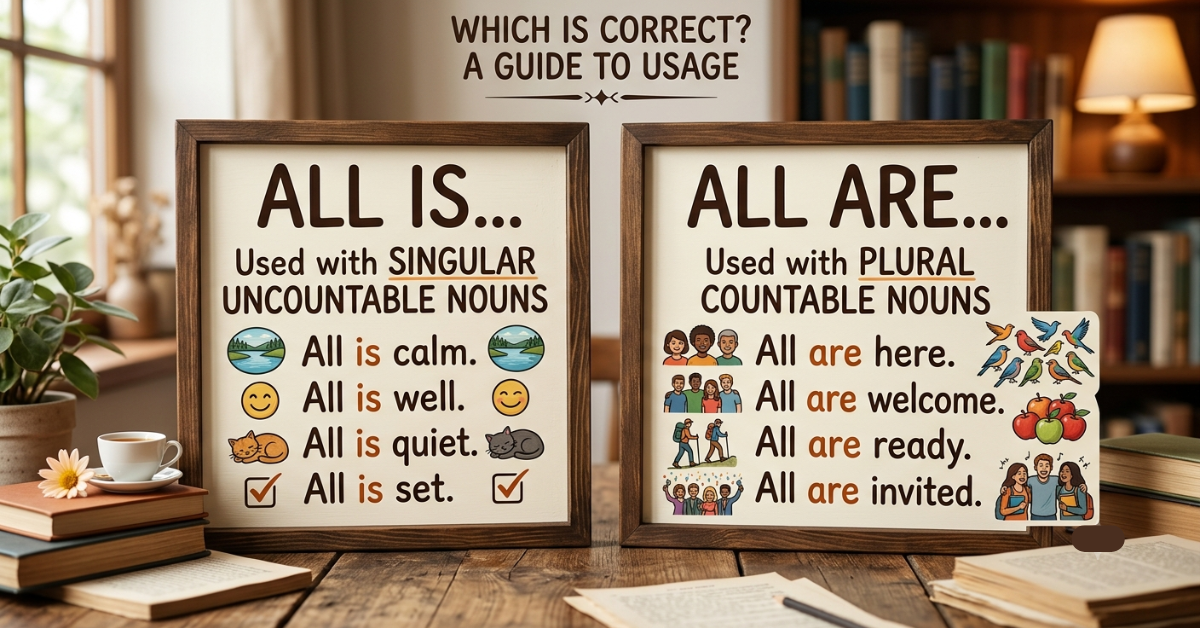
Use all is when you mean one complete situation, condition, or state. In this case, all works like a singular idea.
Examples
- All is well.
- All is ready for the meeting.
- All is quiet now.
- All is lost.
These sentences sound natural because they describe one overall condition. For that reason, the singular verb is fits best.
When to Use “All Are”
Choose all are when all refers to multiple people or things. Here, the meaning is clearly plural, so the plural verb makes sense.
Examples
- All are welcome.
- All are invited to join.
- All are present today.
- All are equal under the law.
Each sentence refers to several individual members of a group. Therefore, are is the correct verb.
All Is or All Are in Everyday English
This grammar point often confuses writers because both forms can sound right at first glance. However, the meaning usually makes the answer clear.
For example, all is done means the task or situation is completely finished. By contrast, all are done suggests that every person or item in the group has finished.
Compare these sentences
- All is calm in the room.
- All are calm in the room.
The first sentence describes the atmosphere as a whole. The second focuses on the people inside the room.
Subject-Verb Agreement Made Simple
At its core, this rule comes down to subject-verb agreement. English verbs must match the number of the subject they describe.
Singular agreement
- All is fine.
- Everything is in order.
- The whole plan is complete.
Plural agreement
- All are fine.
- The students are in order.
- The books are complete.
Even though the word all looks the same in both cases, the meaning behind it changes the verb.
Fixed Expressions You Should Know
Some phrases with all is are so common that they sound completely natural to native speakers.
Common singular expressions
- All is well.
- All is fair in love and war.
- All is not lost.
- All is silent.
These expressions treat all as one complete idea. As a result, the singular verb feels natural.
Meanwhile, plural expressions use are when they refer to multiple people or things.
Common plural expressions
- All are welcome.
- All are invited.
- All are expected to attend.
- All are accounted for.
A Simple Way to Choose the Right Form
A quick test can help you decide between all is or all are. Ask yourself whether the sentence refers to one whole thing or many separate things.
If the idea is complete and unified, use is. If the sentence points to individual people or items, use are.
Try these examples
- All is over → one situation has ended.
- All are over → several people or things are finished.
That small difference in meaning changes the grammar.
Common Mistakes to Avoid
Many learners make the same mistake because they focus only on the word all. Unfortunately, that habit can lead to incorrect verb choice.
Mistake 1
Incorrect: All is waiting outside.
Correct: All are waiting outside.
Mistake 2
Incorrect: All are gone now.
Correct: All is gone now.
Mistake 3
Incorrect: All are fine with the plan.
Correct: All is fine with the plan, if you mean the situation as a whole.
To stay accurate, always look at the meaning of the full sentence before choosing the verb.
Real-World Examples
You will see this rule in formal writing, casual speech, schoolwork, and office communication. Since the context changes, the sentence structure can change too.
In professional writing
- All is ready for the presentation.
- All are asked to review the report carefully.
In casual conversation
- All is good.
- All are here now.
In emails and notices
- All is set for tomorrow.
- All are required to submit the form before noon.
These examples show how flexible the rule can be when you apply it correctly.
Memory Tip That Works
A simple memory trick can make this easier to remember. Think of it like this:
- All is = one whole thing
- All are = many separate things
Another helpful shortcut is to mentally replace all with another word.
- If everything fits, use is
- If everyone or all people fits, use are
This test often makes the answer obvious right away.
Key Takeaways
- The correct form depends on meaning, not just the word all.
- Use all is when you mean one complete state or whole idea.
- Use all are when you mean multiple people or things.
- Fixed phrases like all is well are standard and correct.
- Checking whether the subject is singular or plural in meaning helps you avoid mistakes.
FAQs About All Is or All Are
1. Is “all is well” correct?
Yes, all is well is correct and widely used. It treats all as one complete condition rather than a group of separate items.
2. Which is correct: “all is ready” or “all are ready”?
Both can be correct, depending on meaning. Use all is ready for one complete situation and all are ready for multiple people or things.
3. Why do people say “all is” if “all” sounds plural?
Because all does not always act like a plural subject. In expressions like all is well, it refers to one complete state, so the singular verb is correct.
4. Can I say “all are invited” in formal writing?
Yes, that phrase is perfectly correct in formal writing. It works well when you refer to several people in a group.
5. Is “all is not lost” grammatically correct?
Yes, all is not lost is a correct and common expression. It means the situation is still not hopeless.
6. How can I stop confusing all is or all are?
Focus on meaning first. Ask whether the sentence describes one whole idea or many individual elements, and then choose the verb that matches.
Conclusion
Once you understand the meaning behind the sentence, all is or all are becomes much easier to handle. Use is for one complete situation and are for multiple people or things.
That simple rule can make your writing clearer, more accurate, and more confident. So the next time this grammar question comes up, use the examples above and choose with ease.
Author

linguaezone.com@gmail.com
Related Posts

Kill Two Birds With One Stone Alternative: 50 Better Options
- 0
- 1,569 word
Have you ever paused before saying “kill two birds with one stone” because it sounded too violent or simply didn’t fit the...
Read out all
Happy Sabbath Meaning: A Complete Guide to Its Significance
- 0
- 1,632 word
Have you ever received the message “Happy Sabbath” and wondered what it truly means? Is it simply another way of saying “have...
Read out all
I’m So Proud of You in Other Words: 120+ Heartfelt Alternatives
- 0
- 1,562 word
Have you ever wanted to tell someone you’re proud of them but felt like saying “I’m so proud of you” sounded repetitive?...
Read out all
How Do You Spell Happy Anniversary? Correct Spelling Guide
- 0
- 1,221 word
Have you ever paused before writing an anniversary card and wondered, “How do you spell happy anniversary?” You’re not alone. Whether you’re...
Read out all
Waiting for Your Response Email: Best Examples & Tips
- 0
- 1,483 word
Have you ever sent an important email and found yourself wondering whether you should follow up or simply wait? Whether you’re communicating...
Read out all
Great Asset to the Team: Meaning, Examples & Tips
- 0
- 1,494 word
Have you ever wanted to compliment a coworker but struggled to find words that sound professional and sincere? One of the most...
Read out all