Diddo Meaning: Definition, Origin, and Correct Usage
- 0
- 1,237 word
Have you ever received a text saying “diddo” and wondered if it was a real word? You’re not alone. Many people come across this spelling in chats, social media comments, or casual conversations and aren’t sure what it means.
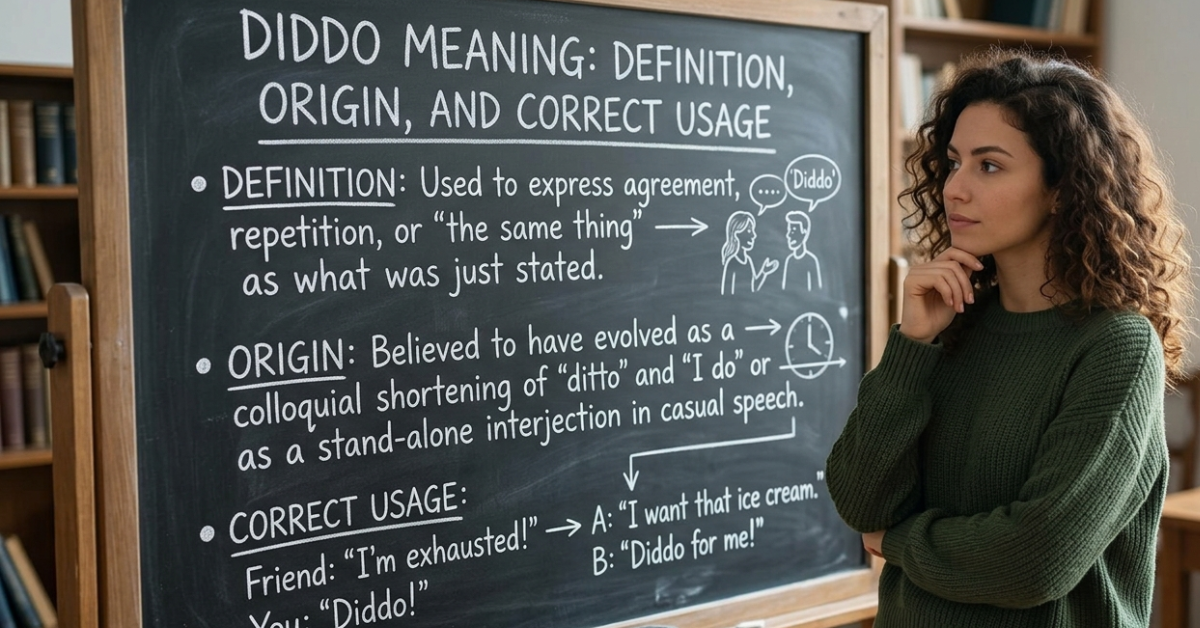
The diddo meaning is surprisingly simple: in most cases, “diddo” is just a misspelling of “ditto.” The intended meaning is usually “the same,” “I agree,” or “me too.” In this guide, you’ll learn what “diddo” means, why people use it, where “ditto” originated, examples of correct usage, common mistakes, and when it’s appropriate to use it in conversation.
What Is the Diddo Meaning?
The most widely accepted diddo meaning is that it refers to the intended word “ditto.”
When someone types diddo, they usually mean:
- Same here
- Me too
- I agree
- Likewise
- The same as what you said
For example:
Person A: “I love traveling to the mountains.”
Person B: “Diddo!”
The intended meaning is:
“Me too!”
Although people understand the message in informal settings, “ditto” is the correct spelling.
Is “Diddo” a Real Word?
In standard English, diddo is not recognized as a dictionary word.
Instead, it’s commonly:
- A typing mistake
- A phonetic spelling of “ditto”
- A casual internet spelling
- An accidental autocorrect result
Because the pronunciation of ditto sounds similar to “diddo” in some accents, many people spell it the way they hear it.
What Does “Ditto” Actually Mean?
The word ditto means:
The same as previously stated.
Instead of repeating information, you simply say “ditto.”
Examples:
- “I enjoyed the movie.”
- “Ditto.”
Meaning:
“I enjoyed it too.”
Another example:
Emma: “I’m exhausted after work.”
Noah: “Ditto.”
Translation:
“I’m exhausted too.”
The Origin of “Ditto”
The word ditto has an interesting history.
It originated from the Italian word detto, meaning:
- Said
- Mentioned
- Already stated
Over time, English speakers adopted the word and began using it in writing to avoid repeating the same information.
Historically, accountants and clerks even used ditto marks (” ) to indicate that the information above should be repeated.
Example:
| Name | City |
| John | London |
| Sarah | “ |
The ditto mark meant Sarah was also from London.
Today, this symbol is less common, but the word ditto remains popular in everyday speech.
Why Do People Spell It “Diddo”?
There are several reasons people write diddo instead of ditto.
1. Pronunciation
In casual speech, the “t” sound often becomes softer.
So:
- Ditto
- Diddo
can sound very similar.
2. Typing Quickly
Texting encourages speed rather than perfect spelling.
Many people accidentally type:
- diddo
- dido
- didooo
instead of ditto.
3. They Have Never Seen the Correct Spelling
Some people learn words by hearing them rather than reading them.
If they’ve only heard friends say “ditto,” they may naturally assume it’s spelled “diddo.”
How Is “Ditto” Used in Everyday Conversation?
Here are some common situations.
Expressing Agreement
Friend: “That restaurant has amazing food.”
You: “Ditto.”
Meaning:
“I completely agree.”
Saying “Me Too”
Coworker: “I’m ready for the weekend.”
You: “Ditto.”
Meaning:
“So am I.”
Responding to Compliments
Person: “Hope you have a wonderful day.”
You: “Ditto!”
Meaning:
“I hope you have a wonderful day too.”
Online Chats
Friend:
“Love this song.”
Reply:
“Ditto”
This is very common in messaging apps.
Diddo vs Ditto
| Diddo | Ditto |
| Misspelling | Correct spelling |
| Not recognized in dictionaries | Official English word |
| Mostly appears in casual texts | Used in speech and writing |
| Avoid in formal writing | Acceptable in most situations |
Whenever you’re writing professionally, always choose ditto.
When Should You Use “Ditto”?
“Ditto” works well in informal communication.
Examples include:
- Text messages
- Casual emails
- Social media
- Friendly conversations
- Family chats
It helps avoid repeating yourself.
Example:
“I’m excited.”
“Ditto.”
Simple and natural.
When Should You Avoid It?
Avoid using ditto in situations requiring precision.
For example:
- Academic papers
- Legal documents
- Research reports
- Business contracts
- Professional reports
Instead of writing:
Ditto
Write the complete information again if clarity is important.
Common Examples of Diddo Meaning
Here are examples where “diddo” is intended to mean “ditto.”
Example 1
Person A:
“I’m hungry.”
Person B:
“Diddo.”
Meaning:
“I’m hungry too.”
Example 2
“I miss summer.”
“Diddo.”
Meaning:
“I miss it as well.”
Example 3
“Hope you enjoy your vacation!”
“Diddo!”
Meaning:
“I hope you enjoy yours too.”
Example 4
“I love coffee.”
“Diddo.”
Meaning:
“Me too.”
Common Synonyms for Ditto
Depending on the situation, you can also say:
- Same
- Likewise
- Me too
- Same here
- I agree
- Absolutely
- Exactly
- So do I
- So am I
- I feel the same
Each carries a slightly different tone, but all express agreement or shared feelings.
Is “Diddo” Ever Correct?
In standard English, no.
However, some people intentionally write diddo:
- As an inside joke
- To imitate pronunciation
- As playful internet slang
- As a nickname or username
Outside these informal contexts, ditto is the preferred spelling.
Common Mistakes People Make
Using “Diddo” in Professional Emails
Incorrect:
Diddo.
Correct:
Ditto.
Or even better:
I agree.
Assuming It’s a Dictionary Word
Many people search for diddo meaning because they believe it’s an official English word.
In reality, dictionaries generally recognize ditto, not diddo.
Overusing Ditto
Although useful, repeating “ditto” constantly can make conversations sound repetitive.
Sometimes phrases like:
- Absolutely
- Same here
- I agree completely
sound more natural.
Practical Tips for Using Ditto Correctly
To use the word naturally:
- Remember that ditto is the correct spelling.
- Reserve it for informal conversations.
- Use it to express agreement or shared feelings.
- Avoid using “diddo” in professional or academic writing.
- Choose more descriptive responses when additional clarity is needed.
Key Takeaways
- Diddo is generally a misspelling of ditto.
- Ditto means “the same,” “me too,” or “I agree.”
- The word comes from the Italian detto.
- “Ditto” is acceptable in casual conversations but should be used carefully in formal writing.
- If you see “diddo” in a text message, the sender almost certainly meant “ditto.”
Frequently Asked Questions
What is the diddo meaning in texting?
In texting, the diddo meaning is almost always “ditto.” It means “same,” “me too,” or “I agree,” and is simply a common misspelling.
Is diddo a real English word?
No. Standard English dictionaries do not recognize diddo as an official word. The correct spelling is ditto.
Why do people type diddo instead of ditto?
People often spell it as “diddo” because of pronunciation, fast typing, autocorrect errors, or because they have only heard the word spoken and never seen it written.
Can I use diddo in professional writing?
It’s best not to. In professional communication, use ditto if appropriate, or write a more explicit response such as “I agree” or “Likewise.”
What is another word for ditto?
Common alternatives include “same here,” “likewise,” “me too,” “I agree,” “exactly,” and “so do I.” The best choice depends on the context and level of formality.
Is “ditto” still commonly used?
Yes. Although it’s less common in formal writing, “ditto” remains widely used in everyday conversations, text messages, and social media to express agreement or shared feelings.
Conclusion
Understanding the diddo meaning helps clear up a common spelling confusion. While many people type diddo in casual conversations, the intended and correct word is ditto, which means “the same,” “me too,” or “I agree.” Knowing the difference ensures your writing is accurate and professional while still allowing you to communicate naturally in everyday conversations.
The next time you see “diddo” in a message, you’ll know it’s almost certainly meant as “ditto”—a simple way of saying you share the same opinion, feeling, or experience.
Author
britsx85@gmail.com
Related Posts
Please Advise Meaning: Proper Usage in Emails & Examples
- 0
- 1,598 word
Have you ever received an email ending with “Please advise” and wondered exactly what the sender meant? Or perhaps you’ve wanted to...
Read out all
TYSM Meaning in Text: What It Means and How to Use It
- 0
- 1,256 word
Have you ever received a message that simply says “TYSM” and wondered what it actually means? You’re not alone. Modern texting is...
Read out all
Happy to Help Meaning: Uses, Replies, and Examples
- 0
- 1,594 word
Have you ever received a message saying, “Happy to help!” after someone answered your question or solved a problem? It’s one of...
Read out all
PU Meaning in Text: What It Means and How to Use It
- 0
- 1,341 word
Have you ever received a message that simply said “PU” and wondered what the sender actually meant? You’re not alone. Text messaging...
Read out all
Have a Safe Journey Meaning: Complete Guide & Examples
- 0
- 1,456 word
Have you ever paused before saying, “Have a safe journey,” and wondered whether it’s the right phrase or what it truly means?...
Read out all
SM Meaning in Chat: What It Really Means in 2026
- 0
- 875 words
Ever received a message like “SM me later” or seen “SM” pop up in a WhatsApp or Instagram chat and felt confused?...
Read out all