
×
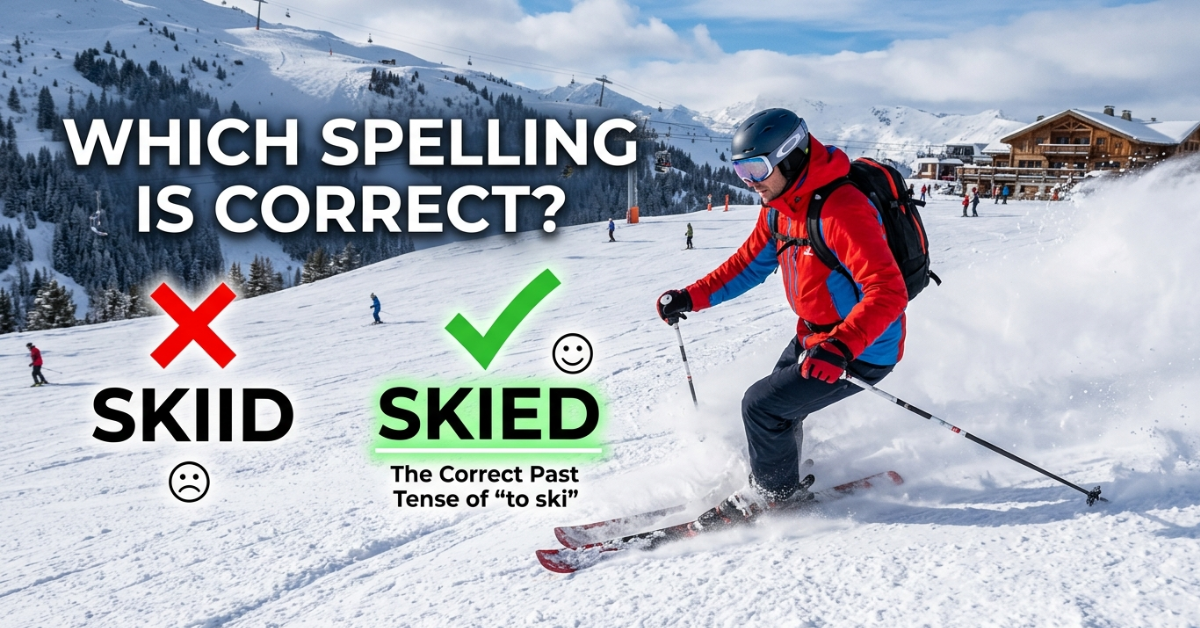
Skiid or Skied: Which Spelling Is Correct?
In

Have you ever typed “skiid” into a document only to see a red underline appear? You’re not alone. English spelling can be tricky, especially when verbs change form in ways that aren’t always obvious.

If you’ve been wondering whether skiid or skied is the correct spelling, this guide will clear up the confusion. You’ll learn the correct past tense of ski, why some people mistakenly write skiid, the grammar rule behind the spelling change, practical examples, and easy tips to help you remember it.

Is It Skiid or Skied?

The correct spelling is skied.

Skiid is not a recognized English word and is considered a spelling mistake.

Here’s the difference:

Word Correct? Meaning
Skied  Yes Past tense and past participle of ski
Skiid  No Incorrect spelling

Examples

  • We skied in the Alps last winter.
  • They skied for six hours without stopping.
  • She has skied since she was five years old.

Incorrect:

  •  We skiid all weekend.
  •  She has skiid before.

Understanding the Verb “Ski”

The verb ski means to travel over snow using skis. It can also refer to water skiing, depending on the context.

Verb forms:

Form Word
Base form Ski
Third-person singular Skis
Present participle Skiing
Past tense Skied
Past participle Skied

Unlike many verbs ending in -y, the verb ski ends with the vowel combination -i, which follows a different spelling pattern.

Why Is It “Skied” Instead of “Skiid”?

The confusion comes from how English forms the past tense of verbs ending in -i.

For most regular verbs, you simply add -ed to the base verb.

Since the word already ends in i, adding ed creates:

ski + ed = skied

It does not become:

ski + id = skiid

English spelling conventions recognize skied as the standard form.

The Grammar Rule Behind “Skied”

Most regular English verbs form the past tense by adding -ed.

Examples:

  • Walk → Walked
  • Jump → Jumped
  • Cook → Cooked
  • Ski → Skied

Although skied may look unusual because of the consecutive vowels, it follows the normal rule for regular verbs.

Why People Write “Skiid”

Several factors contribute to this common mistake.

1. Pronunciation Confusion

People hear the long “ee” sound and assume another “i” should be added.

2. Typing Errors

Fast typing often leads to accidental double letters.

3. Pattern Assumptions

Some writers incorrectly apply spelling rules from unrelated verbs.

4. Lack of Familiarity

Since skiing isn’t an everyday topic for everyone, many people simply haven’t encountered the correct spelling often enough.

Examples of “Skied” in Sentences

Using the correct form helps make your writing look polished and professional.

Simple Past

  • We skied across the mountain yesterday.
  • They skied throughout the holiday.
  • My family skied during winter vacation.

Present Perfect

  • I have skied in Canada twice.
  • She has skied since childhood.
  • They have skied in several countries.

Past Perfect

  • By noon, we had skied nearly twenty kilometers.
  • He had skied before moving to a warmer climate.

Common Mistakes to Avoid

Here are mistakes that frequently appear in writing.

Incorrect

  • I skiid yesterday.
  • We have skiid before.
  • They were skiid all afternoon.

Correct

  • I skied yesterday.
  • We have skied before.
  • They were skiing all afternoon.

Notice that skiing, not skied, is used after forms of were when describing an ongoing action.

Ski vs. Skiing vs. Skied

Understanding all three forms makes grammar much easier.

Word Part of Speech Example
Ski Base verb I love to ski every winter.
Skiing Present participle/Gerund Skiing is my favorite hobby.
Skied Past tense/Past participle We skied last weekend.

Easy Trick to Remember

A simple memory trick is:

If you did it yesterday, you skied.

Just remember:

Ski + ed = Skied

Never double the i.

Real-World Usage

Travel blogs, winter sports magazines, news articles, and ski resort websites consistently use skied.

For example:

  • Families skied during the Christmas holidays.
  • Athletes skied through challenging mountain terrain.
  • Tourists skied in snowy resorts across Europe.

You’ll rarely, if ever, find skiid in professionally edited publications because it isn’t a correct English spelling.

Similar Verbs That Follow Regular Rules

Here are other regular verbs that simply add -ed.

Base Verb Past Tense
Visit Visited
Camp Camped
Climb Climbed
Hike Hiked
Train Trained
Ski Skied

Although skied looks slightly different because of the ending, it follows the same grammatical principle.

Why Correct Spelling Matters

Using the correct word improves:

  • Professional communication
  • Academic writing
  • Job applications
  • Travel blogs
  • Social media captions
  • Business emails

Even a small spelling error can distract readers or reduce credibility, especially in formal writing.

Tips to Avoid This Mistake

Here are a few practical ways to remember the correct spelling:

  • Learn the complete verb forms rather than just the base word.
  • Read professionally edited content regularly.
  • Use spell-check tools as a second line of defense.
  • Practice writing example sentences.
  • Remember that regular verbs usually take -ed in the past tense.

Quick Comparison

Feature Skied Skiid
Correct English spelling Yes No
Dictionary word Yes No
Past tense of ski Yes No
Accepted in formal writing Yes No
Should you use it? Yes Never

Key Takeaways

  • Skied is the correct past tense and past participle of ski.
  • Skiid is a misspelling and should be avoided.
  • The verb follows the regular rule of adding -ed.
  • Professional writers, educators, and dictionaries all recognize skied as the standard spelling.
  • Remember the simple formula: ski + ed = skied.

Frequently Asked Questions

Is skiid ever correct?

No. Skiid is not an accepted English word. The correct spelling is skied in both American and British English.

Why is it spelled skied instead of skiid?

English forms the past tense of the regular verb ski by adding -ed, creating skied. Doubling the i is not part of standard English spelling rules.

Is skied the past tense of ski?

Yes. Skied serves as both the simple past tense and the past participle of the verb ski.

Examples:

  • We skied yesterday.
  • We have skied before.

What is the difference between skiing and skied?

Skiing refers to an ongoing action or the activity itself, while skied describes a completed action in the past.

Example:

  • We were skiing all morning.
  • We skied all morning.

Does British English use skiid?

No. Both British and American English use skied. The spelling skiid is incorrect in both varieties.

Why do people search for “skiid or skied”?

Many people are unsure how to form the past tense of verbs ending in -i. Since skied looks unusual, it’s common to question whether skiid might be correct.

Conclusion

When choosing between skiid or skied, the answer is straightforward: skied is the only correct spelling. It follows the standard rule for forming the past tense of the regular verb ski by adding -ed, while skiid is simply a common misspelling.

Understanding this small but important distinction can improve your grammar, strengthen your writing, and help you communicate more confidently. The next time you describe a winter adventure, you’ll know exactly which word to use: We skied down the mountain—never we skiid.

Leave a Reply

Your email address will not be published. Required fields are marked *

Author

britsx85@gmail.com

Related Posts

Benefited or Benefitted: Which Spelling Is Correct?
In

Benefited or Benefitted: Which Spelling Is Correct?

Have you ever paused mid-sentence and wondered whether to write benefited or benefitted? You are not alone. This is one of those...

Read out all
Dialogue Spelling: Correct Usage, Meaning & Examples
In

Dialogue Spelling: Correct Usage, Meaning & Examples

Have you ever stopped while writing and wondered whether it’s dialogue or dialog? You’re not alone. It’s one of the most common...

Read out all
Cacoon or Cocoon: Which Spelling Is Correct?
In

Cacoon or Cocoon: Which Spelling Is Correct?

Have you ever typed cacoon or cocoon into a search bar and wondered which spelling is actually correct? You’re not alone. It’s...

Read out all
Proportion vs Portion: Meaning, Differences & Easy Examples
In

Proportion vs Portion: Meaning, Differences & Easy Examples

Have you ever paused mid-sentence and wondered whether to write portion or proportion? It happens more often than you might think. Although...

Read out all
Favourite or Favorite: Which Spelling Is Correct?
In

Favourite or Favorite: Which Spelling Is Correct?

Have you ever paused while writing an email or social media post and wondered, “is it favourite or favorite?” You’re not alone....

Read out all
Aswell or As Well: Which One Is Correct?
In

Aswell or As Well: Which One Is Correct?

Have you ever paused while typing and wondered whether you should write aswell or as well? You’re not alone. It’s one of...

Read out all