
Trama vs Trauma: Meaning, Differences, and Common Mistakes
- 0
- 1,361 word
Have you ever typed a word into a search engine only to wonder if you spelled it correctly? If you’ve searched trama vs trauma, you’re not alone. Thousands of people make this exact mistake every month because the two words look and sound similar.
The good news is that the confusion is easy to clear up. In this guide, you’ll learn what “trauma” actually means, whether “trama” is a real word, why the spelling mistake is so common, and how to remember the correct version forever. You’ll also see practical examples, common usage mistakes, and answers to frequently asked questions.
Understanding Trama vs Trauma
At first glance, the difference between these two words seems tiny—just one missing letter. However, that single letter completely changes whether the word is correct.
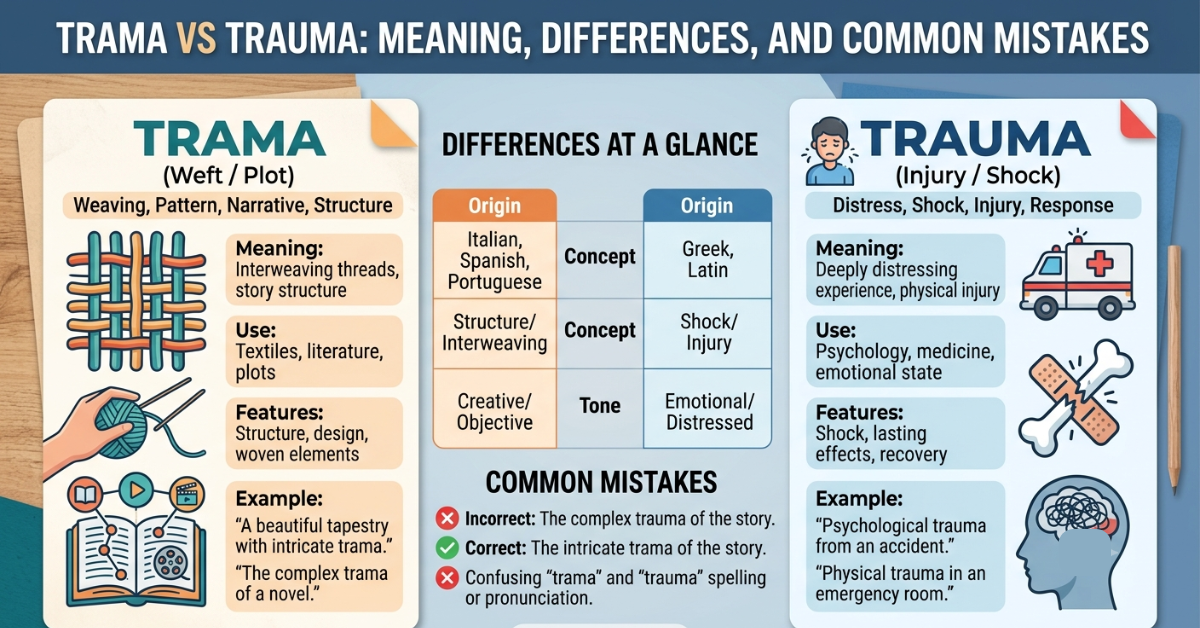
| Word | Is it Correct? | Meaning |
| Trauma | Yes | Physical or psychological injury or distress |
| Trama | Usually No | Most often a misspelling of “trauma” |
In standard English, trauma is the correct spelling. Most searches for “trama” are simply spelling errors.
What Does Trauma Mean?
Trauma refers to serious physical injury or emotional distress caused by a deeply disturbing experience. The meaning depends on the context.
Physical Trauma
In medicine, trauma describes bodily injuries caused by accidents, falls, burns, violence, or other external forces.
Examples include:
- Broken bones after a car accident
- Head injuries
- Severe burns
- Internal bleeding
Doctors often use phrases like:
- blunt trauma
- chest trauma
- spinal trauma
- trauma center
Emotional or Psychological Trauma
In mental health, trauma describes the emotional impact of frightening or overwhelming experiences.
Examples include:
- Childhood abuse
- Natural disasters
- Serious accidents
- Military combat
- Domestic violence
- Sudden loss of a loved one
Not everyone experiences trauma in the same way. Two people may go through the same event but respond very differently depending on personal, biological, and environmental factors.
Is “Trama” a Real Word?
In standard English dictionaries, trama is generally not recognized as an English word.
Most uses fall into one of these categories:
- A typing error
- A spelling mistake
- An autocorrect issue
- A search query where the user intended to write “trauma”
However, “trama” may appear in certain languages with different meanings.
For example:
- In Spanish, trama means “plot” or “storyline.”
- In Italian, trama also refers to the plot of a novel, film, or play.
This often causes additional confusion for multilingual speakers.
Why Do People Search for Trama vs Trauma?
There are several reasons this spelling confusion happens so frequently.
1. Similar Pronunciation
When spoken quickly, the “u” in trauma isn’t always strongly pronounced, making it sound similar to “trama.”
2. Fast Typing
People frequently omit letters while typing on phones or keyboards.
3. Autocorrect Errors
Some devices mistakenly save incorrect spellings after repeated use.
4. Language Influence
Speakers of Spanish or Italian may already know the word “trama,” leading them to accidentally use it in English.
Trauma in Different Contexts
The word trauma appears across many fields.
Medical Context
Medical professionals use trauma to describe severe physical injuries requiring immediate treatment.
Examples:
- Trauma surgery
- Trauma patient
- Trauma unit
- Trauma assessment
Psychology
Mental health professionals use trauma to describe emotional wounds that may continue affecting someone’s thoughts, emotions, and behavior long after an event.
Common terms include:
- emotional trauma
- psychological trauma
- childhood trauma
- complex trauma
Everyday Conversation
People also use trauma informally to describe upsetting experiences.
Example:
“Moving to a new country was emotionally challenging.”
While people sometimes casually say they’re “traumatized” by minor inconveniences, it’s important to recognize that clinical trauma is much more serious.
Types of Trauma
Trauma isn’t one-size-fits-all. Experts generally recognize several forms.
Acute Trauma
Results from a single distressing event.
Examples:
- Car accidents
- Violent attacks
- Natural disasters
Chronic Trauma
Develops after repeated exposure to stressful or harmful situations.
Examples:
- Long-term abuse
- Ongoing neglect
- Continuous bullying
Complex Trauma
Occurs after multiple traumatic experiences, often during childhood or over extended periods.
Complex trauma can affect:
- relationships
- emotional regulation
- self-esteem
- trust
Secondary Trauma
Sometimes people experience emotional distress after witnessing another person’s trauma.
This often affects:
- healthcare workers
- therapists
- emergency responders
- caregivers
Common Examples of Trauma
Trauma can result from many life events, including:
- Serious accidents
- Physical assault
- Sexual violence
- War
- Terrorism
- Domestic abuse
- Childhood neglect
- Medical emergencies
- Sudden bereavement
- Natural disasters
It’s important to remember that trauma is defined by an individual’s response—not simply by the event itself.
Symptoms of Emotional Trauma
Trauma affects both the mind and body.
Common emotional symptoms include:
- Anxiety
- Fear
- Sadness
- Anger
- Emotional numbness
- Guilt
Physical symptoms may include:
- Trouble sleeping
- Fatigue
- Headaches
- Rapid heartbeat
- Difficulty concentrating
Behavioral signs may involve:
- Social withdrawal
- Avoiding reminders
- Irritability
- Loss of interest in hobbies
Symptoms vary widely between individuals.
How Trauma Is Treated
Recovery is possible, although the process differs for everyone.
Treatment options often include:
- Professional counseling
- Cognitive Behavioral Therapy (CBT)
- Trauma-focused therapy
- Eye Movement Desensitization and Reprocessing (EMDR)
- Medication when appropriate
- Support groups
- Healthy coping strategies
Early support often improves long-term outcomes.
Easy Trick to Remember the Correct Spelling
A simple memory trick can help.
TraUma = U for Upsetting experiences.
If the word refers to injury or emotional distress, remember the “U” in trauma.
Without the “U,” you’re probably making a spelling mistake in English.
Common Mistakes People Make
Here are a few examples.
Incorrect:
- trama healing
- trama therapy
- emotional trama
- childhood trama
Correct:
- trauma healing
- trauma therapy
- emotional trauma
- childhood trauma
Trama vs Trauma Comparison
| Feature | Trama | Trauma |
| English spelling | Incorrect (usually) | Correct |
| Medical meaning | No | Yes |
| Psychological meaning | No | Yes |
| Found in English dictionaries | Usually no | Yes |
| Used in healthcare | No | Yes |
| Exists in Spanish and Italian | Yes (different meaning) | No |
Practical Tips to Avoid the Mistake
To remember the correct spelling:
- Think of TraUma with the “U.”
- Use spell-check when writing.
- Read the word aloud slowly.
- Practice writing it correctly several times.
- Remember that medical and psychology professionals always use trauma.
Why Correct Spelling Matters
Correct spelling improves:
- Communication
- Academic writing
- Professional documents
- Medical records
- Search engine results
- Credibility
Searching for the correct word also helps you find more accurate health information.
Key Takeaways
- Trauma is the correct English spelling.
- Trama is usually a misspelling in English.
- Trauma can refer to physical injury or emotional distress.
- The word appears frequently in medicine and psychology.
- Remember the “U” in trauma to avoid spelling mistakes.
- In Spanish and Italian, “trama” has an entirely different meaning related to a story’s plot.
Frequently Asked Questions
Is trama a correct English word?
Generally, no. In English, “trama” is almost always a misspelling of “trauma.” However, it is a legitimate word in some other languages, such as Spanish and Italian.
What is the difference between trama vs trauma?
The difference is simple: trauma is the correct English word referring to physical or emotional injury, while trama is usually a spelling mistake in English.
Why do people spell trauma as trama?
People often omit the letter “U” when typing quickly, relying on autocorrect, or because of pronunciation similarities. Multilingual speakers may also confuse it with the Spanish or Italian word “trama.”
Does trauma only refer to mental health?
No. Trauma can describe both physical injuries and psychological distress. Medical professionals use the term for bodily injuries, while mental health professionals use it for emotional experiences.
How can I remember the correct spelling?
Think of TraUma with the “U” representing “upsetting.” This simple memory trick makes the correct spelling easier to recall.
Is childhood trauma different from adult trauma?
Both involve distressing experiences, but childhood trauma often occurs during critical stages of development and may have long-lasting effects on emotional, social, and cognitive growth if left unaddressed.
Conclusion
Understanding trama vs trauma is easier than it first appears. In English, trauma is the correct spelling and refers to physical injury, emotional distress, or psychological harm. By contrast, trama is almost always a spelling error unless you’re using it in another language where it carries a different meaning.
Using the correct term improves your writing, helps you find accurate information, and ensures clear communication. Whether you’re writing an essay, searching for health resources, or simply expanding your vocabulary, remembering the extra “U” in trauma is a small detail that makes a significant difference.
Author
britsx85@gmail.com
Related Posts
Benefited or Benefitted: Which Spelling Is Correct?
- 0
- 997 words
Have you ever paused mid-sentence and wondered whether to write benefited or benefitted? You are not alone. This is one of those...
Read out all
Dialogue Spelling: Correct Usage, Meaning & Examples
- 0
- 1,316 word
Have you ever stopped while writing and wondered whether it’s dialogue or dialog? You’re not alone. It’s one of the most common...
Read out all
Cacoon or Cocoon: Which Spelling Is Correct?
- 0
- 1,243 word
Have you ever typed cacoon or cocoon into a search bar and wondered which spelling is actually correct? You’re not alone. It’s...
Read out all
Proportion vs Portion: Meaning, Differences & Easy Examples
- 0
- 1,136 word
Have you ever paused mid-sentence and wondered whether to write portion or proportion? It happens more often than you might think. Although...
Read out all
Favourite or Favorite: Which Spelling Is Correct?
- 0
- 1,308 word
Have you ever paused while writing an email or social media post and wondered, “is it favourite or favorite?” You’re not alone....
Read out all
Aswell or As Well: Which One Is Correct?
- 0
- 1,345 word
Have you ever paused while typing and wondered whether you should write aswell or as well? You’re not alone. It’s one of...
Read out all