
×
Leak vs Leek: Meaning, Difference & Easy Guide
In

Have you ever seen the words leak and leek and wondered why they look almost identical but mean completely different things? This confusion is more common than you think. The topic leak vs leek often trips up English learners because the two words are spelled almost the same but belong to totally different categories.

In this guide, we’ll break down the difference between these two words in a simple, practical way. By the end, you’ll clearly understand when to use leak and when to refer to a leek without second-guessing yourself.

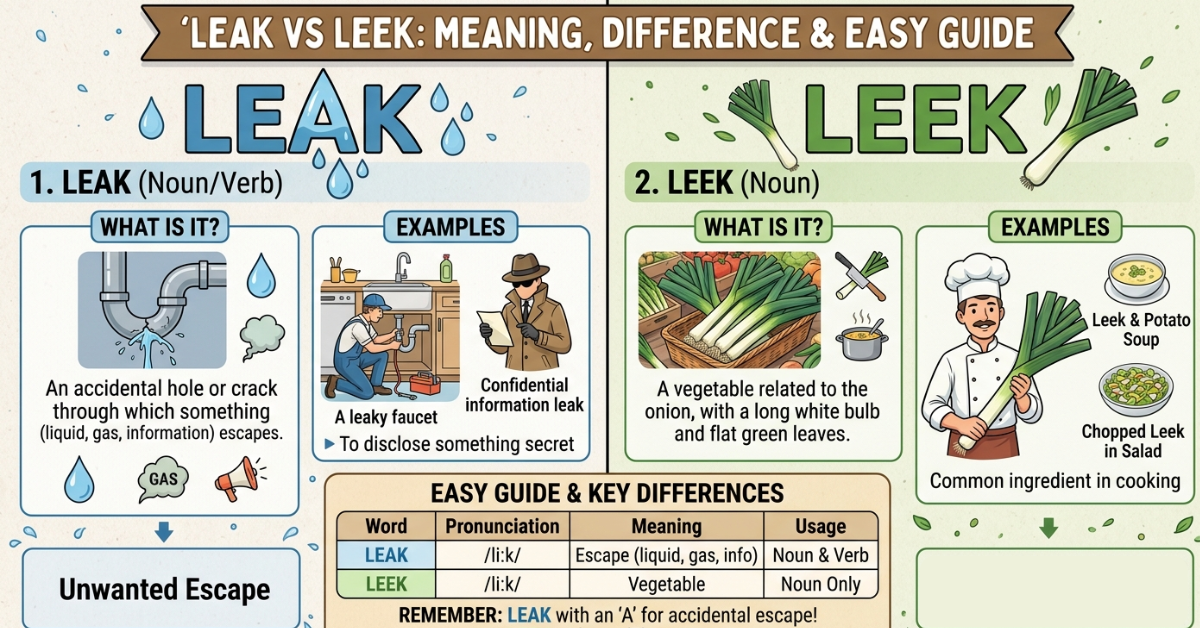
What Does “Leak” Mean?

A leak refers to the escape of a liquid, gas, or information through an unintended opening. It can be physical, digital, or even metaphorical.

Common meanings of “leak”:

  • Water dripping from a pipe or roof
  • Gas escaping from a container
  • Private information being revealed without permission

Examples:

  • There is a water leak in the kitchen ceiling.
  • The company suffered a data leak last night.
  • The tire has a slow air leak.

So, leak is mostly about something escaping where it shouldn’t.

What Does “Leek” Mean?

A leek is a type of vegetable that belongs to the onion family. It looks like a large green onion but has a milder taste.

Key facts about leek:

  • Used in soups, salads, and cooking dishes
  • Has a long white stem and green leafy top
  • Popular in European cuisine

Example:

  • She added chopped leek to the soup for extra flavor.

Unlike leak, this word is strictly related to food and cooking.

Leak vs leek: Key Differences

The confusion between leak vs leek usually comes from their spelling similarity, but their meanings are completely unrelated.

Main differences:

  • Leak = escape of liquid, gas, or information
  • Leek = edible vegetable from the onion family
  • Leak is mostly used in technical or everyday problem situations
  • Leek is used in cooking and food contexts

Simple trick to remember:

  • If it involves damage or escape, think leak
  • If it involves food or cooking, think leek

Understanding leak vs leek becomes easy once you connect each word with its context instead of its spelling.

Common Mistakes People Make

Many learners mix up these words in writing or speech, especially when typing quickly.

Frequent errors:

  • Writing “leek” instead of “leak” in technical reports
  • Confusing spelling in exams or emails
  • Auto-correct replacing the intended word

To avoid mistakes:

  • Double-check context before using the word
  • Practice using both words in sentences
  • Remember that only one relates to food

Memory Tricks to Remember the Difference

Here are a few easy ways to remember the difference:

  1. “A leak leaves the system” – something escapes
  2. “A leek is green like a vegetable” – food association
  3. Visualize a pipe dripping for leak
  4. Visualize a soup with vegetables for leek

These simple mental images make spelling and usage much easier.

FAQs

1. What is the main difference in leak vs leek?

The main difference is meaning: leak refers to escaping substances or information, while leek is a vegetable.

2. Is leek used in cooking?

Yes, leek is commonly used in soups, stews, and various savory dishes.

3. Can leak be used for information?

Yes, leak can also refer to secret or confidential information being revealed.

4. Why do people confuse leak vs leek?

They are spelled almost the same and pronounced similarly, which causes confusion in writing.

Conclusion

To sum up, mastering leak vs leek is all about understanding context. One word deals with unwanted escape or exposure, while the other refers to a healthy green vegetable used in cooking. Once you connect each word with its meaning, the confusion disappears quickly.

Keep practicing with real examples, and soon you’ll never mix them up again.

Leave a Reply

Your email address will not be published. Required fields are marked *

Author

britsx85@gmail.com

Related Posts

Knead vs Need: Meaning, Difference & Usage Guide
In

Knead vs Need: Meaning, Difference & Usage Guide

English can be tricky, especially when two words sound the same but mean completely different things. One such confusing pair is Knead...

Read out all
Jam vs Jamb: Meaning, Difference & Usage Explained
In

Jam vs Jamb: Meaning, Difference & Usage Explained

The confusion around jam vs jamb is more common than you might think, especially among English learners and even native speakers. At...

Read out all
Incite vs Insight: Meaning, Difference & Usage Explained
In

Incite vs Insight: Meaning, Difference & Usage Explained

Have you ever stumbled while writing and wondered whether to use incite vs insight? You’re not alone. These two words sound similar...

Read out all
Idle vs Idol: Meaning, Difference & Usage Guide
In

Idle vs Idol: Meaning, Difference & Usage Guide

The confusion between idle vs idol is more common than you might think, especially in spoken and written English where both words...

Read out all
Hanged vs Hung: Meaning, Grammar & Usage Explained
In

Hanged vs Hung: Meaning, Grammar & Usage Explained

The confusion between hanged vs hung often troubles English learners and even native speakers. Many people mix them up because both forms...

Read out all
Hanger vs Hangar: Meaning, Differences & Usage Guide
In

Hanger vs Hangar: Meaning, Differences & Usage Guide

If you’ve ever paused while writing and wondered whether it’s hanger or hangar, you’re not alone. The confusion is surprisingly common because...

Read out all