
- 0
- 1,052 word
English is full of words that sound alike but carry completely different meanings. One common example is lean vs lien. At first glance, these words may seem interchangeable because they are pronounced similarly, but they belong to entirely different contexts.
Understanding the difference between these two terms can improve your writing, communication, and confidence in using English correctly. In this guide, you’ll learn what each word means, how to use them properly, common mistakes to avoid, and simple examples that make the distinction easy to remember.
Whether you are a student, writer, business professional, or simply someone trying to sharpen your grammar skills, this article will help you master these confusing words once and for all.
What Does “Lean” Mean?
The word lean has several meanings depending on how it is used in a sentence. It can function as a verb, adjective, or noun.
Lean as a Verb
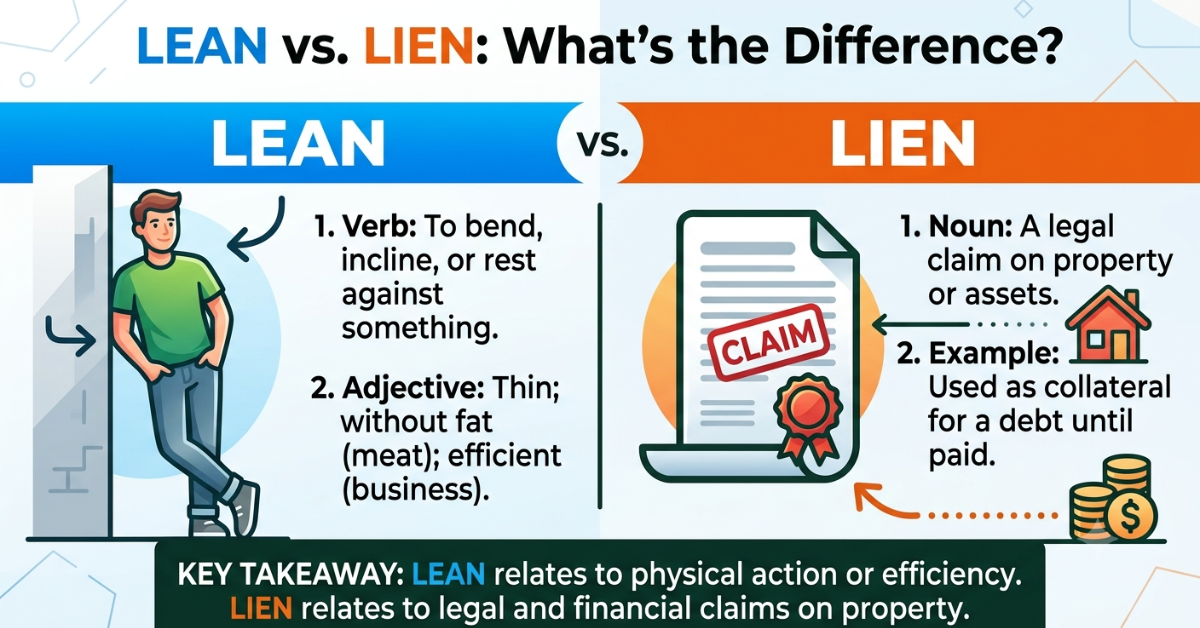
As a verb, it means to rest or tilt against something for support.
Examples:
- She leaned against the wall after a long walk.
- Don’t lean on the glass door.
It can also mean to depend on someone emotionally or mentally.
Example:
- During difficult times, he leaned on his friends for support.
Lean as an Adjective
As an adjective, it often describes something thin, fit, or lacking extra fat.
Examples:
- He has a lean body because he exercises regularly.
- Lean meat is considered healthier than fatty meat.
It may also describe something limited or minimal.
Example:
- The company went through a lean financial period last year.
What Does “Lien” Mean?
A lien is a legal claim placed on property or assets until a debt is paid. This term is commonly used in law, banking, real estate, and finance.
If someone owes money, a lender or creditor may place a lien on their property as security.
Simple Definition
A lien gives another party the legal right to keep or claim property until payment is completed.
Examples:
- The bank placed a lien on the house due to unpaid loans.
- Contractors sometimes file a lien if they are not paid for their work.
Unlike “lean,” this word is almost always used in legal or financial discussions.
Key Differences Between Lean and Lien
Although the pronunciation is similar, the meanings are completely unrelated.
| Feature | Lean | Lien |
|---|---|---|
| Meaning | To tilt, depend, or be thin | A legal claim on property |
| Part of Speech | Verb, adjective, noun | Noun |
| Common Context | Fitness, posture, support | Law, finance, property |
| Example | Lean against the chair | A tax lien on a house |
Why People Confuse These Words
The confusion mostly happens because the two words sound almost identical when spoken aloud. These are known as homophones or near-homophones in English.
Another reason is spelling similarity. Both words are short, four-letter terms with similar pronunciation patterns.
However, remembering the context makes the difference much easier:
- If the sentence relates to posture, health, support, or body shape, the correct word is usually “lean.”
- If the sentence involves debt, legal claims, or property, “lien” is the right choice.
Common Examples in Everyday Usage
Sentences Using “Lean”
- Please do not lean over the balcony.
- Athletes often prefer lean protein in their diets.
- She tends to lean toward creative solutions.
Sentences Using “Lien”
- The unpaid taxes resulted in a property lien.
- The mechanic kept the car under a lien until payment was made.
- A mortgage lien protects the lender’s financial interest.
Easy Memory Tricks
Remembering the difference does not have to be difficult.
Trick for “Lean”
Think of the letter “A” in lean as standing for:
- Angle
- Against
- Athletic
These ideas connect with posture and body shape.
Trick for “Lien”
Think of the letter “I” in lien as standing for:
- Investment
- Insurance
- Interest
These relate to money and legal claims.
Lean in Fitness and Health
The word “lean” is especially common in health and fitness discussions.
Common Fitness Uses
- Lean muscle
- Lean protein
- Lean diet
People often use the term to describe a healthy body composition with lower fat levels and stronger muscle tone.
Example:
- A balanced diet and exercise routine can help build lean muscle.
Lien in Legal and Financial Contexts
A lien is important in business and property law.
Types of Liens
1. Tax Lien
Placed by the government for unpaid taxes.
2. Mortgage Lien
Used by lenders until a home loan is fully paid.
3. Mechanic’s Lien
Filed by contractors or workers who have not received payment.
These legal claims help protect creditors from financial loss.
Pronunciation Guide
Even though the meanings differ, pronunciation can sound very close.
- Lean → /leen/
- Lien → /lee-en/ or sometimes /leen/
Because spoken English varies by accent and region, context becomes very important when listening.
Grammar Tips for Correct Usage
Here are a few practical grammar tips to avoid mistakes:
Use “Lean” When:
- Talking about movement or posture
- Describing body type
- Referring to support or preference
Use “Lien” When:
- Discussing legal claims
- Talking about debt or property
- Referring to financial obligations
Double-checking the sentence topic usually prevents errors.
Common Mistakes to Avoid
Incorrect:
- The bank placed a lean on the property.
Correct:
- The bank placed a lien on the property.
Incorrect:
- He has a lien physique.
Correct:
- He has a lean physique.
These examples show how changing just one letter can completely alter the meaning.
FAQs
Is lien pronounced the same as lean?
In many accents, yes. However, some speakers pronounce lien with two syllables.
Can lean and lien ever mean the same thing?
No. They have completely different meanings and uses.
Is lien a legal term?
Yes. It is primarily used in legal and financial contexts.
What does lean mean in fitness?
It usually refers to low body fat and healthy muscle definition.
How do I remember the difference quickly?
Associate “lean” with posture or fitness and “lien” with loans or legal claims.
Conclusion
Understanding lean vs lien is easier once you focus on context. One relates to posture, support, and physical condition, while the other belongs to the world of finance and law.
Although they sound similar, their meanings are entirely separate. Learning the distinction helps improve grammar, writing accuracy, and everyday communication.
The next time you encounter these words, pause and think about the topic of the sentence. Is it about movement and health, or debt and property? That quick check will help you choose the correct word confidently every time.
Author

linguaezone.com@gmail.com
Related Posts

Kill Two Birds With One Stone Alternative: 50 Better Options
- 0
- 1,569 word
Have you ever paused before saying “kill two birds with one stone” because it sounded too violent or simply didn’t fit the...
Read out all
Happy Sabbath Meaning: A Complete Guide to Its Significance
- 0
- 1,632 word
Have you ever received the message “Happy Sabbath” and wondered what it truly means? Is it simply another way of saying “have...
Read out all
I’m So Proud of You in Other Words: 120+ Heartfelt Alternatives
- 0
- 1,562 word
Have you ever wanted to tell someone you’re proud of them but felt like saying “I’m so proud of you” sounded repetitive?...
Read out all
How Do You Spell Happy Anniversary? Correct Spelling Guide
- 0
- 1,221 word
Have you ever paused before writing an anniversary card and wondered, “How do you spell happy anniversary?” You’re not alone. Whether you’re...
Read out all
Waiting for Your Response Email: Best Examples & Tips
- 0
- 1,483 word
Have you ever sent an important email and found yourself wondering whether you should follow up or simply wait? Whether you’re communicating...
Read out all
Great Asset to the Team: Meaning, Examples & Tips
- 0
- 1,494 word
Have you ever wanted to compliment a coworker but struggled to find words that sound professional and sincere? One of the most...
Read out all