
- 0
- 731 words
English can be tricky, especially when two words sound the same but mean completely different things. One such confusing pair is Knead vs Need. At first glance, they might seem similar, but their meanings are worlds apart. Understanding Knead vs Need is essential for clear writing and accurate communication, especially in exams, professional writing, and everyday conversations.
In this article, we’ll break down their meanings, usage, examples, and easy memory tricks so you never confuse them again.
Knead vs Need: What’s the Difference?
The confusion between Knead vs Need mainly comes from pronunciation—they sound identical, but their spelling and meanings are completely different.
What does “Knead” mean?
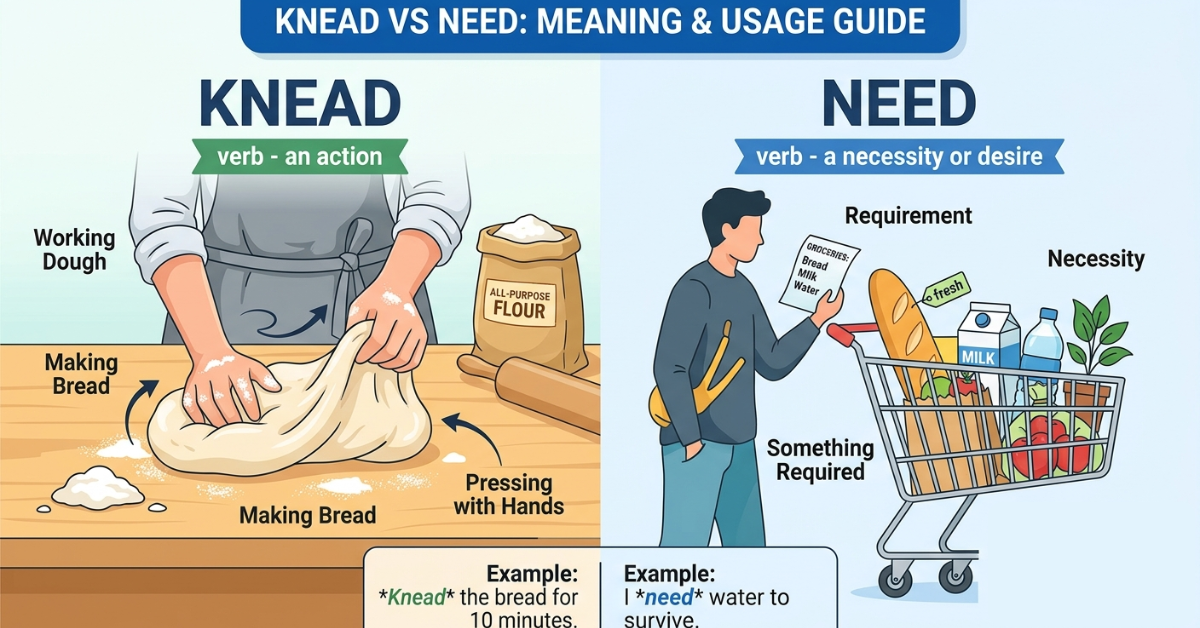
“Knead” refers to the physical action of working dough or similar substances using your hands. It is commonly used in cooking and baking.
Examples of Knead:
- You need to knead the dough for soft bread.
- She learned how to knead pizza dough properly.
What does “Need” mean?
“Need” refers to something that is required or necessary. It is used in daily communication to express necessity or importance.
Examples of Need:
- I need water after a long walk.
- You need to study for your exams.
Understanding Knead vs Need helps avoid spelling mistakes that can change the meaning of your sentence completely.
Why Do People Confuse Knead and Need?
Many learners mix up Knead vs Need because:
- They are homophones (same pronunciation, different meanings)
- They are used in completely different contexts
- Autocorrect sometimes fails to catch the mistake
- Both words appear frequently in writing and speech
This confusion is normal, but once you understand the context, it becomes easy to differentiate.
Real-Life Usage Examples of Knead vs Need
To fully understand Knead vs Need, let’s look at how each word is used in real-life situations.
Everyday Examples of “Knead”
- Bakers knead dough to improve texture.
- You must knead clay before shaping it into pottery.
- The chef showed how to properly knead the mixture.
Everyday Examples of “Need”
- I need help with this assignment.
- We need to leave early for the meeting.
- Children need proper nutrition to grow healthy.
These examples show how context determines the correct word choice.
Simple Tricks to Remember Knead vs Need
If you still struggle, here are some easy memory tricks:
1. Link “Knead” with Kitchen
- “Knead” contains a silent “k,” just like some hidden steps in baking.
- Think: Kitchen = Knead = Dough
2. Link “Need” with Necessity
- “Need” starts with “N,” just like “Necessary.”
- If something is required, you need it.
3. Visual Memory Trick
- Imagine hands pressing dough when you hear “knead.”
- Imagine urgency or importance when you hear “need.”
These simple associations can make a huge difference in remembering it correctly.
Common Mistakes People Make
Even fluent English speakers sometimes slip up. Here are common errors:
- Using “need” when talking about cooking
- Using “knead” in formal or academic writing instead of “need”
- Relying only on pronunciation instead of meaning
- Ignoring context clues in sentences
Avoiding these mistakes will improve both your writing and speaking accuracy.
Quick Comparison Table
| Feature | Knead | Need |
| Meaning | To work dough or clay | To require something |
| Usage Context | Cooking, baking, crafting | Daily communication |
| Type | Verb | Verb (also noun usage) |
| Example | Knead the dough | I need help |
This simple breakdown makes it easier to understand at a glance.
FAQs about Knead vs Need
1. What is the main difference between Knead vs Need?
The main difference is meaning: “knead” refers to working dough, while “need” means something required or necessary.
2. Why do Knead vs Need sound the same?
They are homophones, meaning they share the same pronunciation but differ in spelling and meaning.
3. Can Knead vs Need be used interchangeably?
No, they cannot be used interchangeably because they represent completely different ideas.
4. Is “knead” only used in cooking?
Mostly yes, but it can also be used in crafts involving clay or similar materials.
5. How can I remember Knead vs Need easily?
Associate “knead” with kitchen activities and “need” with necessity or requirement.
Conclusion
Mastering Knead vs Need is a small but powerful step toward improving your English accuracy. While they may sound the same, their meanings are completely different—one belongs in the kitchen, and the other in everyday communication.
By practicing examples and using simple memory tricks, you can confidently use both words without confusion. Keep learning, keep practicing, and soon Knead vs Need will no longer be a challenge in your writing or speech.
Author

linguaezone.com@gmail.com
Related Posts

Kill Two Birds With One Stone Alternative: 50 Better Options
- 0
- 1,569 word
Have you ever paused before saying “kill two birds with one stone” because it sounded too violent or simply didn’t fit the...
Read out all
Happy Sabbath Meaning: A Complete Guide to Its Significance
- 0
- 1,632 word
Have you ever received the message “Happy Sabbath” and wondered what it truly means? Is it simply another way of saying “have...
Read out all
I’m So Proud of You in Other Words: 120+ Heartfelt Alternatives
- 0
- 1,562 word
Have you ever wanted to tell someone you’re proud of them but felt like saying “I’m so proud of you” sounded repetitive?...
Read out all
How Do You Spell Happy Anniversary? Correct Spelling Guide
- 0
- 1,221 word
Have you ever paused before writing an anniversary card and wondered, “How do you spell happy anniversary?” You’re not alone. Whether you’re...
Read out all
Waiting for Your Response Email: Best Examples & Tips
- 0
- 1,483 word
Have you ever sent an important email and found yourself wondering whether you should follow up or simply wait? Whether you’re communicating...
Read out all
Great Asset to the Team: Meaning, Examples & Tips
- 0
- 1,494 word
Have you ever wanted to compliment a coworker but struggled to find words that sound professional and sincere? One of the most...
Read out all