
- 0
- 1,136 word
Have you ever paused mid-sentence and wondered whether to write portion or proportion? It happens more often than you might think. Although these words look similar, they do very different jobs in English.
In this guide, we will break down proportion vs portion in a simple, practical way. You will learn what each word means, when to use it, common mistakes, and memory tricks that make the difference easy to remember.
What Do These Words Actually Mean?
At first glance, the two words seem close. However, their meanings are not the same.
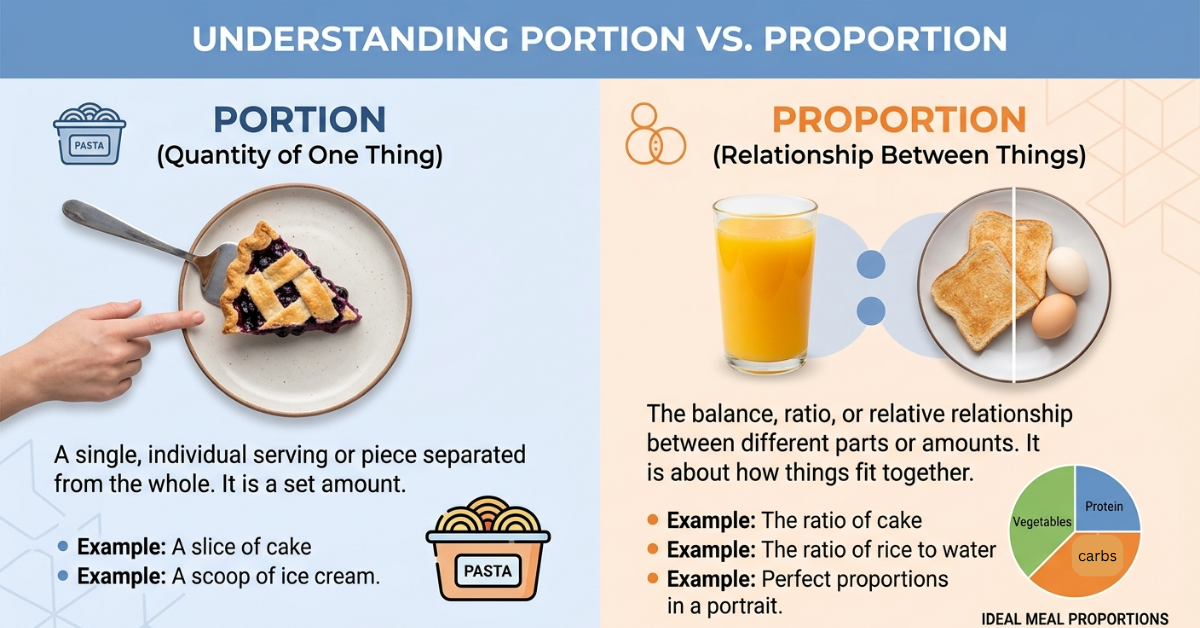
- Portion means a part, piece, serving, or share of something.
- Proportion means the relationship, ratio, or balance between parts.
So, while both words are connected to the idea of “parts,” they are used in different contexts. That difference matters a lot.
What Does “Portion” Mean?
A portion is a part taken from a larger whole. Usually, it refers to something you can divide, serve, or separate.
For example:
- She ate a small portion of cake.
- A large portion of the road was closed.
- He donated a portion of his salary.
Most of the time, people use portion when talking about food. Nevertheless, it can also describe sections, shares, or pieces of something larger.
Common Uses of Portion
You will often see this word in these situations:
- Food servings
- Shares of money or profits
- Sections of land or text
- Parts of an object or task
For instance, you might say, “Only a portion of the report is finished.” In that sentence, the word refers to a part of the whole report.
What Does “Proportion” Mean?
A proportion is about comparison. Instead of describing one piece, it explains how two or more parts relate to each other.
This word appears often in:
- Mathematics
- Design
- Architecture
- Art
- Statistics
- Photography
For example:
- The ingredients must be mixed in the correct proportion.
- The room has excellent proportions.
- The artist corrected the body proportions in the sketch.
In other words, proportion is about balance, ratio, and scale.
Proportion vs Portion: A Simple Comparison
Although the words are similar, they are not interchangeable.
| Portion | Proportion |
| A part or serving | A ratio or relationship |
| Refers to one piece | Refers to comparison between parts |
| Common in food and daily speech | Common in math, design, and art |
| Example: a portion of rice | Example: the proportion of red to blue |
This quick comparison makes the difference much easier to see.
Easy Examples in Everyday English
Here are some simple examples to make the distinction clearer.
Portion Examples
- Please give me a smaller portion.
- A portion of the garden needs watering.
- She saved a portion of her pocket money.
Proportion Examples
- The window is in perfect proportion to the wall.
- The recipe works only if the flour and water are in the right proportion.
- The graph shows the proportion of students who passed.
Notice the difference? One word refers to an amount, while the other refers to balance or comparison.
When Should You Use Portion?
Use portion when you mean:
- a serving of food
- a part of something
- a share of money, land, or work
For example, “I ate a large portion of pasta” is correct because it describes a serving. By contrast, “I ate a large proportion of pasta” sounds awkward because proportion is not used for servings.
When Should You Use Proportion?
Use proportion when you mean:
- ratio
- balance
- scale
- relationship between parts
For example, “The table is out of proportion with the room” is correct because it compares sizes. Similarly, “The proportion of sugar to flour matters in baking” is also correct.
Why Do People Confuse Them?
The confusion is understandable. After all, the words look and sound alike. In addition, both words relate to the idea of “parts.”
Still, their functions are different. Portion focuses on one part of a whole. Proportion, on the other hand, focuses on how parts compare with each other.
A Quick Memory Trick
Here is an easy way to remember them:
- Portion = Piece
- Proportion = Relationship
So, whenever you think of food, servings, or sections, choose portion. Whenever you think of balance, ratio, or size comparison, choose proportion.
Real-World Relevance
This difference is useful in everyday life, especially in areas like:
Food and Nutrition
People often talk about portion sizes, portion control, and healthy eating. In this context, portion is the right word.
Interior Design and Architecture
Designers care deeply about proportion. A sofa, lamp, or wall feature should look balanced within a space. Therefore, proportion is the correct choice here.
Mathematics and Science
In math, ratios and equal relationships are described using proportion. Because of that, the word shows up often in equations, measurements, and formulas.
Common Mistakes to Avoid
Here are some incorrect and correct examples of proportion vs portion:
- Incorrect: The room has beautiful portions.
Correct: The room has beautiful proportions. - Incorrect: I ate a large proportion of fries.
Correct: I ate a large portion of fries. - Incorrect: The artist checked the portion of the face.
Correct: The artist checked the proportion of the face.
These small changes make your English sound much more accurate.
Practical Tips for Using the Words Correctly
To avoid mistakes, ask yourself a simple question:
- Am I talking about a part or serving? Use portion.
- Am I talking about comparison or balance? Use proportion.
That quick test works surprisingly well. Moreover, it helps you decide fast while writing or speaking.
Key Takeaways
- Portion means a part, piece, or serving.
- Proportion means a ratio, balance, or relationship between parts.
- Portion is common in food, shares, and sections.
- Proportion is common in math, design, art, and measurements.
- Although the words look alike, they are not interchangeable.
Frequently Asked Questions
Is proportion the same as portion?
No, they are different. Portion means a part or serving, while proportion means a relationship or ratio between parts.
Can I use portion for food?
Yes, absolutely. In fact, portion is the correct word when talking about food servings or meal size.
What does proportion mean in design?
In design, proportion refers to the size relationship between elements. For example, furniture should be balanced with the room size.
How do I remember the difference easily?
Think of portion as a piece and proportion as a relationship. That simple trick usually makes the meaning clear.
Is proportion only used in math?
No. It is also used in art, architecture, photography, interior design, and even everyday conversation when discussing balance or scale.
Conclusion
Understanding proportion vs portion becomes easy once you focus on meaning instead of spelling. One word refers to a part or serving, while the other describes balance, ratio, or comparison.
So, the next time you write, pause for a second and check the context. That small habit will help you choose the right word every time and make your English sound clearer, smarter, and more natural.
Author

linguaezone.com@gmail.com
Related Posts
Kill Two Birds With One Stone Alternative: 50 Better Options
- 0
- 1,569 word
Have you ever paused before saying “kill two birds with one stone” because it sounded too violent or simply didn’t fit the...
Read out all
Happy Sabbath Meaning: A Complete Guide to Its Significance
- 0
- 1,632 word
Have you ever received the message “Happy Sabbath” and wondered what it truly means? Is it simply another way of saying “have...
Read out all
I’m So Proud of You in Other Words: 120+ Heartfelt Alternatives
- 0
- 1,562 word
Have you ever wanted to tell someone you’re proud of them but felt like saying “I’m so proud of you” sounded repetitive?...
Read out all
How Do You Spell Happy Anniversary? Correct Spelling Guide
- 0
- 1,221 word
Have you ever paused before writing an anniversary card and wondered, “How do you spell happy anniversary?” You’re not alone. Whether you’re...
Read out all
Waiting for Your Response Email: Best Examples & Tips
- 0
- 1,483 word
Have you ever sent an important email and found yourself wondering whether you should follow up or simply wait? Whether you’re communicating...
Read out all
Great Asset to the Team: Meaning, Examples & Tips
- 0
- 1,494 word
Have you ever wanted to compliment a coworker but struggled to find words that sound professional and sincere? One of the most...
Read out all