×
Aswell or As Well: Which One Is Correct?
In

Have you ever paused while typing and wondered whether you should write aswell or as well? You’re not alone. It’s one of the most common writing questions among English learners, students, professionals, and even native speakers.

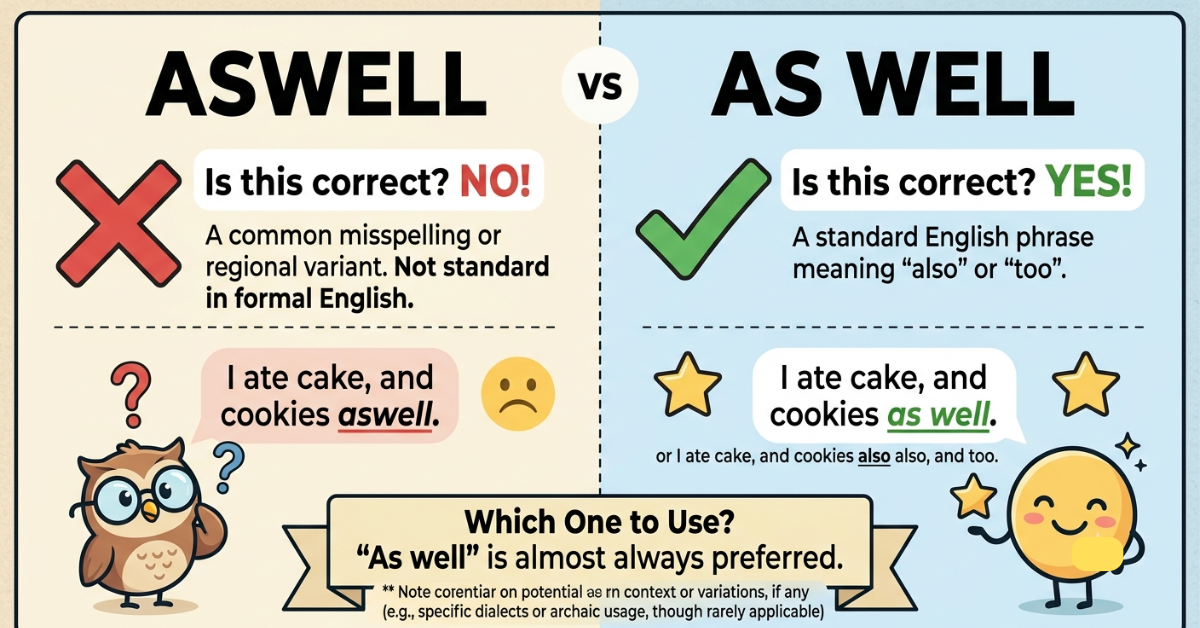
The short answer is simple: “as well” is correct, while “aswell” is generally considered incorrect in standard English. If you’ve been searching for is it aswell or as well or trying to understand the aswell or as well meaning, this guide explains everything you need to know. By the end, you’ll understand the correct spelling, meaning, grammar rules, common mistakes, and how to use the phrase naturally in everyday writing.

What Is the Correct Form: Aswell or As Well?

The correct expression is as well—written as two separate words.

 Incorrect: I would like coffee aswell.

 Correct: I would like coffee as well.

In modern English grammar, “aswell” is not recognized as a standard word in dictionaries or formal writing. If you write it as one word, grammar checkers and spell-check tools will usually flag it as an error.

Quick Rule:

  •  As well = Correct
  •  Aswell = Incorrect

As Well Meaning

The phrase as well means:

  • Also
  • Too
  • In addition
  • Besides

It is used to add extra information or include another person, object, or action.

Examples

  • I’d like dessert as well.
  • Sarah is coming as well.
  • We need milk as well as bread.
  • He speaks Spanish as well as English.

In most situations, as well has the same meaning as “also” or “too.”

Why Do People Write “Aswell”?

Many people combine the words because English contains similar expressions that eventually became one word, such as:

  • Already
  • Always
  • Somehow
  • Nowadays

This makes writers assume that aswell follows the same pattern. However, English grammar has not accepted this spelling.

Other reasons include:

  • Fast typing
  • Autocorrect errors
  • Informal texting
  • Lack of grammar knowledge

Although you might occasionally see “aswell” on social media or in personal messages, it should be avoided in professional and academic writing.

Is It Aswell or As Well in Formal English?

If you’re asking is it aswell or as well, the answer is always as well in formal English.

This applies to:

  • Academic papers
  • Business emails
  • Reports
  • Books
  • Articles
  • Job applications
  • Professional communication

Using the correct spacing improves clarity and demonstrates strong writing skills.

How to Use “As Well” Correctly

The phrase is flexible and can appear in different parts of a sentence.

At the End of a Sentence

This is the most common placement.

Examples:

  • I’d like to join as well.
  • She bought one as well.
  • We can help as well.

Before a Verb

Less common but still correct.

Examples:

  • She may as well leave now.
  • You might as well call him.

Here, “may as well” and “might as well” have a slightly different meaning, suggesting that something is the best or easiest option.

Example:

  • We have time, so we might as well walk.

In the Middle of a Sentence

“As well” can also connect ideas.

Examples:

  • She enjoys cooking as well as baking.
  • The hotel offers breakfast as well as free parking.

As Well vs Also vs Too

These three expressions often have similar meanings, but they differ slightly in usage.

Phrase Meaning Common Position
As well Also Usually at the end
Also In addition Before the main verb
Too Also Usually at the end

Examples

Also

  • I also enjoy reading.

Too

  • I enjoy reading too.

As well

  • I enjoy reading as well.

All three are grammatically correct, although their placement changes.

Common Examples of “As Well”

Here are everyday examples to help you remember the correct usage.

In Conversation

  • I’ll come as well.
  • Can I join as well?
  • She wants one as well.

At Work

  • Please send me the report as well.
  • Include the budget document as well.

At School

  • James completed the assignment as well.
  • The teacher explained the answer as well.

In Writing

  • This strategy improves efficiency as well.
  • The software supports mobile devices as well.

Common Mistakes to Avoid

Many writers unknowingly make small grammar mistakes involving this phrase.

Writing It as One Word

Incorrect:  Aswell

Correct: As well

Using It Too Frequently

Instead of repeating “as well” multiple times, vary your language with:

  • Also
  • Too
  • Additionally
  • Furthermore
  • Besides

This makes writing smoother and more engaging.

Confusing “As Well As” with “And”

Although similar, they aren’t always interchangeable.

Example:

She sings as well as dances.

Better:

She sings as well as she dances.

Or

She sings and dances.

Context determines the better choice.

Grammar Rule Behind “As Well”

English grammar treats as and well as separate words because they perform different functions together as a fixed phrase.

Unlike compound words such as:

  • Somehow
  • Everywhere
  • Anything

the expression as well has remained two words throughout the history of modern English.

That’s why dictionaries consistently list it as a phrase rather than a single word.

As Well As: What Does It Mean?

Another common expression is as well as.

It means:

  • In addition to
  • Along with
  • Besides

Examples

  • She plays tennis as well as football.
  • He speaks French as well as German.
  • We serve breakfast as well as lunch.

This phrase connects similar ideas or items.

Real-Life Examples

Imagine you’re sending an email.

Incorrect:

Please attach the invoice aswell.

Correct:

Please attach the invoice as well.

Or when chatting with friends:

Incorrect:

I’m coming aswell!

Correct:

I’m coming as well!

Even in casual writing, using the correct spelling helps develop better writing habits.

Tips to Remember the Correct Spelling

Remember these simple tricks:

  • Think of as well as meaning also.
  • If you can replace it with “too,” write it as two words.
  • Grammar checkers will usually correct “aswell.”
  • Proofread emails and assignments before sending them.

A useful memory trick:

If it means “also,” always leave a space.

Why Correct Spelling Matters

Small grammar mistakes can affect how your writing is perceived.

Using as well correctly helps you:

  • Look more professional
  • Improve academic writing
  • Communicate clearly
  • Build confidence in English
  • Avoid unnecessary grammar corrections

Whether you’re writing emails, essays, blog posts, or social media captions, correct grammar leaves a positive impression.

Key Takeaways

  • As well is the correct spelling.
  • Aswell is considered incorrect in standard English.
  • The phrase means also, too, or in addition.
  • It usually appears at the end of a sentence.
  • “As well as” means “in addition to.”
  • Using the correct form improves both grammar and professionalism.

Frequently Asked Questions

Is aswell or as well correct?

The correct form is as well. Writing it as one word (“aswell”) is considered a spelling mistake in standard English.

What is the meaning of as well?

As well means also, too, or in addition. It adds extra information to a sentence.

Is “aswell” ever acceptable?

No. Standard dictionaries and grammar guides do not recognize aswell as a correct English word. Always write it as as well.

Can I replace “as well” with “also”?

Yes. In many sentences, also and as well have the same meaning, although their position in the sentence is usually different.

Example:

  • I also agree.
  • I agree as well.

What does “as well as” mean?

As well as means in addition to or along with. It connects two related people, things, or actions.

Example:

  • She teaches mathematics as well as science.

Is “as well” formal or informal?

As well works in both formal and informal English. It’s suitable for academic writing, professional emails, conversations, and everyday communication.

Conclusion

If you’ve ever wondered aswell or as well, the answer is straightforward: as well is the only correct spelling in standard English. The phrase means also, too, or in addition, and it’s widely used in both spoken and written communication. While “aswell” may appear in casual typing or online posts, it isn’t accepted in formal grammar and should be avoided.

By understanding where and how to use as well, you’ll write with greater accuracy, confidence, and professionalism. Keep practicing with real-life examples, proofread your work, and apply these simple grammar rules to make your English clearer and more polished.

Leave a Reply

Your email address will not be published. Required fields are marked *

Author

britsx85@gmail.com

Related Posts

Benefited or Benefitted: Which Spelling Is Correct?
In

Benefited or Benefitted: Which Spelling Is Correct?

Have you ever paused mid-sentence and wondered whether to write benefited or benefitted? You are not alone. This is one of those...

Read out all
Dialogue Spelling: Correct Usage, Meaning & Examples
In

Dialogue Spelling: Correct Usage, Meaning & Examples

Have you ever stopped while writing and wondered whether it’s dialogue or dialog? You’re not alone. It’s one of the most common...

Read out all
Cacoon or Cocoon: Which Spelling Is Correct?
In

Cacoon or Cocoon: Which Spelling Is Correct?

Have you ever typed cacoon or cocoon into a search bar and wondered which spelling is actually correct? You’re not alone. It’s...

Read out all
Proportion vs Portion: Meaning, Differences & Easy Examples
In

Proportion vs Portion: Meaning, Differences & Easy Examples

Have you ever paused mid-sentence and wondered whether to write portion or proportion? It happens more often than you might think. Although...

Read out all
Favourite or Favorite: Which Spelling Is Correct?
In

Favourite or Favorite: Which Spelling Is Correct?

Have you ever paused while writing an email or social media post and wondered, “is it favourite or favorite?” You’re not alone....

Read out all
Phoenix or Pheonix: Which Spelling Is Correct?
In

Phoenix or Pheonix: Which Spelling Is Correct?

Have you ever stopped while typing phoenix and wondered whether it should actually be spelled pheonix? You’re definitely not alone. Thousands of...

Read out all