
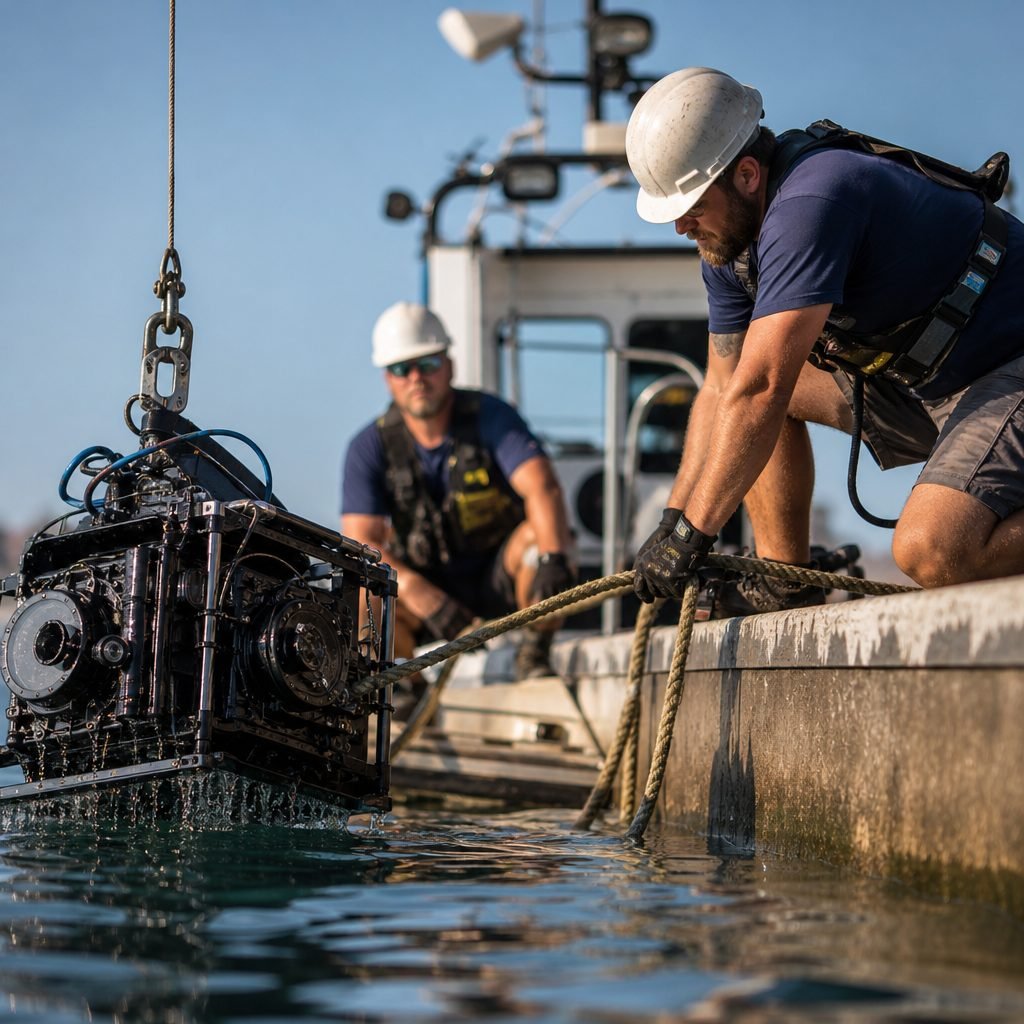
Most underwater photographers think about weight in terms of what they can swim with. But the hardest part of a serious project — a reef restoration survey, a shipwreck documentation shoot, a long-term time-lapse station on the seabed — usually happens before anyone gets wet. Someone has to pick a 900-pound frame off a flatbed, swing it over a gunwale or a quay edge, and set it down on a rolling deck without crushing a dome port or bending a mounting arm. That is a rigging problem, not a diving problem, and it is where otherwise well-planned expeditions lose equipment. The equipment that solves it is borrowed straight from construction and industrial work: spreader bars, lifting beams, slings, shackles, and load-measuring hardware. Understanding how those pieces behave is worth as much to a project lead as understanding strobe placement.
Why a single sling ruins expensive hardware
Hook a long, awkward object with two sling legs coming down to a single crane hook and you create a triangle. The shallower the angle at the top, the more tension builds in each leg — and, critically, the more that tension tries to pull the two lift points toward each other. On a steel billet nobody cares. On a camera cage, a lighting truss, an acrylic habitat window, or a fiberglass ROV skid, that inward squeeze is exactly the force that cracks fairings, deforms frames, and pinches cable runs. A spreader bar removes the triangle. The bar sits horizontally between the lift points and takes the compression itself, so the slings drop vertically and the load sees only clean upward force. A lifting beam does something related but mechanically different: it carries the load in bending from a single top attachment, which keeps overall headroom tight when you are working under a low boat davit, a dock gantry, or a warehouse door. Engineers have written at length about why the two behave differently under load, and KHL's guide to spreader beam application and construction is a useful primer on how the geometry, sling angles, and end-fitting design drive the capacity you actually get.
Choose a spreader bar when
- The load is long and would be squeezed by angled slings — a camera truss, a pipe section, a pre-assembled reef module.
- You have plenty of vertical clearance above the load.
- You want the lift points to stay exactly where the designer put them.
Choose a lifting beam when
- Headroom is the constraint, not sling angle.
- The load has one or two fixed pick points underneath and needs minimal rigging height.
- You are lifting through a hatch, a moon pool, or a doorway.
Adjustable and telescopic versions matter more than people expect. A fixed bar is sized for one span; a telescopic or modular unit lets you reconfigure between a 12-foot habitat frame on Monday and a 30-foot survey sled on Thursday without hauling two separate pieces of steel to site. Capacity typically drops as span increases, so always confirm the rating at the span you will actually set, not the headline figure on the spec sheet.
Trust the instrument, not the feeling
Divers already accept this logic underwater. Nobody guesses at nitrogen loading or ascent rate when a device is on their wrist giving them real numbers, which is why a dive computer is standard equipment on every serious imaging dive — the instrument buys you the time and confidence to work carefully instead of nervously. Rigging deserves the same discipline. A load cell between the hook and the bar turns "it feels about right" into a figure you can compare with the gear's rated capacity, and it catches the two situations that hurt people: a load that is heavier than the manifest claimed, and a load that is still partly stuck to the deck or the seabed while the crane keeps pulling. Weigh the gear once, write the number on the frame in paint pen, and stop re-deriving it from memory. Flooded housings, waterlogged ballast, silt inside a recovered structure, and biofouling all add mass that nobody estimated at the start of the trip.
Renting the steel instead of owning it
Project-based teams rarely lift the same thing twice, which makes ownership a poor fit: a fixed bar bought for one span becomes dead weight in a container the following season, and it still needs inspection and documentation to stay usable. Renting shifts that burden. Tway Lifting Products, a rigging equipment manufacturer founded in 1945 with locations in Indianapolis and Fort Wayne, Indiana, offers fixed, adjustable, telescopic and modular units through its spreader bar rental program, covering 2 to 100 tons and spans up to 40 feet, with telescopic models rated up to 30,000 lbs. Rental units are proof-load tested and built to ISO-9001, ASME B30.20 and OSHA requirements, and the company also rents fixed, adjustable and modular lifting beams plus ready-to-go rigging kits with slings, shackles, hoists, load cells and rolling blocks — which is usually what a field team actually needs, since the bar alone does nothing without the right shackles and sling lengths. Free nationwide delivery and pickup, daily, weekly or monthly terms, on-site custom sling fabrication, inspection and proof loading services, and 24/7 emergency dispatch cover the awkward realities of fieldwork: a weather window that shifts, a sling that fails inspection the morning of a mobilization, a span that changes once the frame is assembled on the dock.
A short pre-lift routine worth repeating
- Confirm the weight and the center of gravity. Asymmetric loads — a frame with batteries at one end and a housing at the other — will rotate in the air unless the pick points straddle the center of gravity.
- Match the span to the lift points. Set the bar so slings hang vertically. If they angle in, you have the wrong span.
- Check the ratings at that configuration. Capacity, span, and allowable sling angle are a package, not three independent numbers.
- Inspect every soft component. Cuts, abrasion, heat glazing, and UV damage on synthetic slings are the fastest-growing problems on salt-exposed jobs. Rinse and dry slings after every marine lift.
- Protect the load. Softeners and corner guards at every contact point; tag lines instead of hands for control.
- Trial lift a few inches. Let it hang, watch for tilt, listen for anything shifting inside, then set it back down and fix what you saw.
What this buys an underwater project
Properly rigged lifts protect budgets more than they protect backs. A survey sled that arrives undamaged means a full week of data instead of three days and an improvised repair. A reef module placed gently sits where the biologists wanted it rather than two meters off-station in a cloud of silt. And a photographer whose housing never got squeezed on the dock gets to spend the dive thinking about light instead of leaks. The steel is unglamorous, but it is the part of the workflow that decides whether everything downstream of it actually happens.
Author

khizarnisar367@gmail.com
Related Posts
Diesel Room Literacy for Dive Travelers: Reading the Engine That Carries Your Camera Rig
Every underwater photographer has a story about a trip that collapsed for mechanical reasons. A liveaboard limps back to port on one...
Read out all
Rolling Basecamps: How Dive Teams and Coral Restoration Projects Specify Purpose-Built Mobile Units
Most underwater projects are won or lost on land. The dive plan may be elegant, the camera rigs immaculate, but if the...
Read out all
Enclosed vs. Open-Frame DC Motor Controllers: Which Should You Choose?
Picking up the right DC motor controller includes more than matching the controller’s current rating to the motor. Its physical construction, installation...
Read out all
Practical AI Tools That Support Classroom Teaching
- 0
- 1,879 word
Teachers have always been resourceful. Give an experienced educator a stack of paper, a few markers, and a room full of curious...
Read out all
How Many Solar Panels Does a Generator Need?
- 0
- 954 words
Panels are the part of a solar setup people buy by feel, usually after the generator has already arrived. The array is...
Read out all
How Do You Calculate Solar Generator Runtime?
- 0
- 916 words
Solar generator runtime is not simply the battery capacity divided by the largest appliance wattage. A useful estimate has to reflect how...
Read out all