
- 0
- 2,133 words
Have you ever come across the words vial and viol and wondered whether they mean the same thing—or if one of them is just a spelling mistake? It’s an easy mix-up. They sound somewhat similar, look nearly identical at a glance, and both are relatively uncommon in everyday conversation. But in reality, Vial vs Viol is a comparison between two completely different words with separate meanings, histories, and uses.
One refers to a small container used for liquids, medicines, or samples. The other refers to a historical string instrument from the Renaissance and Baroque periods. If you’ve ever been unsure which word to use in writing, this guide will clear it up. In this article, you’ll learn the meaning of each word, how to use them correctly, where the confusion comes from, and how to remember the difference for good.
What Does “Vial” Mean?
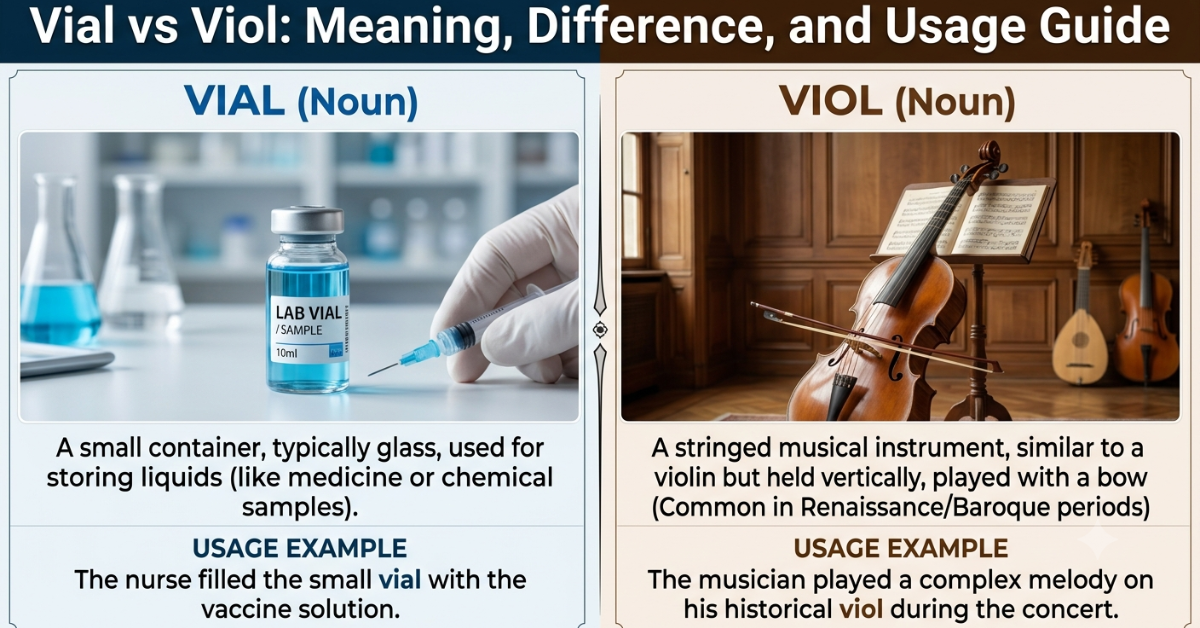
A vial is a small container, usually made of glass or plastic, used to hold liquids, powders, medicines, perfumes, lab samples, or other substances in small quantities.
Common definition of vial
A vial is typically:
- Small and portable
- Sealed with a cap, stopper, or rubber top
- Used in medical, laboratory, cosmetic, or chemical settings
Examples of “vial” in a sentence
- The nurse prepared a vial of vaccine before the injection.
- The scientist labeled each vial with the sample number.
- She kept a tiny vial of perfume in her handbag.
- The pharmacist handed over a vial containing the prescribed medicine.
Where you’ll commonly see the word “vial”
You’re most likely to encounter vial in contexts like:
Medicine and healthcare
- vaccine vials
- insulin vials
- injectable medication vials
Science and laboratory work
- sample vials
- specimen vials
- chemical storage vials
Beauty and fragrance
- perfume vials
- serum vials
- skincare sample vials
In modern English, vial is by far the more commonly used word compared to viol.
What Does “Viol” Mean?
A viol is a musical instrument from an older family of bowed string instruments. It was especially popular in Europe during the Renaissance and Baroque eras. The viol family includes instruments such as the bass viol, treble viol, and viola da gamba.
Unlike the modern violin, a viol usually has:
- six or seven strings
- frets on the fingerboard
- a softer, more delicate tone
- a shape somewhat similar to a cello or violin, depending on the type
Examples of “viol” in a sentence
- The musician performed a Renaissance piece on the viol.
- The museum displayed an antique viol from the 17th century.
- She studies early music and specializes in the bass viol.
- The composer wrote several works for viol and lute.
Where “viol” is commonly used
You’ll mostly find the word viol in:
- classical music history
- early music studies
- museum descriptions
- academic discussions of Renaissance instruments
- historical performance practice
So if vial belongs to the worlds of medicine, chemistry, and packaging, viol belongs to the world of historical music.
Vial vs Viol: The Core Difference
At the simplest level, the difference comes down to this:
- Vial = a small container
- Viol = an old string instrument
That’s the entire distinction in one line—but there’s more to understand if you want to avoid mistakes in writing.
Quick comparison table
| Word | Meaning | Category | Common Contexts | Example |
| Vial | A small container for liquids, powders, or samples | Noun | Medicine, labs, cosmetics, pharmacy | “The doctor opened a vial of medication.” |
| Viol | A historical bowed string instrument | Noun | Music history, Renaissance music, Baroque performance | “He played a piece on the viol.” |
Why People Confuse Vial and Viol
The confusion in Vial vs Viol usually happens for three main reasons:
1. The words look very similar
Only one letter changes, so at a quick glance, they can easily be mistaken for each other.
2. Neither word is used constantly in everyday writing
Most people know vial from medicine or science, but viol is much rarer unless they study music or literature. That makes it easier to forget which spelling belongs to which meaning.
3. Spell-check doesn’t always save you
Because viol is a real English word—not a typo—some writing tools won’t automatically flag it if you accidentally use it instead of vial.
For example:
- Incorrect: The nurse opened a viol of medicine.
- Correct: The nurse opened a vial of medicine.
The incorrect sentence might slip through if you’re relying only on spell-check.
Pronunciation: Vial vs Viol
Pronunciation can also add to the confusion.
Vial pronunciation
Vial is commonly pronounced like:
VY-ul /ˈvaɪ.əl/
Viol pronunciation
Viol is often pronounced:
VY-uhl or sometimes vee-ol, depending on historical or musical context and regional usage.
Because the pronunciations can overlap or sound close in modern speech, it’s easy to see why writers mix them up. But in writing, the meanings remain very distinct.
The Meaning of Vial in Modern Usage
Since vial is the more common word, it’s worth looking at how it functions in everyday English.
Vial in medical settings
In healthcare, a vial often contains:
- vaccines
- injectable antibiotics
- insulin
- blood samples
- sterile compounds
Examples:
- The clinic stored the vaccine in a refrigerated vial.
- The doctor checked the dosage printed on the vial.
Vial in laboratories
Scientists use vials to store:
- chemical solutions
- biological samples
- test substances
- powdered compounds
Examples:
- Each vial was sealed and catalogued for testing.
- The researcher placed the specimen into a sterile vial.
Vial in beauty and fragrance
The word also appears in consumer products:
- sample perfume vials
- facial serum vials
- ampoule-style skincare containers
Example:
- The brand included a complimentary vial of fragrance with the order.
The Meaning of Viol in Music and History
The word viol is much more specialized. It belongs mainly to the history of Western classical music.
What kind of instrument is a viol?
A viol is part of a family of bowed string instruments that were played from roughly the 15th to 18th centuries. These instruments were held in different ways depending on their size, and they were used in chamber music, court music, and sacred music.
Features of a viol
A traditional viol often has:
- a flat back
- sloping shoulders
- frets, unlike most modern orchestral string instruments
- strings tuned in intervals that differ from the violin family
Related terms you may see
If you encounter viol, you may also see related terms such as:
- viola da gamba
- viol consort
- bass viol
- treble viol
- early music ensemble
These all belong to the same historical musical world.
Vial vs Viol in Sentences
Sometimes the best way to understand word differences is to see them side by side.
Correct use of vial
- The chemist poured the liquid into a glass vial.
- A small vial of essential oil was included in the package.
- The pharmacist checked the expiration date on the vial.
Correct use of viol
- The performer tuned the viol before the concert.
- He wrote his dissertation on music for the viol in the Baroque era.
- The antique viol was preserved behind museum glass.
Side-by-side contrast
- She placed the medicine in a vial.
- She played a melody on the viol.
One holds liquid. The other makes music.
Is “Viol” Ever a Misspelling of “Vial”?
Yes—very often in modern writing, “viol” is simply an accidental misspelling of vial, especially in contexts involving medicine, laboratories, or beauty products.
For example, if someone writes:
- “Please bring the viol of insulin”
- “The sample was stored in a viol”
they almost certainly mean vial, not viol.
A good rule of thumb
If the sentence is about:
- medication
- samples
- perfume
- chemicals
- containers
the correct word is almost always vial.
If it’s about:
- music
- instruments
- Renaissance performance
- Baroque history
then viol may be the right word.
Vial vs Viol: Etymology and Word Origins
Understanding where the words come from can make them easier to remember.
Origin of “vial”
Vial comes from older forms of English and French related to containers or bottles. Its history is connected to small vessels used to hold liquids.
Origin of “viol”
Viol comes from European musical traditions and is related to the family of string instruments that also influenced later instrument names like viola and violin.
Even though the spellings look close, their roots point to completely different categories of objects.
How to Remember the Difference Between Vial and Viol
If you keep second-guessing yourself, these simple memory tricks can help.
Memory trick #1: Vial has an “a” like ampoule
Both vial and ampoule belong to the world of medicine and containers.
Memory trick #2: Viol looks closer to violin
The word viol is connected to musical instruments, so think of violin, viola, or violoncello.
Memory trick #3: Ask what the sentence is about
Before choosing the word, ask:
- Is this about holding something? → vial
- Is this about playing something? → viol
That one question solves most cases immediately.
Common Mistakes in Usage
Here are a few mistakes that show up often:
Mistake 1: Using “viol” in medical writing
Incorrect: The lab received ten viols of blood samples.
Correct: The lab received ten vials of blood samples.
Mistake 2: Assuming “viol” is just an old spelling of “vial”
It isn’t. These are two different words with different meanings.
Mistake 3: Treating “vial” as a music term
Incorrect: He played the vial beautifully during the recital.
Correct: He played the viol beautifully during the recital.
When Does This Difference Matter in Real Life?
At first glance, Vial vs Viol may seem like a tiny spelling issue, but it matters more than you might think.
In professional writing
If you’re writing about:
- healthcare
- pharmaceuticals
- lab procedures
- cosmetic packaging
using viol instead of vial can make the writing look careless or inaccurate.
In academic or historical writing
If you’re discussing early music or Renaissance instruments, using vial instead of viol can completely change the meaning and confuse readers.
In search and SEO content
Writers creating educational, product, or medical content need to use the correct term so the page matches search intent. Someone looking up a medicine container is not searching for a Baroque instrument, and someone researching early music doesn’t want information about sample bottles.
Quick Summary: Vial vs Viol
Here’s the simplest way to remember it:
- Vial = a small bottle or container, especially for medicine, samples, or liquids
- Viol = a historical string instrument played with a bow
If the object can be filled, it’s probably a vial.
If it can be played, it’s a viol.
Practical Tips for Using the Right Word
If you write professionally, study language, or create educational content, these tips can help:
1. Check the context first
Read the sentence and identify the subject area:
- healthcare/science = vial
- music/history = viol
2. Don’t rely only on spell-check
Because both words are valid English terms, spell-check may not catch the mistake.
3. Keep a simple association in mind
- vial → medicine, sample, bottle
- viol → violin-like instrument
4. Be extra careful in technical writing
Medical, academic, and educational writing demands precision. A one-letter mistake can change the meaning entirely.
FAQs About Vial vs Viol
1. What is the difference between vial and viol?
A vial is a small container used for liquids, medicine, or samples, while a viol is a historical bowed string instrument. They are unrelated words despite their similar spelling.
2. Is “viol” a correct word in English?
Yes, viol is a real English word. It refers to an early musical instrument from the Renaissance and Baroque periods.
3. Is “viol” a typo for “vial”?
Sometimes it is. In modern medical, laboratory, or cosmetic contexts, people often write viol by mistake when they actually mean vial.
4. How do you use “vial” in a sentence?
You can say: The doctor opened a vial of medicine before the injection. In this sentence, vial means a small container holding medication.
5. How do you use “viol” in a sentence?
You can say: The musician performed on a bass viol during the early music concert. Here, viol refers to a historical string instrument.
6. Which word is more common: vial or viol?
Vial is much more common in everyday English because it appears in medicine, science, and consumer products. Viol is relatively rare and mostly used in historical or musical contexts.
Final Thoughts on Vial vs Viol
The difference between vial and viol is simple once you see the pattern: one is a container, the other is an instrument. Still, because the words look so similar, they’re easy to confuse—especially in quick writing or typed notes. That’s why understanding the meaning, context, and usage of each term matters.
If you remember just one thing, let it be this: a vial holds something, while a viol plays something. Keep that distinction in mind, and you’ll avoid one of the most common mix-ups tied to these two words. And if you write educational, medical, or historical content regularly, getting small distinctions like this right can make your writing clearer, stronger, and more trustworthy.
Author

linguaezone.com@gmail.com
Related Posts

Kill Two Birds With One Stone Alternative: 50 Better Options
- 0
- 1,569 word
Have you ever paused before saying “kill two birds with one stone” because it sounded too violent or simply didn’t fit the...
Read out all
Happy Sabbath Meaning: A Complete Guide to Its Significance
- 0
- 1,632 word
Have you ever received the message “Happy Sabbath” and wondered what it truly means? Is it simply another way of saying “have...
Read out all
I’m So Proud of You in Other Words: 120+ Heartfelt Alternatives
- 0
- 1,562 word
Have you ever wanted to tell someone you’re proud of them but felt like saying “I’m so proud of you” sounded repetitive?...
Read out all
How Do You Spell Happy Anniversary? Correct Spelling Guide
- 0
- 1,221 word
Have you ever paused before writing an anniversary card and wondered, “How do you spell happy anniversary?” You’re not alone. Whether you’re...
Read out all
Waiting for Your Response Email: Best Examples & Tips
- 0
- 1,483 word
Have you ever sent an important email and found yourself wondering whether you should follow up or simply wait? Whether you’re communicating...
Read out all
Great Asset to the Team: Meaning, Examples & Tips
- 0
- 1,494 word
Have you ever wanted to compliment a coworker but struggled to find words that sound professional and sincere? One of the most...
Read out all