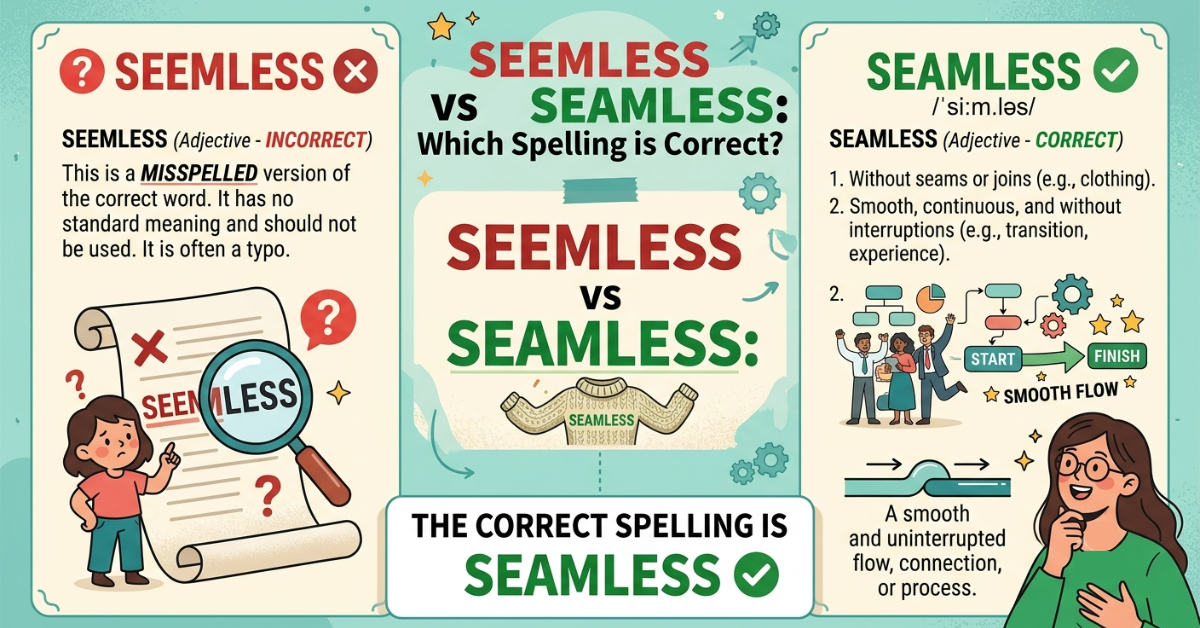
Have you ever typed a word with complete confidence, only to have your spell checker underline it in red? If you’ve found yourself wondering about seemless vs seamless, you’re not alone. This spelling confusion is surprisingly common, especially because both words appear as though they could be correct.
The truth is simple: only one of these spellings is accepted in standard English. In this guide, you’ll learn the difference between seemless vs seamless, why the confusion exists, how to remember the correct spelling, and how to use the word properly in everyday writing.
The Quick Answer
When comparing seemless vs seamless, the correct spelling is:
Correct: Seamless
Incorrect: Seemless
“Seamless” is a recognized English adjective that means smooth, continuous, or without visible joins, interruptions, or flaws.
“Seemless” is generally considered a misspelling and does not appear as a standard word in major English dictionaries.
What Does Seamless Mean?
The word seamless comes from the noun seam, which refers to a line where two pieces of material are joined together.
When something is seamless, it appears to have no visible seams or joins.
Definition
Seamless (adjective):
- Without seams
- Smooth and continuous
- Free from interruptions
- Perfectly integrated
Examples
- The designer created a seamless transition between the living room and kitchen.
- The software provides a seamless user experience.
- Their teamwork resulted in a seamless presentation.
- The dress featured a seamless construction for extra comfort.
In modern usage, the word is often used figuratively rather than literally.
Why Do People Write “Seemless”?
The confusion in seemless vs seamless usually comes from pronunciation.
When spoken aloud, “seam” and “seem” sound exactly the same in many English accents. Because of this, people often assume the word is related to the verb seem.
For example:
- Seem = to appear
- Seam = a line where things join
Since “seemless” looks logical to some writers, they accidentally substitute it for “seamless.”
However, the actual word originates from seam, not seem.
The Origin of Seamless
Understanding the etymology helps eliminate confusion.
Word Breakdown
Seam + Less = Seamless
- Seam = a joining line
- Less = without
Therefore:
Seamless = without seams
Over time, the meaning expanded beyond clothing and fabrics to describe anything that works smoothly or appears perfectly connected.
Seamless in Modern Usage
Today, seamless is used across many industries and contexts.
Technology
Tech companies frequently use the word to describe smooth experiences.
Examples:
- Seamless integration
- Seamless connectivity
- Seamless synchronization
Interior Design
Interior designers often discuss seamless aesthetics.
Examples:
- Seamless flooring
- Seamless wall finishes
- Seamless room transitions
Business
Organizations use the term when discussing efficient operations.
Examples:
- Seamless customer service
- Seamless communication
- Seamless workflow management
Fashion
The original meaning still applies.
Examples:
- Seamless underwear
- Seamless leggings
- Seamless garments
Seemless vs Seamless: Side-by-Side Comparison
| Feature |
Seamless |
Seemless |
| Correct spelling |
Yes |
No |
| Found in dictionaries |
Yes |
No |
| Standard English word |
Yes |
No |
| Used in professional writing |
Yes |
No |
| Derived from “seam” |
Yes |
No |
| Recommended usage |
Always |
Never |
The comparison clearly shows that seamless is the only correct option.
Examples of Correct Usage
Here are some examples showing how seamless should be used in different contexts.
In Technology
The app offers a seamless login experience.
Data transfers occur seamlessly between devices.
In Business
The merger resulted in a seamless transition for customers.
We aim to provide seamless support across all channels.
In Design
The architect created a seamless flow between indoor and outdoor spaces.
The flooring provides a seamless appearance throughout the home.
In Everyday Writing
Her presentation was seamless from start to finish.
The event organization appeared seamless to attendees.
Common Mistakes to Avoid
When discussing seemless vs seamless, writers often make several errors.
Mistake #1: Writing “Seemless”
Incorect: The software provides a seemless experience.
Correct: The software provides a seamless experience.
Mistake #2: Assuming It Comes from “Seem”
Many people think the word means “without seeming” or “not appearing.”
This is incorrect.
The word is related to seams, not appearances.
Mistake #3: Ignoring Spell Check Warnings
Most writing tools flag “seemless” as an error.
If your editor suggests “seamless,” accept the correction.
How to Remember the Correct Spelling
A simple memory trick can help.
The Fabric Trick
Think of a piece of clothing.
- Clothing has seams
- Something without seams is seamless
Since the word comes from seam, it must be spelled:
S-E-A-M-L-E-S-S
Visual Memory
Imagine a perfectly smooth surface with no visible joins.
No seams = seamless.
This connection makes the correct spelling much easier to remember.
Words Commonly Used with Seamless
The word frequently appears alongside other terms.
Popular Collocations
- Seamless experience
- Seamless integration
- Seamless transition
- Seamless communication
- Seamless workflow
- Seamless operation
- Seamless design
- Seamless connection
- Seamless collaboration
- Seamless process
These combinations are widely used in business, technology, design, and marketing.
Is “Seemless” Ever Correct?
In standard English, no.
Major dictionaries, style guides, academic publications, and professional writing standards recognize only seamless.
You may occasionally see “seemless” in:
- Typographical errors
- Social media posts
- Informal online comments
- Unedited content
However, it is not considered a valid standard spelling.
Key Takeaways
- Seamless is the correct spelling.
- Seemless is a misspelling.
- The word comes from seam, meaning a joining line.
- Seamless means smooth, continuous, integrated, or without visible joins.
- It is commonly used in technology, business, design, fashion, and everyday communication.
- Remember: No seams = seamless.
Frequently Asked Questions
Is seemless a real word?
No. “Seemless” is generally considered a spelling error. The accepted English word is “seamless.”
Which is correct: seemless or seamless?
When comparing seemless vs seamless, seamless is the correct spelling in all standard writing contexts.
Why do people misspell seamless?
The confusion occurs because “seam” and “seem” are pronounced similarly, causing many writers to choose the wrong spelling.
What does seamless mean?
Seamless means smooth, continuous, perfectly connected, or without visible seams or interruptions.
Can I use seemless in professional writing?
No. Professional, academic, and business writing should always use “seamless.”
How can I remember the correct spelling?
Think of a garment without seams. Since the word comes from “seam,” the correct spelling is “seamless.”
Conclusion
The debate over seemless vs seamless has a straightforward answer: seamless is correct, while seemless is a misspelling. The confusion arises because the words seam and seem sound alike, but the origin and meaning clearly point to seam.
Whether you’re writing a business proposal, creating website content, discussing interior design, or describing a smooth user experience, using the correct spelling enhances your credibility and professionalism. Keep the simple rule in mind—if there are no seams, it’s seamless—and you’ll never make this mistake again.