
- 0
- 1,289 word
Have you ever found yourself using the word “your” repeatedly in the same paragraph and wondered if there’s a better alternative? You’re not alone. Many writers, students, professionals, and content creators search for synonyms of your to make their writing more engaging and less repetitive.
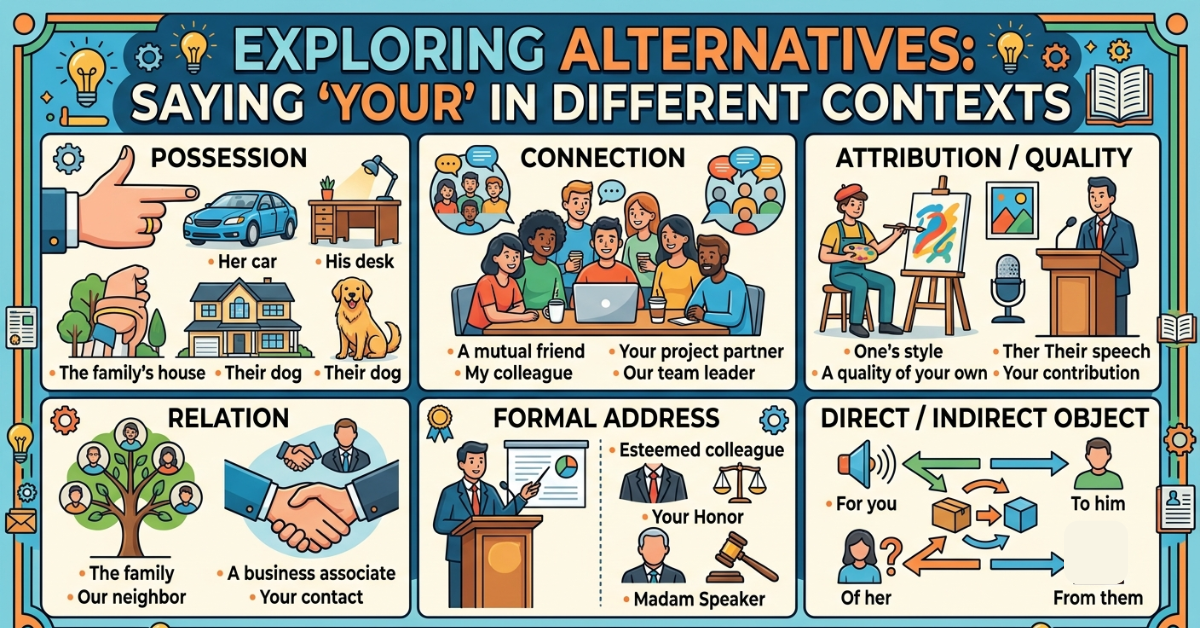
The truth is that “your” is a possessive determiner in English, so it doesn’t have many direct one-word synonyms. However, depending on the context, there are several effective alternatives and rewording techniques you can use. In this guide, you’ll learn when to replace “your,” the best contextual alternatives, practical examples, common mistakes to avoid, and expert tips for improving your writing naturally.
What Does “Your” Mean?
The word your is a possessive determiner used to show ownership or association with the person being addressed.
Examples include:
- Your phone is ringing.
- I like your idea.
- Please bring your notebook tomorrow.
In each sentence, your indicates that something belongs to or is connected with the listener or reader.
Are There Direct Synonyms of Your?
The short answer is not exactly.
Unlike descriptive words such as “happy” or “large,” the word your has a specific grammatical function. Because of this, English doesn’t offer many perfect one-word replacements.
Instead, writers typically use:
- Different possessive words
- Rephrased sentences
- Formal alternatives
- Inclusive language
- Context-specific substitutions
Choosing the right option depends entirely on the sentence.
Best Synonyms of Your by Context
1. Yours
One of the closest alternatives is yours.
However, it serves a different grammatical purpose because it replaces the noun instead of describing it.
Example
Instead of:
This is your book.
You can write:
This book is yours.
Notice how the sentence structure changes.
2. One’s
This is commonly used in formal writing or general advice.
Example
Instead of:
You should protect your privacy.
Write:
One should protect one’s privacy.
This version sounds more academic and formal.
3. Their
Modern English often uses their as a gender-neutral alternative when referring to an unspecified person.
Example
Instead of:
Every student should submit your assignment.
Use:
Every student should submit their assignment.
This is grammatically correct and widely accepted.
4. His or Her
For formal situations where gender needs to be specified.
Example
Every employee should update his or her profile.
Although correct, many writers now prefer their because it sounds more natural.
5. The
Sometimes you can remove your completely.
Example:
Instead of:
Raise your hand.
You can say:
Raise the hand.
However, this sounds unnatural in English.
A better rewrite is:
Raise a hand.
or simply
Raise your hand.
This illustrates that replacing your isn’t always the best choice.
Common Alternatives to Your
| Original | Alternative | Best Used When |
| your | yours | Replacing the noun |
| your | one’s | Formal writing |
| your | their | Gender-neutral references |
| your | his or her | Formal documents |
| your | my | Changing perspective |
| your | our | Inclusive writing |
| your | the person’s | Third-person references |
When Should You Replace “Your”?
Replacing your can improve readability in several situations.
Avoid Repetition
Instead of:
Your work reflects your creativity and your dedication.
Try:
Your work reflects the creativity and dedication you bring.
The revised sentence flows much better.
Make Writing More Formal
Academic writing often avoids direct second-person language.
Instead of:
You should organize your notes.
Write:
Students should organize their notes.
Improve Professional Tone
Business documents frequently use role-based wording.
Instead of:
Update your profile.
Write:
Employees should update their profiles.
Create Inclusive Content
Marketing teams increasingly replace repeated “your” statements with inclusive language.
Instead of:
Your success matters to us.
Sometimes:
Our customers’ success matters to us.
can sound more customer-focused.
Examples of Synonyms of Your in Sentences
Here are practical examples.
Original
Your opinion matters.
Alternative
Your opinion is valuable.
Alternative
The opinion you shared is valuable.
Original
Your account has been updated.
Alternative
The account has been updated successfully.
Original
Please bring your documents.
Alternative
Please bring the required documents.
Original
Your support means a lot.
Alternative
The support you provided means a lot.
Words Often Confused with “Your”
Many English learners confuse similar-looking words.
Your
Shows possession.
Example:
Your jacket looks nice.
You’re
Means you are.
Example:
You’re doing great.
Quick trick:
If you can replace it with you are, then you’re is correct.
Yours
A possessive pronoun.
Example:
The decision is yours.
Yourself
A reflexive pronoun.
Example:
Believe in yourself.
Writing Tips Instead of Replacing “Your”
Sometimes rewriting the sentence produces much stronger writing than searching for alternatives.
Passive Construction
Instead of:
We received your application.
Use:
The application has been received.
Change Sentence Structure
Instead of:
We appreciate your patience.
Write:
Thank you for being patient.
This sounds warmer and more conversational.
Use Nouns Instead
Instead of:
Update your profile.
Write:
Profile updates can be completed online.
Common Mistakes to Avoid
Many writers make these errors.
Assuming “your” has dozens of synonyms
It doesn’t. Since it serves a grammatical function, contextual alternatives work better than direct replacements.
Confusing “your” and “you’re”
This remains one of the most common grammar mistakes in English.
Wrong:
Your welcome.
Correct:
You’re welcome.
Overusing Formal Alternatives
Words like one’s sound appropriate in academic writing but can feel stiff in casual conversations.
Changing Meaning Accidentally
Always make sure the replacement preserves the original meaning.
Practical Tips for Better Writing
If you’re trying to improve your writing, remember these strategies:
- Replace repeated your by rewriting the sentence rather than forcing a synonym.
- Match the level of formality to your audience.
- Use their for inclusive language when appropriate.
- Read sentences aloud to check whether the replacement sounds natural.
- Prioritize clarity over variety.
These habits make your writing smoother without sacrificing meaning.
Key Takeaways
- Your is a possessive determiner that indicates ownership.
- There are very few true one-word replacements.
- Context determines the best alternative.
- Yours, their, one’s, and his or her are useful in specific situations.
- Often, rewriting the sentence is the most effective solution.
- Understanding grammar helps you choose the right wording naturally.
Frequently Asked Questions
What are the best synonyms of your?
There are no exact one-word synonyms for your, but depending on the context, alternatives such as yours, their, one’s, or his or her can work. In many cases, rewriting the sentence is the most natural option.
Is “yours” the same as “your”?
No. Your comes before a noun, while yours replaces the noun entirely. For example, “Your bag” becomes “The bag is yours.”
Can I replace “your” in formal writing?
Yes. Formal writing often replaces direct second-person language with one’s, their, or a specific noun phrase to create a more objective tone.
Why doesn’t “your” have many synonyms?
Because your is a grammatical word that expresses possession rather than describing a quality. Most alternatives depend on sentence structure instead of vocabulary.
Is it better to rewrite a sentence than replace “your”?
In many situations, yes. Rewriting often improves readability, reduces repetition, and preserves the original meaning more effectively than forcing a substitute.
How can I avoid repeating “your” in my writing?
Try varying sentence structure, using possessive pronouns like yours where appropriate, replacing repeated references with nouns, or rephrasing the sentence entirely to maintain a natural flow.
Conclusion
Finding effective synonyms of your is less about discovering identical replacement words and more about understanding how English grammar works. While direct alternatives are limited, options like yours, their, one’s, and thoughtful sentence rewrites can help you avoid repetition and create clearer, more engaging writing.
Whether you’re writing an academic paper, a business email, website content, or everyday messages, choosing the right alternative depends on your audience and purpose. Apply these techniques consistently, and you’ll produce writing that sounds more polished, professional, and natural. Explore more grammar and vocabulary strategies to continue strengthening your communication skills.
Author

linguaezone.com@gmail.com
Related Posts

Kill Two Birds With One Stone Alternative: 50 Better Options
- 0
- 1,569 word
Have you ever paused before saying “kill two birds with one stone” because it sounded too violent or simply didn’t fit the...
Read out all
Happy Sabbath Meaning: A Complete Guide to Its Significance
- 0
- 1,632 word
Have you ever received the message “Happy Sabbath” and wondered what it truly means? Is it simply another way of saying “have...
Read out all
I’m So Proud of You in Other Words: 120+ Heartfelt Alternatives
- 0
- 1,562 word
Have you ever wanted to tell someone you’re proud of them but felt like saying “I’m so proud of you” sounded repetitive?...
Read out all
How Do You Spell Happy Anniversary? Correct Spelling Guide
- 0
- 1,221 word
Have you ever paused before writing an anniversary card and wondered, “How do you spell happy anniversary?” You’re not alone. Whether you’re...
Read out all
Waiting for Your Response Email: Best Examples & Tips
- 0
- 1,483 word
Have you ever sent an important email and found yourself wondering whether you should follow up or simply wait? Whether you’re communicating...
Read out all
Great Asset to the Team: Meaning, Examples & Tips
- 0
- 1,494 word
Have you ever wanted to compliment a coworker but struggled to find words that sound professional and sincere? One of the most...
Read out all