Awaiting Your Response Meaning: Complete Guide & Examples
- 0
- 1,466 word
Have you ever received an email ending with “awaiting your response” and wondered whether it sounded polite, formal, or even a little demanding? You’re not alone. This common business phrase appears in countless emails, yet many people aren’t completely sure what it actually implies.
Understanding the awaiting your response meaning can help you communicate more professionally, avoid misunderstandings, and write emails that encourage timely replies without sounding pushy. In this guide, you’ll learn what the phrase means, when to use it, whether it’s polite, practical alternatives, real-world examples, and common mistakes to avoid.
What Does “Awaiting Your Response” Mean?
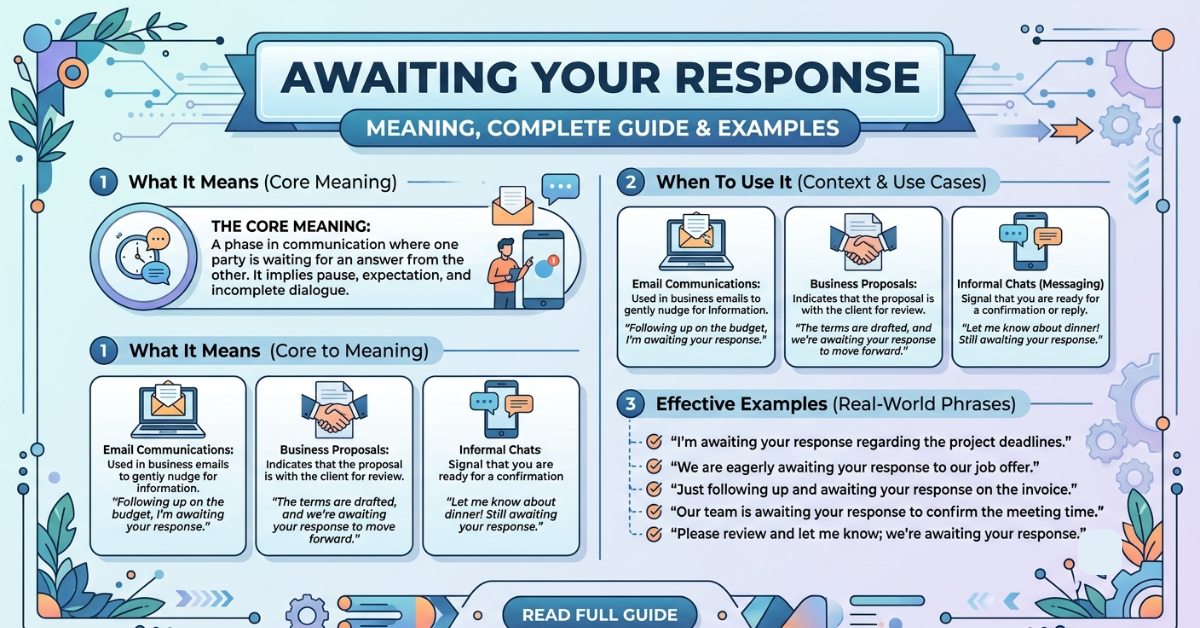
The phrase “awaiting your response” simply means:
“I am waiting for your reply.”
It indicates that the sender expects the recipient to respond before the conversation or task can move forward.
Although the meaning is straightforward, the tone depends on the context. In professional communication, it generally sounds formal, respectful, and business-like.
For example:
We have shared the proposal and are awaiting your response.
This tells the recipient that the sender is waiting for feedback or a decision.
Breaking Down the Phrase
Understanding each word makes the meaning even clearer.
Awaiting
“Awaiting” means waiting for something to happen or expecting something.
Unlike the casual word “waiting,” “awaiting” sounds more formal and is commonly used in professional writing.
Your
This refers directly to the person receiving the message.
Response
A response is a reply, answer, feedback, or reaction to a message, request, or question.
Together, the phrase means:
“We are waiting for your reply.”
Is “Awaiting Your Response” Polite?
Yes, in most situations, it is considered polite.
However, it is more formal than everyday conversation. It’s especially common in:
- Business emails
- Customer support communication
- Job applications
- Legal correspondence
- Sales follow-ups
- Academic communication
Because it sounds formal, it works best when communicating professionally rather than with close friends or family.
When Should You Use “Awaiting Your Response”?
The phrase fits situations where you genuinely need a reply before taking the next step.
Common situations include:
After Sending a Proposal
Example:
We have submitted the project proposal and are awaiting your response before proceeding.
Following Up on an Interview
Example:
Thank you for your time yesterday. I am awaiting your response regarding the next steps.
Customer Service
Example:
We require additional information and are awaiting your response to continue processing your request.
Business Negotiations
Example:
We look forward to finalizing the agreement and are awaiting your response.
Academic Communication
Example:
I have submitted the assignment revision and am awaiting your response.
Is It Formal or Informal?
It is primarily a formal expression.
Here’s how it compares with similar phrases.
| Phrase | Formality | Best Used For |
| Awaiting your response | Very Formal | Business emails |
| Waiting for your reply | Neutral | General communication |
| Looking forward to hearing from you | Friendly Professional | Most emails |
| Please let me know | Casual | Everyday conversations |
| Hope to hear from you soon | Warm | Networking and follow-ups |
Professional Email Examples
Here are several natural examples.
Example 1
Dear Sarah,
Thank you for reviewing the proposal.
We are awaiting your response regarding the project timeline.
Kind regards,
Michael
Example 2
Hello David,
Please review the attached contract at your convenience.
I am awaiting your response before scheduling the next meeting.
Best regards,
Emma
Example 3
Dear Hiring Manager,
Thank you for considering my application.
I am awaiting your response regarding the interview outcome.
Sincerely,
James
Better Alternatives to “Awaiting Your Response”
Although the phrase is correct, repeating it frequently can make emails feel repetitive.
Here are excellent alternatives.
Looking Forward to Your Reply
More positive and friendly.
Example:
I look forward to your reply.
Looking Forward to Hearing from You
One of the most commonly used professional closings.
Example:
I look forward to hearing from you.
Please Let Me Know
Direct and conversational.
Example:
Please let me know your thoughts.
I’d Appreciate Your Feedback
Useful when requesting opinions.
Example:
I’d appreciate your feedback on the proposal.
Please Respond at Your Earliest Convenience
Polite while encouraging a timely reply.
Example:
Please respond at your earliest convenience.
Hope to Hear from You Soon
Friendly and warm.
Example:
I hope to hear from you soon.
Does the Phrase Sound Too Demanding?
Usually, no.
However, context matters.
For example:
Awaiting your immediate response.
This can feel urgent or even demanding.
Compare it with:
Looking forward to your response.
The second version feels softer and more approachable.
If you’re communicating with clients or customers, choosing warmer wording often creates a better impression.
Common Mistakes to Avoid
Many people misuse this phrase in subtle ways.
Using It Too Frequently
Ending every email with “awaiting your response” can make your writing feel repetitive.
Instead, rotate between different professional closings.
Using It with Friends
This expression is overly formal for personal conversations.
Instead of:
Awaiting your response.
Say:
Let me know what you think.
Forgetting Context
If no reply is actually required, avoid saying you’re awaiting one.
For example, after sending information that doesn’t require action, the phrase may sound unnecessary.
Sounding Too Forceful
Avoid phrases like:
- Awaiting your urgent response.
- Awaiting your immediate reply.
- Awaiting your prompt action.
Unless the situation genuinely requires urgency.
Difference Between “Awaiting Your Response” and “Looking Forward to Your Response”
Although similar, they aren’t identical.
| Awaiting Your Response | Looking Forward to Your Response |
| States you’re waiting | Expresses anticipation |
| More formal | More friendly |
| Neutral tone | Positive tone |
| Common in official communication | Common in business and networking |
Most modern business emails prefer:
Looking forward to your response.
because it feels more positive.
Synonyms and Similar Expressions
Depending on the situation, you can also use:
- Waiting for your reply
- Awaiting your reply
- Looking forward to hearing from you
- Hoping to hear from you soon
- Please let me know
- Kindly reply
- I’d appreciate your response
- Waiting for your feedback
- Awaiting your confirmation
- Looking forward to your feedback
Using a variety of these expressions makes your communication sound more natural.
Why This Phrase Is Common in Business Communication
Professional communication often emphasizes clarity, courtesy, and next steps.
Saying you’re awaiting someone’s response:
- Clarifies that further action depends on their reply.
- Encourages timely communication.
- Maintains a professional tone.
- Reduces ambiguity.
- Signals that the conversation remains open.
That’s why you’ll often see it in corporate emails, recruitment messages, customer support interactions, and formal requests.
Practical Tips for Using the Phrase Naturally
To sound professional without appearing overly formal:
- Use it only when a reply is genuinely needed.
- Pair it with a polite closing.
- Avoid excessive urgency unless necessary.
- Consider friendlier alternatives for everyday emails.
- Match the tone to your audience.
A small wording change can make your emails feel warmer while remaining professional.
Key Takeaways
- Awaiting your response means “I am waiting for your reply.”
- It is a formal expression commonly used in professional communication.
- The phrase is polite when used appropriately.
- Friendlier alternatives often work better in modern business emails.
- Use it only when the recipient is expected to respond before the next step.
Frequently Asked Questions
What is the awaiting your response meaning in an email?
The awaiting your response meaning is simply that the sender is waiting for your reply before continuing with the conversation, decision, or task. It’s a formal and professional expression.
Is “awaiting your response” rude?
No. It is generally considered polite and respectful. However, if combined with words like “immediately” or “urgent” without good reason, it may sound more demanding.
Can I say “awaiting your response” in a job application?
Yes. It’s appropriate in professional job-related emails, especially when following up after an interview or submitting required documents.
What’s a better alternative to “awaiting your response”?
Some excellent alternatives include:
- Looking forward to hearing from you
- Looking forward to your reply
- Please let me know
- I’d appreciate your feedback
These often sound warmer while remaining professional.
Is “awaiting your response” grammatically correct?
Yes. The phrase is grammatically correct and widely used in business communication, customer service, and professional correspondence.
Should I use “awaiting your response” in casual messages?
Generally, no. For personal conversations, simpler expressions like “Let me know,” “Text me back,” or “Hope to hear from you soon” sound more natural.
Conclusion
Understanding the awaiting your response meaning helps you communicate with greater confidence in professional settings. While the phrase simply means that you’re waiting for someone’s reply, its formal tone makes it especially suitable for business emails, job applications, customer service, and official correspondence.
Choosing the right wording based on your audience can make your messages feel both professional and approachable. Whether you use “awaiting your response,” “looking forward to hearing from you,” or another polite alternative, the goal is the same: encourage clear, respectful communication. Apply these tips in your next email, and you’ll leave a stronger, more professional impression.
Author
khatrialiraza31@gmail.com
Related Posts
What Does LYK Mean in Text? Simple Guide
- 0
- 1,029 word
Ever received a message that says “LYK” and paused for a second? You are not alone. If you have been wondering what...
Read out all
Thank You for Your Prompt Response Meaning Explained
- 0
- 1,172 word
Have you ever received a quick reply and wanted to sound polite, professional, and appreciative in return? That is exactly where thank...
Read out all
I Agree With You: Meaning, Synonyms & Better Alternatives
- 0
- 1,603 word
Have you ever found yourself saying “I agree with you” repeatedly in conversations, emails, or meetings? While it’s a perfectly correct phrase,...
Read out all
Thank You as Always Meaning: Usage, Examples & Best Replies
- 0
- 1,450 word
Have you ever received a message saying, “Thank you, as always,” and wondered what the person really meant? At first glance, it...
Read out all
What Does YN Mean? Slang, TikTok, Snapchat & Text Explained
- 0
- 1,376 word
Have you ever been scrolling through TikTok or Snapchat and suddenly come across “YN” in a comment or caption? If you paused...
Read out all
ALR Meaning in Text: What It Means & How to Use It
- 0
- 1,212 word
Have you ever received a message that simply said “ALR” and wondered what it actually meant? You’re not alone. Modern texting is...
Read out all