
×
Son vs Están in Spanish: Simple Rules Explained
In

Have you ever hesitated before saying son or están in Spanish and wondered which one sounds right? You are not alone. The difference between son vs estan is one of the most common grammar challenges for Spanish learners, because both words can mean “are,” but they are used in very different ways.

In this guide, we will break down son vs estan in Spanish, explain when to use son vs estan, and show you easy examples that make the difference feel natural. By the end, you will understand the rule, the context, and the reasoning behind each choice.

What Do Son and Están Mean?

Both words come from two very important Spanish verbs:

  • Son comes from ser
  • Están comes from estar

In English, both verbs can often translate to “to be,” which is why learners get confused. But Spanish separates them into two different jobs.

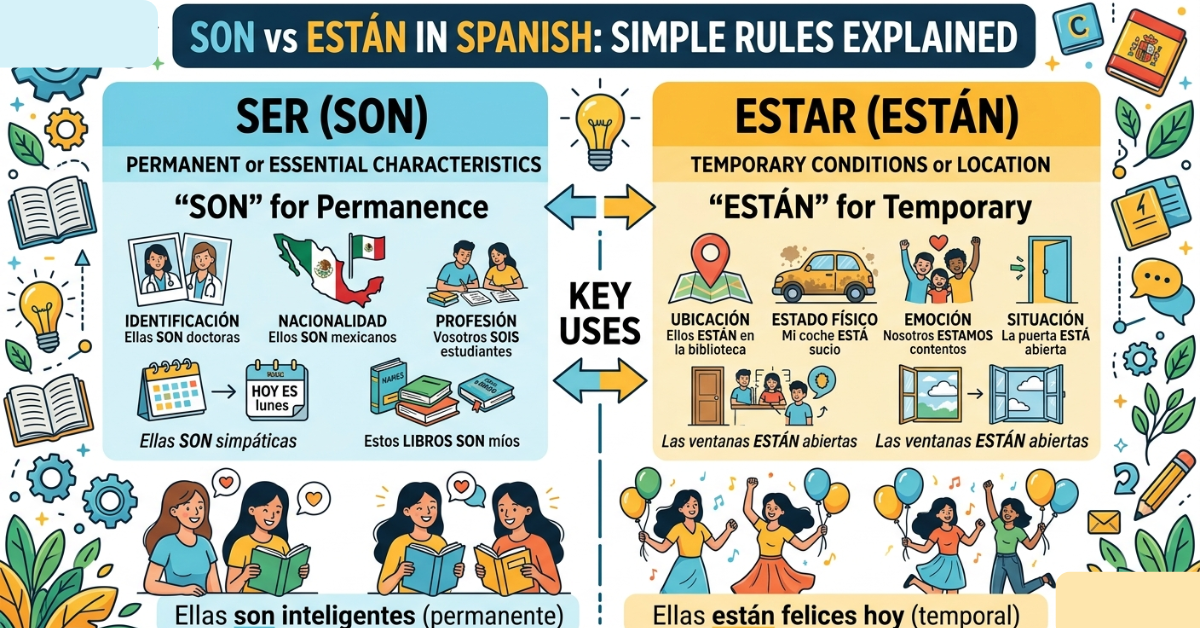
Son = permanent identity, characteristics, or classification

Use son when talking about:

  • identity
  • origin
  • profession
  • time
  • relationships
  • general qualities
  • classification

Están = location, condition, or temporary state

Use están when talking about:

  • where someone or something is
  • emotions
  • health
  • physical condition
  • temporary situations
  • ongoing actions in some contexts

The Core Rule for Son vs Están

A simple way to remember son vs están is this:

  • Son = what something is
  • Están = how something is right now or where it is

This is the heart of son vs estan in Spanish. Once you learn this difference, many sentences become much easier.

When to Use Son

Use son when the sentence describes something that is usually stable, essential, or part of identity.

1. Identity and profession

  • Ellos son estudiantes.
    They are students.
  • Mi madre y mi padre son médicos.
    My mother and father are doctors.

Here, you are describing who they are, not a temporary state.

2. Origin or nationality

  • Somos de Pakistán.
    We are from Pakistan.
  • Ellos son españoles.
    They are Spanish.

3. Time and dates

  • Son las tres.
    It is three o’clock.
  • Hoy son las cinco de la tarde.
    Today it is five in the evening.

Time expressions always use son in this form.

4. General qualities and descriptions

  • Las flores son hermosas.
    The flowers are beautiful.
  • Los libros son interesantes.
    The books are interesting.

These describe lasting or general characteristics.

5. Relationships and classification

  • María y Ana son hermanas.
    María and Ana are sisters.
  • Eso son problemas de gramática.
    Those are grammar problems.

When to Use Están

Use están when the sentence refers to location, temporary condition, or something that can change.

1. Location

  • Los estudiantes están en clase.
    The students are in class.
  • El libro está en la mesa.
    The book is on the table.

If you are saying where something is, use están.

2. Temporary physical state or mood

  • Estoy cansada.
    I am tired.
  • Ellos están felices hoy.
    They are happy today.

Tiredness, mood, and feelings often use estar because they can change.

3. Health or condition

  • La comida está fría.
    The food is cold.
  • Mi hermana está enferma.
    My sister is sick.

These describe current conditions, not permanent identity.

4. Ongoing actions

  • Estamos estudiando español.
    We are studying Spanish.
  • Los niños están jugando.
    The children are playing.

This form is very common when describing what is happening right now.

Son vs Están: Side-by-Side Comparison

Here is where the difference becomes clearer.

Using son Using están
Ellos son inteligentes. Ellos están cansados.
La casa es grande. La casa está en la calle principal.
Nosotros somos amigos. Nosotros estamos en casa.
Las manzanas son rojas. Las manzanas están en la nevera.

Notice the pattern:

  • Son describes identity or permanent traits
  • Están describes location or temporary conditions

A Very Important Tip: Some Adjectives Change Meaning

One of the trickiest parts of son vs estan is that some adjectives can mean something different depending on whether you use ser or estar.

Examples

  • Es aburrido = He is boring
  • Está aburrido = He is bored
  • Es listo = He is clever
  • Está listo = He is ready
  • Es rico = He is rich
  • Está rico = It tastes delicious

This is where many learners make mistakes, because the verb changes the meaning, not just the grammar.

Easy Memory Tricks

If you are still unsure about when to use son vs estan, these tricks help a lot.

1. Use “son” for identity

Ask yourself:
“Am I describing what this person or thing is?”

If yes, use son.

2. Use “están” for location or temporary situation

Ask yourself:
“Am I describing where it is or how it is right now?”

If yes, use están.

3. Think permanent vs temporary

  • Son = more permanent or defining
  • Están = more temporary or changeable

This is not a perfect rule for every single sentence, but it works very well for beginners.

Common Mistakes Learners Make

Here are a few frequent errors with son vs estan in Spanish.

Mistake 1: Using están for identity

Wrong: Ellos están estudiantes.
Correct: Ellos son estudiantes.

Students is a classification, so use son.

Mistake 2: Using son for location

Wrong: Los libros son en la mesa.
Correct: Los libros están en la mesa.

Location needs están.

Mistake 3: Mixing up temporary and permanent traits

Wrong: Estoy inteligente hoy.
Correct: Soy inteligente.

Intelligence is usually seen as a characteristic, so soy is correct, not estoy.

Real-Life Examples in Daily Spanish

To understand son vs estan, it helps to see how native speakers use them in everyday life.

At school

  • Los profesores son estrictos.
    The teachers are strict.
  • Los profesores están en la oficina.
    The teachers are in the office.

At home

  • Mis hermanos son muy tranquilos.
    My siblings are very calm.
  • Mis hermanos están durmiendo.
    My siblings are sleeping.

In a restaurant

  • La sopa está caliente.
    The soup is hot.
  • Los ingredientes son frescos.
    The ingredients are fresh.

With emotions

  • Estoy contenta.
    I am happy.
  • Ella está nerviosa.
    She is nervous.

These examples show how natural the difference becomes once you start noticing context.

A Quick Formula to Choose the Right Word

When deciding between son and están, use this fast check:

  1. Is it identity, profession, time, or a general characteristic?
    → Use son
  2. Is it location, emotion, health, or a temporary state?
    → Use están
  3. Is the adjective changing the meaning depending on the verb?
    → Check the context carefully

Key Takeaways

  • Son comes from ser and is used for identity, origin, time, and general traits.
  • Están comes from estar and is used for location, temporary conditions, emotions, and ongoing actions.
  • Some adjectives change meaning depending on which verb you use.
  • The easiest way to remember son vs estan is: son = what it is, están = where or how it is right now.

FAQ: Son vs Están in Spanish

1. What is the difference between son and están?

Son is used for identity, time, and permanent or general traits. Están is used for location, temporary conditions, and states that can change.

2. When to use son vs estan in Spanish?

Use son for who or what something is, and están for where it is or how it is at the moment. That is the simplest way to separate them.

3. Is son from ser and están from estar?

Yes. Son is a form of ser, and están is a form of estar. Both mean “to be,” but they are used in different situations.

4. Can son and están both mean “are”?

Yes, both can translate as “are” in English, which is why learners confuse them. The real difference depends on the type of meaning in the sentence.

5. Why does está aburrido mean “bored” but es aburrido mean “boring”?

Because estar often describes a temporary state, while ser describes a more permanent quality. That is why the meaning changes.

6. How can I remember son vs estan easily?

Think: son for identity and general description, están for location and temporary condition. Repeating simple examples helps the pattern stick quickly.

Conclusion

Learning son vs estan is one of the most useful steps in building confidence in Spanish. Once you understand the difference between ser and estar, the language starts to feel much more logical and less random.

The best way to master son vs estan in Spanish is to practice with real sentences, pay attention to context, and remember the simple rule: son for what something is, están for where it is or how it is right now. Keep using the examples, and the choice will become much more natural over time.

Leave a Reply

Your email address will not be published. Required fields are marked *

Author

britsx85@gmail.com

Related Posts

To Many or Too Many: What's the Correct Usage?
In

To Many or Too Many: What’s the Correct Usage?

Have you ever paused while writing and wondered whether it should be to many or too many? You’re not alone. This is...

Read out all
Shown Synonym: Best Alternatives, Meaning & Examples
In

Shown Synonym: Best Alternatives, Meaning & Examples

Have you ever written the word shown several times in the same paragraph and wondered if there was a better alternative? You’re...

Read out all
To Fast or Too Fast? Learn the Correct Usage Easily
In

To Fast or Too Fast? Learn the Correct Usage Easily

Have you ever paused while typing and wondered, “Is it to fast or too fast?” You’re not alone. It’s one of the...

Read out all
Inter vs Intra: Meaning, Differences & Easy Examples
In

Inter vs Intra: Meaning, Differences & Easy Examples

Have you ever wondered why words like international, interstate, intramural, and intracellular all sound similar but mean completely different things? The secret...

Read out all
Learn the difference between vicious vs viscous with simple definitions, examples, pronunciation, and easy memory tricks to use each word correctly.
In

Vicious vs Viscous: What’s the Difference?

Have you ever read a sentence and wondered whether the correct word was vicious or viscous? You’re not alone. These two words...

Read out all
What Is FAFO? Meaning, Slang, Parenting, and Texting
In

What Is FAFO? Meaning, Slang, Parenting, and Texting

Ever seen FAFO in a comment, text, or parenting discussion and wondered what it means? The short answer is that what is...

Read out all