×
Oar vs Ore: Meaning, Differences & Easy Guide Explained
In

The confusion between oar vs ore is more common than you might think. Even native English speakers sometimes mix them up because they sound identical but have completely different meanings. In this guide, we’ll break down oar vs ore in a simple, human way so you never confuse them again.

At first glance, these words may seem similar, but one belongs to the world of water and rowing, while the other comes from geology and mining. Let’s clear up the confusion once and for all.

What is an Oar?

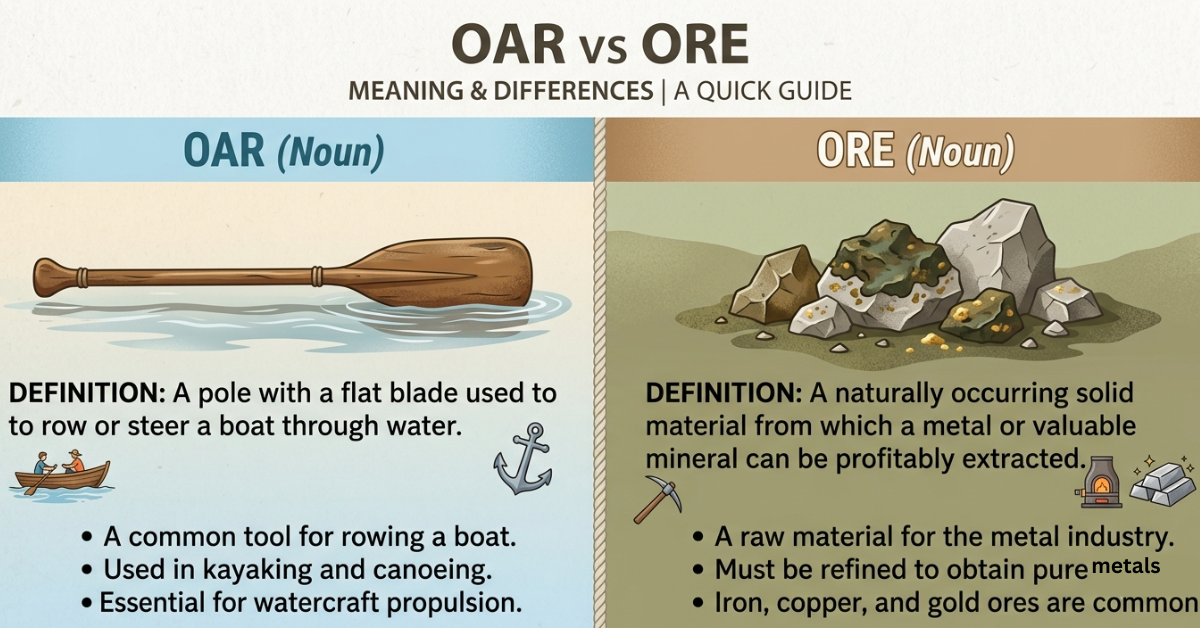
An oar is a long, flat blade attached to a boat and used for rowing through water. It helps propel small boats like rowboats, canoes, or kayaks.

Key Features of an Oar:

  • Used in water transport
  • Manually operated (no engine needed)
  • Made of wood, aluminum, or fiberglass
  • Helps push or pull water for movement

Example Sentences:

  • He grabbed the oar and rowed across the lake.
  • The boat moved smoothly as she dipped the oar into the water.

In simple terms, an oar is all about movement on water.

What is Ore?

Ore refers to a naturally occurring rock or mineral from which valuable metals or resources can be extracted. It is commonly used in mining and geology.

Key Features of Ore:

  • Found in the earth’s crust
  • Contains valuable metals like iron, copper, or gold
  • Extracted through mining
  • Used in industries and manufacturing

Example Sentences:

  • The miners discovered a rich deposit of iron ore.
  • Gold ore is processed to extract pure gold.

So, ore is all about natural resources hidden inside the earth.

Oar vs Ore: Key Differences

Understanding oar vs ore becomes easy when you compare them side by side:

1. Meaning

  • Oar: A tool for rowing boats
  • Ore: A natural mineral containing metals

2. Usage

  • Oar: Water transport and rowing
  • Ore: Mining and geology

3. Origin

  • Oar: Man-made tool
  • Ore: Naturally occurring substance

4. Context

  • Oar: Rivers, lakes, boats
  • Ore: Mines, rocks, industries

Why Do People Confuse Oar and Ore?

The main reason behind the confusion is pronunciation. Both words sound exactly the same, making them classic examples of homophones in English.

Other similar confusing word pairs include:

  • their / there
  • sea / see
  • flour / flower

These words often trip up learners because spelling is the only difference.

Easy Trick to Remember Oar vs Ore

Here’s a simple memory hack:

  • Oar = Ocean (water) → think rowing a boat
  • Ore = Earth (minerals) → think mining from the ground

This association makes it much easier to remember the difference.

Common Usage Examples

Here are more real-life examples to strengthen your understanding:

Oar Examples:

  • The fisherman fixed the broken oar.
  • They rowed together, each holding an oar.

Ore Examples:

  • The country exports large quantities of iron ore.
  • The scientist studied samples of copper ore.

Quick Comparison List

  • One is used in water, the other in mining
  • One is a tool, the other is a natural material
  • One helps movement, the other provides resources
  • Both sound the same but mean completely different things

FAQs About Oar vs Ore

1. What is the main difference between oar and ore?

An oar is used for rowing boats, while ore is a natural mineral containing metals.

2. Are oar and ore pronounced the same?

Yes, they are homophones and sound identical but have different meanings.

3. Is oar a tool or a material?

An oar is a tool used in boating.

4. Where is ore found?

Ore is found naturally in the earth, usually in mines or rock formations.

5. Why are oar and ore confusing?

They are confusing because they have the same pronunciation but different spellings and meanings.

Conclusion

Understanding oar vs ore becomes simple once you remember their context: one belongs to water and rowing, and the other belongs to earth and mining. Although they sound the same, their meanings are completely unrelated.

Next time you come across these words, think of boats for oar and minerals for ore. This small trick will help you avoid confusion forever and improve your English vocabulary naturally.

Leave a Reply

Your email address will not be published. Required fields are marked *

Author

khatrialiraza31@gmail.com

Related Posts

Kill Two Birds With One Stone Alternative: 50 Better Options
In

Kill Two Birds With One Stone Alternative: 50 Better Options

Have you ever paused before saying “kill two birds with one stone” because it sounded too violent or simply didn’t fit the...

Read out all

Happy Sabbath Meaning: A Complete Guide to Its Significance
In

Happy Sabbath Meaning: A Complete Guide to Its Significance

Have you ever received the message “Happy Sabbath” and wondered what it truly means? Is it simply another way of saying “have...

Read out all

I'm So Proud of You in Other Words: 100+ Heartfelt Alternatives
In

I’m So Proud of You in Other Words: 120+ Heartfelt Alternatives

Have you ever wanted to tell someone you’re proud of them but felt like saying “I’m so proud of you” sounded repetitive?...

Read out all

How Do You Spell Happy Anniversary? Correct Spelling Guide
In

How Do You Spell Happy Anniversary? Correct Spelling Guide

Have you ever paused before writing an anniversary card and wondered, “How do you spell happy anniversary?” You’re not alone. Whether you’re...

Read out all

Waiting for Your Response Email: Best Examples & Tips
In

Waiting for Your Response Email: Best Examples & Tips

Have you ever sent an important email and found yourself wondering whether you should follow up or simply wait? Whether you’re communicating...

Read out all

Great Asset to the Team: Meaning, Examples & Tips
In

Great Asset to the Team: Meaning, Examples & Tips

Have you ever wanted to compliment a coworker but struggled to find words that sound professional and sincere? One of the most...

Read out all