×
No Later Than or Then: Which One Is Correct?
In

Have you ever written a sentence like “Submit the form no later than Friday or then Friday” and suddenly paused, unsure if it even makes sense? You’re not alone. Many English learners—and even native speakers—get confused between no later than or then, especially when setting deadlines or describing time.

In this guide, we’ll break down no later than or then, explain their correct usage, highlight common mistakes, and give you simple examples so you never mix them up again.

Understanding “No Later Than” vs “Then”

Before comparing them directly, it’s important to understand what each phrase actually means.

What does “No later than” mean?

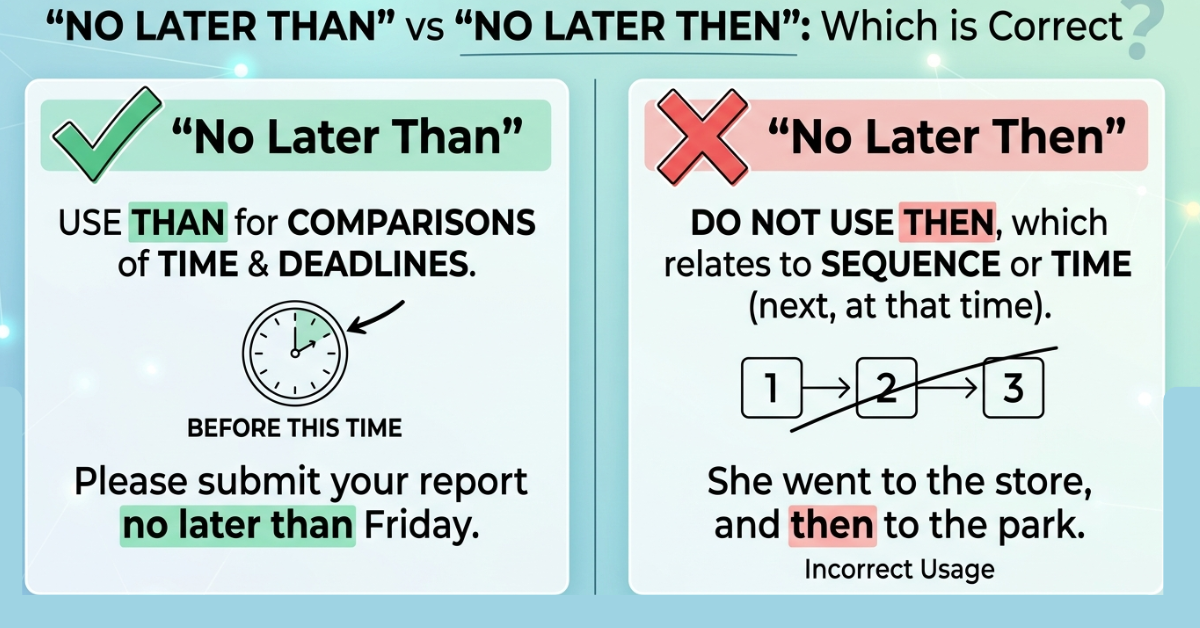
“No later than” is used to set a strict deadline. It means something must happen at or before a specific time.

Examples:

  • Submit your assignment no later than Monday.
  • Arrive no later than 8 PM.
  • Payment must be made no later than the due date.

In simple terms, it defines a limit—nothing after that point is allowed.

So when you ask no later than or then, the correct phrase for deadlines is always “no later than.”

What does “Then” mean?

“Then” refers to time or sequence. It tells us what happens next or at that time.

Examples:

  • We went to dinner, and then we watched a movie.
  • If you finish early, then you can leave.
  • He studied hard and then passed the exam.

Unlike “no later than,” “then” does not set deadlines. It simply connects events in order.

No Later Than or Then: Key Difference Explained

The confusion between usually comes from their similar sound and time-related meanings. But grammatically, they serve completely different purposes.

Here’s a clear comparison:

Phrase Meaning Usage
No later than Deadline or limit Used for due dates, schedules
Then Sequence or next step Used for order of events

Simple rule to remember:

  • Use “no later than” when talking about deadlines.
  • Use “then” when talking about what happens next.

So, if you’re still wondering about, the correct choice depends entirely on your intent.

Why People Confuse “No Later Than or Then”

There are a few common reasons this confusion happens:

1. Time-related context

Both phrases deal with time, which makes them easy to mix up.

2. Spoken English influence

In fast speech, “than” and “then” can sound almost identical.

3. Lack of grammar clarity

Many learners never clearly learn the difference between time sequencing and time limits.

Understanding this distinction finally clears up the confusion.

Real-World Examples

Let’s see how both are used in everyday situations:

Using “No later than”

  • Job applications must be submitted no later than Friday.
  • Students should arrive no later than 9 AM.
  • The report is due no later than the end of the day.

Using “Then”

  • Finish your homework, then watch TV.
  • She packed her bags and then left for the airport.
  • Study first, and then relax.

These examples make it clear: no later than or then are not interchangeable.

Common Mistakes to Avoid

When using, watch out for these errors:

  • Incorrect:  Submit it no later then Monday
    Correct: Submit it no later than Monday
  • Incorrect:  Finish your work no later than you can go
    Correct: Finish your work, and then you can go
  • Incorrect:  We ate dinner no later than watched a movie
    Correct: We ate dinner, and then watched a movie

Even small spelling changes can completely change meaning.

Practical Tips to Remember the Difference

Here are some simple tricks:

  • Think of “than” = limit (comparison/deadline)
  • Think of “then” = time order (what happens next)
  • If you can replace it with “after that,” use then
  • If you can replace it with “by this time,” use no later than

These memory tricks make no later than or then much easier to handle.

Key Takeaways

  • No later than = strict deadline or time limit
  • Then = sequence of events or next action
  • They are not interchangeable
  • Most confusion comes from similar pronunciation
  • Context determines the correct choice

FAQ: No Later Than or Then

1. Is it “no later than” or “no later then”?

The correct phrase is “no later than.” “Then” is incorrect in this context because it does not express a deadline.

2. Can I use “then” instead of “no later than”?

No. “Then” is used for sequence, not deadlines. Using it instead of “no later than” changes the meaning completely.

3. What does “no later than” mean in simple words?

It means something must happen before or at a specific time, but never after it.

4. Why do people confuse no later than or then?

They sound similar when spoken, and both relate to time, but their grammatical roles are different.

5. Is “submit it then Monday” correct?

No. The correct form is “submit it no later than Monday.”

6. How do I remember the difference easily?

Use this rule:

  • Than = deadline
  • Then = next step

Conclusion

Understanding this is easier once you know their roles in a sentence. One sets a strict deadline, while the other shows sequence. They may sound similar, but their meanings are completely different.

Next time you write or speak, choose carefully based on context. If you’re talking about timing limits, go with no later than. If you’re describing what happens next, use then.

Mastering this small difference can instantly improve your clarity and make your English sound more natural and professional.

Leave a Reply

Your email address will not be published. Required fields are marked *

Author

khatrialiraza31@gmail.com

Related Posts

Kill Two Birds With One Stone Alternative: 50 Better Options
In

Kill Two Birds With One Stone Alternative: 50 Better Options

Have you ever paused before saying “kill two birds with one stone” because it sounded too violent or simply didn’t fit the...

Read out all

Happy Sabbath Meaning: A Complete Guide to Its Significance
In

Happy Sabbath Meaning: A Complete Guide to Its Significance

Have you ever received the message “Happy Sabbath” and wondered what it truly means? Is it simply another way of saying “have...

Read out all

I'm So Proud of You in Other Words: 100+ Heartfelt Alternatives
In

I’m So Proud of You in Other Words: 120+ Heartfelt Alternatives

Have you ever wanted to tell someone you’re proud of them but felt like saying “I’m so proud of you” sounded repetitive?...

Read out all

How Do You Spell Happy Anniversary? Correct Spelling Guide
In

How Do You Spell Happy Anniversary? Correct Spelling Guide

Have you ever paused before writing an anniversary card and wondered, “How do you spell happy anniversary?” You’re not alone. Whether you’re...

Read out all

Waiting for Your Response Email: Best Examples & Tips
In

Waiting for Your Response Email: Best Examples & Tips

Have you ever sent an important email and found yourself wondering whether you should follow up or simply wait? Whether you’re communicating...

Read out all

Great Asset to the Team: Meaning, Examples & Tips
In

Great Asset to the Team: Meaning, Examples & Tips

Have you ever wanted to compliment a coworker but struggled to find words that sound professional and sincere? One of the most...

Read out all