
- 0
- 765 words
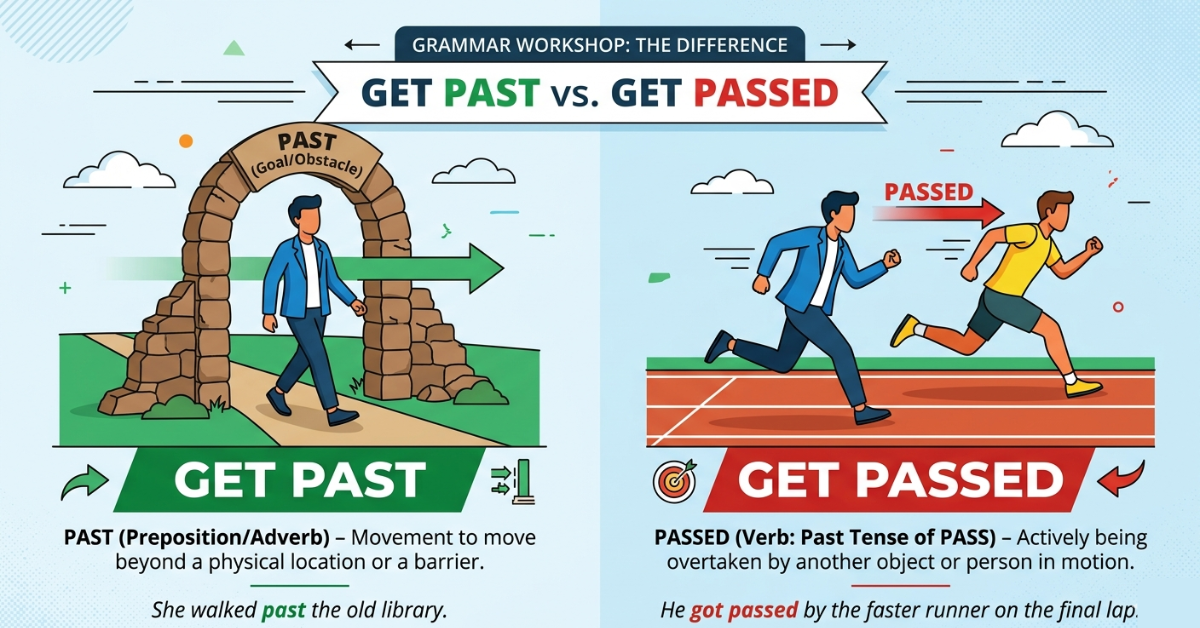
Have you ever felt unsure about whether to use get past or get passed in a sentence? This is a very common grammar confusion, and it often leads to mistakes in writing and speaking. Although these two phrases look similar, they carry completely different meanings. Because of that, using them correctly depends on understanding context rather than spelling alone.
In this guide, you will learn how both phrases work, when to use them, and how to avoid common errors. You will also see simple examples that make everything easy to remember.
Understanding “get past”
First, let’s understand get past. This phrase usually refers to moving beyond something, overcoming an obstacle, or progressing forward. It shows action and effort from the subject.
For example:
- I cannot get past this issue right now.
- She is trying to get past her fear of flying.
- We must get past this stage to continue the project.
In all these cases, the focus stays on overcoming something. The subject actively works through a difficulty, challenge, or barrier.
Understanding “get passed”
Now let’s look at. This phrase works differently because it often appears in passive structures. It refers to something being approved, transferred, or moved along by another person or system.
For example:
- The proposal got passed after the meeting.
- The message got passed to the manager.
- His name got passed over for promotion.
Here, the subject receives the action instead of doing it. This is why get passed feels more passive in meaning and structure.
Key difference between the two
To make things easier, compare both meanings side by side.
- Get past → focuses on overcoming or moving beyond something
- Get passed → focuses on approval, transfer, or passive action
So, while one shows progress through effort, the other shows something happening to the subject through external action.
Real-world examples
Let’s look at how both phrases appear in real life.
Using get past:
- He struggled but finally got past the difficult exam.
- I need to get past this stressful situation.
- They couldn’t get past the security checkpoint.
Using get passed:
- The bill got passed by parliament.
- The note got passed around the room.
- She got passed over during the selection process.
As you can see, context clearly decides which phrase fits better.
Common mistakes learners make
Many learners mix up because both words sound similar. However, the meaning changes completely if you choose the wrong one.
Here are corrected examples:
- Incorrect: I want to get passed this problem.
Correct: I want to get past this problem. - Incorrect: The law got past the parliament.
Correct: The law got passed by the parliament. - Incorrect: She got passed her fear.
Correct: She got past her fear.
Once you focus on meaning instead of spelling, these mistakes become easier to avoid.
Easy memory trick
To remember the difference quickly, use this simple idea:
- “Past” = beyond or forward movement
- “Passed” = something done or approved by others
So, whenever you think about overcoming something, choose get past. However, when something is approved or transferred, choose get passed.
Why this distinction matters
Understanding this difference improves both writing and speaking clarity. It also helps you sound more natural in English conversations. Even though this seems like a small grammar point, it plays an important role in effective communication.
Moreover, using the correct phrase builds confidence, especially in academic and professional settings.
Quick summary
- Get past = overcome or move beyond something
- Get passed = something is approved, transferred, or acted on
Always check the meaning before choosing the phrase.
FAQ: Get past or get passed
1. What is the main difference between get past or get passed?
“Get past” means overcoming something, while “get passed” refers to something being approved or transferred.
2. Is get past a phrasal verb?
Yes, it is a phrasal verb used to describe moving beyond challenges or obstacles.
3. When should I use get passed?
Use it in passive situations like laws, messages, or decisions being approved or transferred.
4. Why do people confuse these two phrases?
They sound similar, but their meanings depend on context and grammar structure.
5. Can both phrases be used in everyday English?
Yes, both are common, but they are used in different situations depending on meaning.
Conclusion
The difference between get past or get passed becomes simple once you understand their roles. One helps you talk about overcoming challenges, while the other describes approval or passive actions. By focusing on meaning instead of appearance, you can avoid mistakes and use both phrases correctly.
With regular practice, you will naturally choose the right expression without hesitation, making your English clearer and more accurate.
Author

linguaezone.com@gmail.com
Related Posts
Kill Two Birds With One Stone Alternative: 50 Better Options
- 0
- 1,569 word
Have you ever paused before saying “kill two birds with one stone” because it sounded too violent or simply didn’t fit the...
Read out all
Happy Sabbath Meaning: A Complete Guide to Its Significance
- 0
- 1,632 word
Have you ever received the message “Happy Sabbath” and wondered what it truly means? Is it simply another way of saying “have...
Read out all
I’m So Proud of You in Other Words: 120+ Heartfelt Alternatives
- 0
- 1,562 word
Have you ever wanted to tell someone you’re proud of them but felt like saying “I’m so proud of you” sounded repetitive?...
Read out all
How Do You Spell Happy Anniversary? Correct Spelling Guide
- 0
- 1,221 word
Have you ever paused before writing an anniversary card and wondered, “How do you spell happy anniversary?” You’re not alone. Whether you’re...
Read out all
Waiting for Your Response Email: Best Examples & Tips
- 0
- 1,483 word
Have you ever sent an important email and found yourself wondering whether you should follow up or simply wait? Whether you’re communicating...
Read out all
Great Asset to the Team: Meaning, Examples & Tips
- 0
- 1,494 word
Have you ever wanted to compliment a coworker but struggled to find words that sound professional and sincere? One of the most...
Read out all