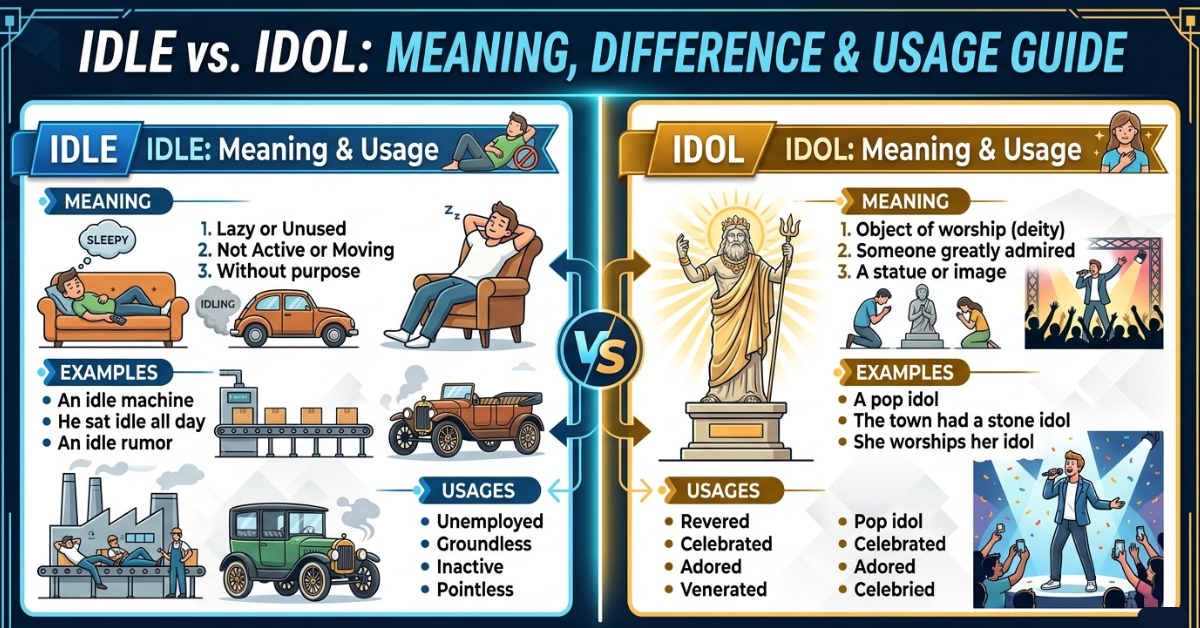
The confusion between idle vs idol is more common than you might think, especially in spoken and written English where both words sound almost identical. The phrase idle vs idol often appears in search queries because learners want to avoid embarrassing spelling mistakes that completely change meaning.
At first glance, these words may look similar, but they carry very different meanings. One refers to inactivity, while the other represents admiration or worship. Let’s break it down in a simple, practical way so you never mix them up again.
Idle vs Idol: Meaning Explained
To understand idle vs idol, you need to look at each word separately.
Idle (meaning inactivity or unused)
The word idle is used when something is not working, moving, or being used.
Common meanings:
- Not active or in use
- Lazy or doing nothing
- Engine running without movement
Examples:
- The machine has been idle for hours.
- He spent the afternoon feeling idle at home.
- The car engine was left idle at the signal.
Idol (meaning admiration or worship)
On the other hand, idol refers to someone or something that is greatly admired, loved, or even worshipped.
Common meanings:
- A famous person admired by fans
- An object of worship in religion
- A role model
Examples:
- She is a pop music idol for millions of fans.
- In ancient times, people worshipped stone idols.
- He is my childhood sports idol.
Key Difference Between Idle vs Idol
The main difference in idle vs idol is meaning and usage context. Even though they sound similar, their functions in sentences are completely unrelated.
Here’s a simple breakdown:
- Idle → inactivity, not working, or being lazy
- Idol → admiration, worship, or role model
Quick Comparison:
- Idle computer = not in use
- Idol singer = highly admired celebrity
Understanding this distinction helps improve spelling accuracy and communication clarity.
Common Mistakes People Make
Many English learners confuse because of pronunciation similarities. This often leads to spelling errors in exams, writing, or casual messaging.
Here are common mistakes:
- Writing “I am idol at home” instead of “idle”
- Using “idle” when talking about celebrities
- Mixing meanings in sentences due to sound similarity
Why this happens:
- Both words sound almost identical
- Fast typing leads to auto-correct errors
- Lack of context understanding
Easy Memory Trick to Remember Idle vs Idol
If you struggle, this simple trick can help:
- Idle = D for Doing nothing (or “Dead activity”)
- Idol = O for Object of admiration
Another way:
- Idle has an “e” like “empty”
- Idol has an “o” like “only admired”
These mental associations make it easier to recall the correct spelling during writing.
Real-Life Usage Examples
Let’s make even clearer with everyday usage:
- The factory machines remained idle during the holiday.
- She considers her mother her biggest idol in life.
- Don’t let your phone stay idle for too long.
- Teenagers often follow their favorite social media idols.
- A parked car with its engine idle consumes fuel unnecessarily.
FAQs about Idle vs Idol
1. What is the main difference between idle and idol?
Idle means not active or in use, while idol means someone or something greatly admired or worshipped.
2. Why do people confuse idle vs idol?
Because both words sound similar in pronunciation, leading to spelling and meaning confusion.
3. Can idle be used for people?
Yes, it can describe a person not doing any work or being inactive.
4. What is an example of idol in a sentence?
“Rihanna is a global music idol for millions of fans.”
5. How can I remember idle vs idol easily?
Think of idle as inactivity (empty time) and idol as admiration (a role model).
Conclusion
Understanding idle vs idol is essential for clear and correct English communication. While idle refers to inactivity or lack of use, idol represents admiration and respect toward a person or figure.
By remembering simple examples and memory tricks, you can easily avoid confusion and improve your writing skills. Keep practicing with real sentences, and soon the difference will become second nature.