
×
Hanged vs Hung: Meaning, Grammar & Usage Explained
In

The confusion between hanged vs hung often troubles English learners and even native speakers. Many people mix them up because both forms come from the same verb “hang.” However, the hanged vs hung meaning changes depending on context, tense, and usage.

In this guide, we clearly explain hanged vs hung grammar, show real examples, and also highlight hanged vs hung USA usage. Moreover, you will learn simple tricks that help you avoid mistakes forever.

What Do Hanged vs Hung Mean?

To understand this topic clearly, we first need to separate the two forms of the verb.

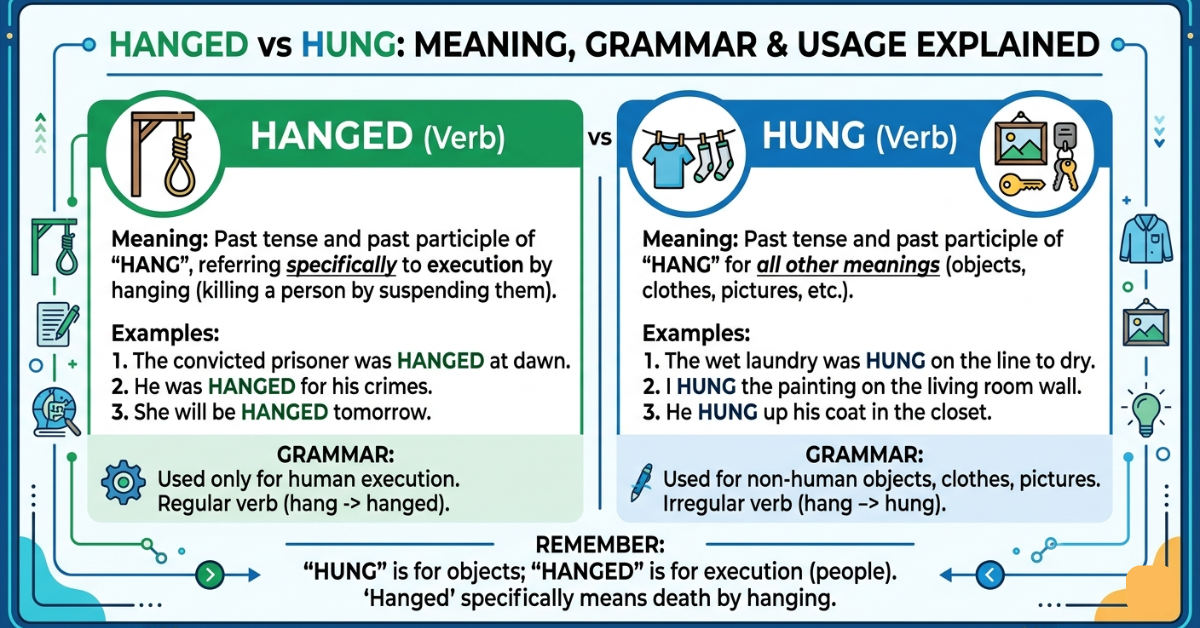
 Hung (General Usage)

We use “hung” in most everyday situations. It describes objects being placed or suspended.

For example:

  • She hung the curtains yesterday.
  • He hung the painting carefully on the wall.
  • They have hung the decorations already.

Therefore, “hung” works as the standard form in modern English.

 Hanged (Special Usage Only)

On the other hand, we use “hanged” only in one specific case—execution by hanging.

For example:

  • The criminal was hanged in the 1800s.
  • Historical records show he was hanged for treason.

In short, “hanged” applies only to legal or historical execution, not objects.

Hanged vs Hung Grammar Rules (Simple Breakdown)

To avoid confusion, follow these clear grammar rules.

1. Use “Hung” for Objects

We always use “hung” when talking about things like clothes, pictures, or decorations.

2. Use “Hanged” for Execution

We use “hanged” only when referring to capital punishment.

3. Avoid Common Mistakes

Many learners incorrectly mix both forms. However, this rule fixes it instantly:

Incorrect:  He was hung for murder.
Correct: He was hanged for murder.

Hanged vs Hung in USA English Usage

In the USA, writers follow the same rule. However, they apply it more strictly in formal writing such as legal documents, news reports, and academic texts.

For example:

  • Newspapers consistently use “hanged” for execution cases.
  • Meanwhile, everyday speech mostly uses “hung” for all objects and actions.

As a result, the USA distinction stays consistent across both British and American English.

Quick Comparison Table

To make things easier, here is a simple comparison:

Situation Correct Form Example
Clothes on a line Hung She hung the clothes
Painting on wall Hung The frame was hung neatly
Execution Hanged The prisoner was hanged
Decorations Hung Lights were hung everywhere

Real-Life Examples

Let’s look at more practical examples to strengthen understanding:

  • She hung the mirror above the sofa.
  • The thief was hanged in historical records.
  • They hung flowers at the wedding venue.
  • The pirate was hanged for his crimes.

In addition, these examples show how context completely changes meaning.

Hanged vs Hung Worksheet Practice

Now, try this quick exercise to test your understanding.

Fill in the blanks:

  1. The criminal was ______ for murder.
  2. She ______ the curtains yesterday.
  3. The painting was ______ on the wall.
  4. The spy was ______ in the 1800s.

Answers:

  1. hanged
  2. hung
  3. hung
  4. hanged

Moreover, practicing this kind of worksheet regularly helps you master the rule faster.

Why People Still Get Confused

People often struggle with this grammar point for several reasons.

First, both words come from the same base verb “hang.”
Second, English irregular verbs behave differently depending on context.
Finally, modern usage simplifies “hung” in most daily communication.

Therefore, learners naturally mix them up.

Easy Memory Trick

To make it simple, remember this rule:

People are hanged, objects are hung.

Additionally, repeating this line helps you avoid errors in both writing and speech.

FAQs on Hanged vs Hung

1. What is the main difference between hanged vs hung?

“Hung” applies to objects, while “hanged” applies only to execution cases.

2. Can we use hung for people?

No. However, we only use “hanged” for execution-related meaning.

3. Is hanged vs hung still important in modern English?

Yes. In fact, it is very important for formal writing and exams.

4. What is the correct past tense of hang?

We use “hung” in general cases, but “hanged” for execution.

5. Does US English follow the same rule?

Yes. The USA follows the same grammar rule, although formal writing is stricter.

Conclusion

To summarize, the difference between hanged vs hung becomes easy once you understand the rule. We use hung for objects and hanged only for execution. Therefore, the hanged vs hung meaning depends completely on context.

In addition, mastering grammar improves your writing accuracy and helps you avoid common mistakes in exams and professional communication.

Finally, keep practicing examples and worksheets. Over time, the correct usage will become completely natural.

Leave a Reply

Your email address will not be published. Required fields are marked *

Author

britsx85@gmail.com

Related Posts

Leak vs Leek: Meaning, Difference & Easy Guide
In

Leak vs Leek: Meaning, Difference & Easy Guide

Have you ever seen the words leak and leek and wondered why they look almost identical but mean completely different things? This...

Read out all
Knead vs Need: Meaning, Difference & Usage Guide
In

Knead vs Need: Meaning, Difference & Usage Guide

English can be tricky, especially when two words sound the same but mean completely different things. One such confusing pair is Knead...

Read out all
Jam vs Jamb: Meaning, Difference & Usage Explained
In

Jam vs Jamb: Meaning, Difference & Usage Explained

The confusion around jam vs jamb is more common than you might think, especially among English learners and even native speakers. At...

Read out all
Incite vs Insight: Meaning, Difference & Usage Explained
In

Incite vs Insight: Meaning, Difference & Usage Explained

Have you ever stumbled while writing and wondered whether to use incite vs insight? You’re not alone. These two words sound similar...

Read out all
Idle vs Idol: Meaning, Difference & Usage Guide
In

Idle vs Idol: Meaning, Difference & Usage Guide

The confusion between idle vs idol is more common than you might think, especially in spoken and written English where both words...

Read out all
Hanger vs Hangar: Meaning, Differences & Usage Guide
In

Hanger vs Hangar: Meaning, Differences & Usage Guide

If you’ve ever paused while writing and wondered whether it’s hanger or hangar, you’re not alone. The confusion is surprisingly common because...

Read out all