
- 0
- 1,299 word
Have you ever stopped mid-sentence and wondered whether to write here is or here are? That small choice can feel confusing, especially when you are trying to sound natural and correct at the same time. Fortunately, the rule is simple once you understand how the noun works.
In this guide, you will learn when to use each form, how to choose the right one in here is or here are the details, and how to apply the rule with practical here is or here are examples. In addition, you will see common mistakes, useful tips, and a quick FAQ to make the idea easy to remember.
What “Here Is” and “Here Are” Mean
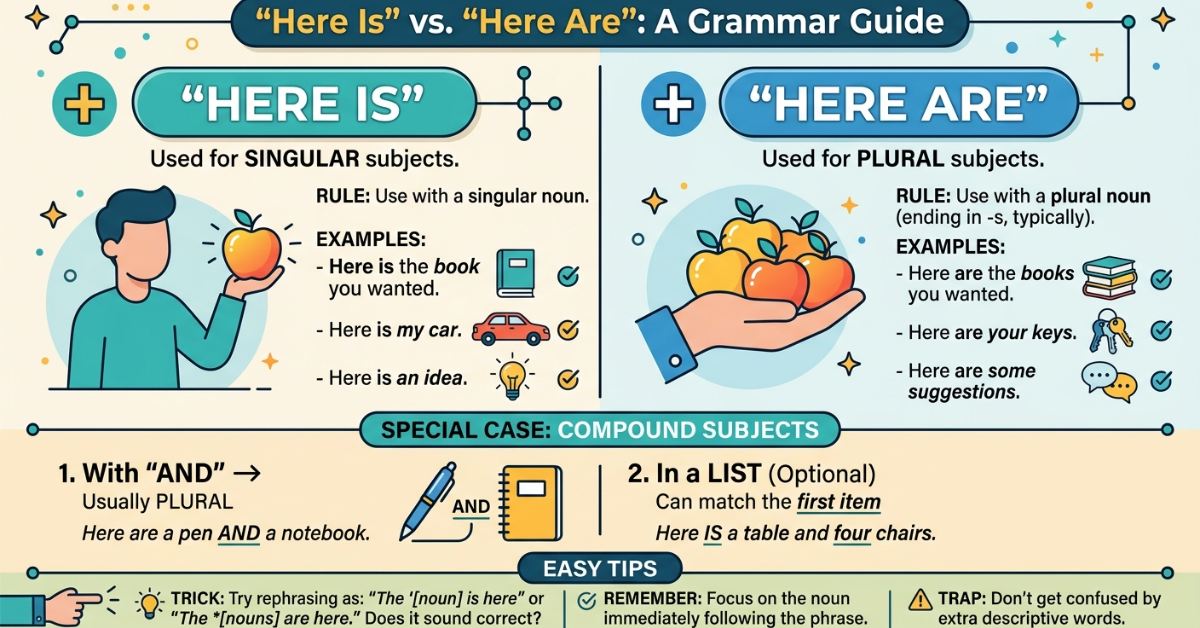
Both phrases are used to introduce or present something. In other words, they help you point out an item, a person, a document, or a piece of information.
- Here is is used with singular nouns and uncountable nouns.
- Here are is used with plural nouns.
For example:
- Here is your receipt.
- Here are your receipts.
So, the main job is to match the verb with the noun that follows it.
The Main Rule: Match the Verb to the Noun
The easiest way to choose correctly is to look at the noun after the phrase. If the noun is singular, use is. If it is plural, use are. Likewise, uncountable nouns usually take is.
Singular Nouns
Use Here is with one person or one thing.
- Here is the answer.
- Here is my bag.
- Here is the schedule.
Plural Nouns
Use Here are with more than one person or thing.
- Here are the answers.
- Here are my bags.
- Here are the schedules.
Uncountable Nouns
Use Here is with nouns that cannot be counted one by one.
- Here is some information.
- Here is the evidence.
- Here is your advice.
As a result, the sentence becomes grammatically correct and easier to understand.
Here Is or Here Are the Details?
This is one of the most common questions people search for. The correct form is Here are the details.
Why? Because details is a plural noun. Therefore, it needs the plural verb are.
Correct
- Here are the details.
Incorrect
- Here is the details.
Even though this mistake is common in speech, it is not correct in formal writing. For business emails, school work, and professional messages, here are the details is the form you should use.
Here Is or Here Are Examples
Examples make the rule much easier to remember. Moreover, they show how the phrase changes depending on the noun.
Singular Examples
- Here is your phone.
- Here is the report.
- Here is a fresh idea.
- Here is my notebook.
- Here is the final answer.
Plural Examples
- Here are your keys.
- Here are the reports.
- Here are three fresh ideas.
- Here are my notes.
- Here are the final answers.
Uncountable Examples
- Here is some water.
- Here is the information you asked for.
- Here is useful advice.
- Here is the furniture for the room.
- Here is the luggage from your trip.
Notice that the noun after the verb decides everything. For that reason, it is smarter to focus on the noun first and the phrase second.
Why People Get Confused
This grammar point confuses many learners because spoken English often sounds different from formal English. In casual conversation, people may say here’s before a plural noun without thinking about the rule. However, that habit does not always work in writing.
Another reason for the confusion is word order. Since here appears first, many people assume it controls the verb. In reality, the noun that comes after the verb is what matters.
Common Mistakes to Avoid
Here are a few mistakes that appear often:
- Here is the books → incorrect
Here are the books → correct - Here are the information → incorrect
Here is the information → correct - Here is the details → incorrect
Here are the details → correct - Here’s your keys → informal, but not ideal in formal writing
Here are your keys → correct
In formal communication, accuracy matters. Consequently, using the right form can make your writing look polished and professional.
A Simple Trick to Remember
A fast way to choose the correct form is to ignore the word here for a moment and look only at the noun.
Ask yourself:
- Is it one thing? Use here is.
- Is it more than one thing? Use here are.
- Is it uncountable? Use here is.
For example:
- One document → Here is the document.
- Several documents → Here are the documents.
- Some information → Here is the information.
This method works almost every time.
Real-Life Uses
You will see these phrases in everyday life, especially in school, work, and customer service.
At Work
- Here is the file you requested.
- Here are the meeting notes.
- Here is the updated schedule.
At School
- Here is your assignment.
- Here are the exam papers.
- Here is the class list.
In Daily Conversation
- Here is your coffee.
- Here are your shoes.
- Here is your message.
Because these phrases are so common, mastering them can instantly improve your spoken and written English.
Why Formal Writing Needs Extra Care
In speech, grammar can be more relaxed. In writing, however, readers expect clear and correct language. That is why here is or here are should be used carefully in emails, reports, essays, and presentations.
For example:
- Here are the details of the project sounds professional and correct.
- Here is the details of the project sounds awkward and incorrect.
Therefore, a small grammar choice can affect how polished your message appears.
Quick Comparison Table
| Noun Type | Correct Form | Example |
| Singular noun | Here is | Here is the book. |
| Plural noun | Here are | Here are the books. |
| Uncountable noun | Here is | Here is the information. |
This table is a handy reminder whenever you feel unsure.
Key Takeaways
- Use here is with singular nouns.
- Use here are with plural nouns.
- Use here is with uncountable nouns.
- The correct phrase is here are the details.
- The noun after the phrase matters more than the word here.
- In formal writing, avoid mixing singular and plural forms.
Frequently Asked Questions
Is it correct to say “here is the details”?
No. The word details is plural, so the correct form is here are the details. This is the version you should use in formal and professional writing.
Can I say “here’s your keys” in conversation?
Yes, people say it in casual speech, but it is not the best choice for formal writing. In standard grammar, here are your keys is correct.
What is the rule for here is or here are?
Use here is with singular and uncountable nouns, and use here are with plural nouns. The noun after the phrase decides which one is correct.
Is “here are examples” correct?
Yes, it is correct because examples is plural. In the same way, you would say here are the examples or here are some examples.
Why do native speakers sometimes mix these up?
In everyday conversation, people often focus on speed rather than grammar. As a result, they may use here’s even when the noun is plural.
How can I remember the difference easily?
Check the noun first. If it is one item, use here is. If it is more than one, use here are. That simple habit will prevent most mistakes.
Conclusion
Learning here is or here are is really about one thing: matching the verb to the noun. Once you notice whether the noun is singular, plural, or uncountable, the correct choice becomes much easier. In addition, remembering the phrase here are the details will help you avoid one of the most common grammar errors in English.
With a little practice, you will start using these phrases naturally and correctly. So, keep this rule in mind, apply it in your writing, and use the examples above whenever you need a quick reminder.
Author

linguaezone.com@gmail.com
Related Posts

Kill Two Birds With One Stone Alternative: 50 Better Options
- 0
- 1,569 word
Have you ever paused before saying “kill two birds with one stone” because it sounded too violent or simply didn’t fit the...
Read out all
Happy Sabbath Meaning: A Complete Guide to Its Significance
- 0
- 1,632 word
Have you ever received the message “Happy Sabbath” and wondered what it truly means? Is it simply another way of saying “have...
Read out all
I’m So Proud of You in Other Words: 120+ Heartfelt Alternatives
- 0
- 1,562 word
Have you ever wanted to tell someone you’re proud of them but felt like saying “I’m so proud of you” sounded repetitive?...
Read out all
How Do You Spell Happy Anniversary? Correct Spelling Guide
- 0
- 1,221 word
Have you ever paused before writing an anniversary card and wondered, “How do you spell happy anniversary?” You’re not alone. Whether you’re...
Read out all
Waiting for Your Response Email: Best Examples & Tips
- 0
- 1,483 word
Have you ever sent an important email and found yourself wondering whether you should follow up or simply wait? Whether you’re communicating...
Read out all
Great Asset to the Team: Meaning, Examples & Tips
- 0
- 1,494 word
Have you ever wanted to compliment a coworker but struggled to find words that sound professional and sincere? One of the most...
Read out all