
×
Calve or Calf: Meaning, Difference & Usage Explained
In

Have you ever paused mid-sentence wondering whether to write calve or calf? You’re not alone. These two words look similar, sound somewhat related, but they belong to completely different meanings and contexts.

Understanding calve or calf is not just about grammar—it helps you write clearly, avoid confusion, and sound more confident in English. In this guide, you’ll learn their meanings, differences, correct usage, real-life examples, and common mistakes people make.

Let’s clear up the confusion once and for all.

What Does “Calf” Mean? (Noun Usage Explained)

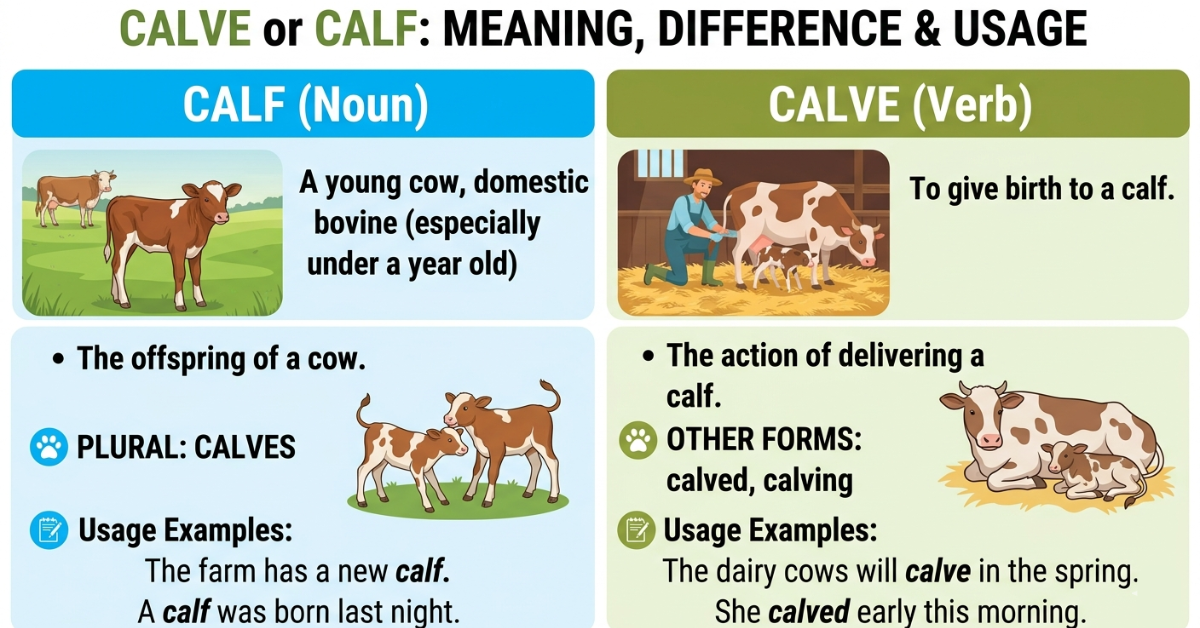
The word calf is a noun and has two primary meanings:

1. A Baby Animal

A calf refers to the young of certain large mammals, such as:

  • Cows
  • Elephants
  • Whales
  • Giraffes

Example:
The cow gave birth to a healthy calf.

2. Part of the Human Leg

The calf also refers to the back portion of your lower leg, between the knee and ankle.

Example:
He felt pain in his calf after running.

In simple terms, calf = a baby animal or a leg muscle area.

What Does “Calve” Mean? (Verb Usage Explained)

Unlike “calf,” the word calve is a verb.

It is mostly used in farming and biology, especially in the field of Animal Husbandry.

Meaning of Calve:

To calve means:

  • A cow (or similar animal) gives birth to a calf
  • Ice breaks off from a glacier (in geography)

Example in farming:
The cow will calve in early spring.

Example in geography:
Large icebergs calve from glaciers in Antarctica.

So, calve = the action of giving birth or breaking off (in ice context).

Calve or Calf: Key Differences Explained

To avoid confusion, here’s a simple breakdown:

Feature Calf Calve
Word type Noun Verb
Meaning Baby animal / leg part To give birth / break off
Usage Naming something Describing an action
Example The calf is healthy The cow will calve soon

 The simplest way to remember:

  • Calf = a thing (noun)
  • Calve = an action (verb)

How to Use Calf Correctly in Sentences

Here are real-world examples to make it clear:

  • The farmer sold the newborn calf at the market.
  • She injured her calf during exercise.
  • A baby elephant is called a calf.
  • The calf followed its mother closely.

Notice how calf always refers to a noun (thing or being).

How to Use Calve Correctly in Sentences

Now let’s see calve or calf in action through the verb:

  • The dairy cow is expected to calve next month.
  • Several whales calve in warmer waters.
  • Icebergs calve from the glacier due to warming temperatures.
  • The farm monitors cows before they calve.

Here, calve always shows an action happening.

Common Mistakes People Make

Many learners confuse calve or calf in writing. Here are the most common errors:

1. Using “calf” as a verb

Incorrect: The cow will calf soon
Correct: The cow will calve soon

2. Using “calve” as a noun

Incorrect: The calve is running
Correct: The calf is running

3. Spelling confusion

Because they sound similar, people mix them up in fast writing.

Simple Trick to Remember Calve or Calf

Here’s an easy memory hack:

  • Calf = F for “Friend” (a baby animal is a little friend)
  • Calve = V for “Verb” (it’s an action word)

Or even simpler:

If it’s a thing → calf

If it’s an action → calve

Why Understanding Calve or Calf Matters

Knowing the difference is useful in:

  • Academic writing
  • Agriculture and farming discussions
  • English exams and grammar tests
  • Everyday communication

In professional fields like farming and veterinary science under Animal Husbandry, using these terms correctly is especially important.

Key Takeaways

  • Calf = noun (baby animal or leg muscle)
  • Calve = verb (to give birth or ice breaking off)
  • They are not interchangeable
  • Context decides correct usage
  • Remember: noun vs action distinction is key

FAQs About Calve or Calf

1. What is the difference between calve or calf?

“Calf” is a noun meaning a baby animal or leg part, while “calve” is a verb meaning to give birth or break off.

2. Is it correct to say “cow calf”?

No, that is incorrect. You should say “cow gives birth to a calf.”

3. Can calve be used in everyday English?

Yes, but it is mostly used in farming or scientific contexts, not casual conversation.

4. What is a calf in human body terms?

A calf refers to the back part of your lower leg between the knee and ankle.

5. How do I remember calve or calf easily?

Think of “calf” as a noun (thing) and “calve” as a verb (action).

6. Is calving related to weather or climate?

Yes, in geography, calving refers to ice breaking off glaciers into the sea.

Conclusion

Understanding calve or calf becomes simple once you separate them into noun and verb categories. While calf refers to a baby animal or leg muscle, calve describes the action of giving birth or ice breaking away.

By mastering this small but important grammar distinction, your writing becomes clearer, more accurate, and more professional. Keep practicing with real examples, and soon you’ll never confuse calve or calf again.

If you want to improve your grammar further, explore similar word pairs and continue building your English confidence step by step.

Leave a Reply

Your email address will not be published. Required fields are marked *

Author

britsx85@gmail.com

Related Posts

Walkthrough or Walk-Through: Meaning & Usage Guide
In

Walkthrough or Walk-Through: Meaning & Usage Guide

Have you ever paused while writing and wondered whether it should be walkthrough or walk-through? You’re not alone—this is one of those...

Read out all
Totalling vs Totaling: Spelling Explained Simply
In

Totalling vs Totaling: Spelling Explained Simply

Have you ever stopped mid-sentence and wondered whether it should be totalling or totaling? You’re not alone. This small spelling difference confuses...

Read out all
Humor or Humour: Meaning & Usage Explained
In

Humor or Humour: Meaning & Usage Explained

Have you ever paused while writing and wondered whether it should be humor or humour? You’re not alone—this small spelling difference often...

Read out all
No Later Than or Then: Which One Is Correct?
In

No Later Than or Then: Which One Is Correct?

Have you ever written a sentence like “Submit the form no later than Friday or then Friday” and suddenly paused, unsure if...

Read out all
Get Past or Get Passed: The Clear Grammar Difference
In

Get Past or Get Passed: The Clear Grammar Difference

Have you ever felt unsure about whether to use get past or get passed in a sentence? This is a very common...

Read out all
Recieve or Receive? The Correct Spelling Guide
In

Recieve or Receive? The Correct Spelling Guide

Have you ever typed recieve and stopped to wonder whether it looks right? You are not alone. This spelling mistake is extremely...

Read out all