
- 0
- 1,219 word
Have you ever come across the words cachet and cache and wondered whether they mean the same thing? Since they look and sound somewhat alike, it’s easy to confuse them. However, these two words have entirely different meanings and are used in completely different contexts.
In this guide to Cachet vs Cache, you’ll discover what each word means, how to pronounce them correctly, where they’re commonly used, and practical examples that will help you remember the difference forever. Whether you’re writing professionally, studying English, or simply expanding your vocabulary, understanding these commonly confused words will improve both your writing and communication.
What Does Cache Mean?
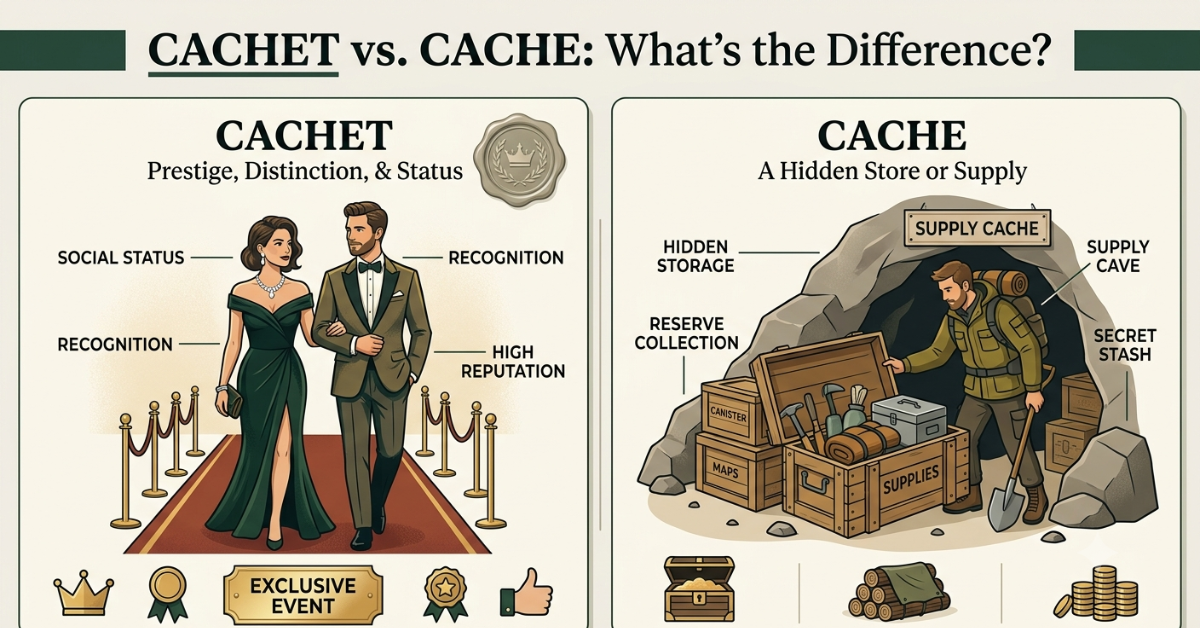
A cache is a hidden or stored collection of something that can be accessed later. The word appears in two major contexts: everyday language and technology.
Definition
Cache (noun):
A collection of items hidden away for future use, or temporary stored data that helps computers and applications work faster.
Pronunciation
Cache: kash (/kæʃ/)
Common Uses of Cache
The word is widely used in:
- Computing
- Web browsing
- Smartphones
- Gaming
- Treasure hunting
- Military operations
Examples
- Your browser stores images in its cache to load websites faster.
- Clearing your phone’s cache can free up storage space.
- The hikers found a hidden cache of emergency supplies.
- The game saves frequently accessed files in the cache.
Cache in Technology
When discussing computers, a cache temporarily stores frequently used information so the system doesn’t need to retrieve it repeatedly.
Examples include:
- Browser cache
- CPU cache
- Memory cache
- Application cache
- DNS cache
Why Cache Matters
Benefits include:
- Faster performance
- Reduced loading times
- Lower network usage
- Improved user experience
- Better overall efficiency
What Does Cachet Mean?
Unlike cache, cachet has nothing to do with computers or hidden storage.
Definition
Cachet (noun):
Prestige, distinction, admiration, or a mark of high status that makes someone or something especially respected or desirable.
Pronunciation
Cachet: ka-SHAY (/kæˈʃeɪ/)
The word comes from French, where it originally meant an official seal or stamp.
Common Uses of Cachet
Cachet often describes:
- Prestige
- Reputation
- Luxury
- Exclusivity
- High social standing
- Brand image
Examples
- Winning the award gave the restaurant tremendous cachet.
- The university carries considerable international cachet.
- Driving a luxury sports car adds social cachet for some buyers.
- Working for a famous company brings professional cachet.
Cachet vs Cache: Side-by-Side Comparison
| Feature | Cache | Cachet |
| Meaning | Hidden storage or temporary data | Prestige or social status |
| Pronunciation | Kash | Ka-SHAY |
| Origin | French cacher (to hide) | French cachet (seal, prestige) |
| Common Context | Technology, storage, hidden supplies | Reputation, luxury, influence |
| Part of Speech | Noun | Noun |
| Related Idea | Speed and storage | Prestige and distinction |
The Biggest Difference Between Cachet and Cache
Although both words originate from French, their meanings have evolved separately.
Cache is about storing something for future use.
Cachet is about having prestige, elegance, or admired status.
Think of it this way:
- Cache stores information.
- Cachet earns admiration.
Easy Trick to Remember the Difference
A simple memory trick can help.
Cache
Think of:
- Computer cache
- Hidden treasure
- Stored files
The word is associated with storage.
Cachet
Notice the ending “-et.”
Imagine it as something that adds an extra touch of elegance.
The word represents prestige.
Real-Life Examples
Example 1: Technology
Correct: The browser uses a cache to load websites quickly.
Incorrect: The browser uses a cachet to load websites quickly.
Example 2: Luxury Brands
Correct: The fashion brand enjoys tremendous cachet among celebrities.
Incorrect: The fashion brand enjoys tremendous cache among celebrities.
Example 3: Hidden Supplies
Correct: Soldiers discovered a cache of ammunition.
Incorrect: Soldiers discovered a cachet of ammunition.
Example 4: Reputation
Correct: Publishing in that journal adds academic cachet.
Incorrect: Publishing in that journal adds academic cache.
Why People Confuse Cache and Cachet
Several factors contribute to the confusion.
Similar Appearance
The words differ by only two letters.
French Origins
Both originated from French vocabulary.
Similar Pronunciation
Although pronounced differently, both begin with the same sound.
Rare Everyday Usage
Most people encounter cachet less often than cache, making mistakes more likely.
Common Mistakes to Avoid
Mistake 1
Incorrect: This luxury hotel has a lot of cache.
Correct: This luxury hotel has a lot of cachet.
Mistake 2
Incorrect: Clear your browser cachet.
Correct: Clear your browser cache.
Mistake 3
Incorrect: The actor’s cache improved after winning the award.
Correct: The actor’s cachet improved after winning the award.
When Should You Use Cache?
Use cache when discussing:
- Computers
- Browsers
- Mobile apps
- Temporary files
- Gaming
- Hidden supplies
- Data storage
- System performance
When Should You Use Cachet?
Use cachet when discussing:
- Prestige
- Social status
- Luxury products
- Reputation
- Brand value
- Professional recognition
- Exclusivity
- Influence
Cache vs Cachet in Everyday Writing
Consider these examples.
Correct
- Clear your phone’s cache regularly.
- The luxury neighborhood has considerable cachet.
- The app’s cache improves loading speed.
- The award gave her career new cachet.
Incorrect
- Delete your browser cachet.
- The celebrity’s cache increased after the movie.
Similar Word Pairs People Also Confuse
English contains many word pairs that look alike but have different meanings.
Examples include:
- Affect vs Effect
- Complement vs Compliment
- Stationary vs Stationery
- Principal vs Principle
- Capital vs Capitol
- Discreet vs Discrete
- Peak vs Peek vs Pique
Learning these distinctions improves writing accuracy and vocabulary.
Practical Tips for Remembering Cachet vs Cache
- Associate cache with computers and stored files.
- Associate cachet with prestige and reputation.
- Remember that browser settings mention cache, never cachet.
- Think of luxury brands, elite schools, and prestigious awards when you hear cachet.
- Practice using both words in your own sentences to reinforce the distinction.
Key Takeaways
- Cache refers to hidden storage or temporary stored data.
- Cachet refers to prestige, distinction, or admired status.
- Cache is common in computing and technology.
- Cachet is common when discussing reputation, luxury, or exclusivity.
- Despite their similar spelling, the words are never interchangeable.
- Remember: Cache stores. Cachet impresses.
Frequently Asked Questions
What is the difference between cache and cachet?
The main difference is that cache refers to stored data or hidden supplies, while cachet refers to prestige, distinction, or social status. They have different meanings despite their similar spelling.
Is cache pronounced the same as cachet?
No. Cache is pronounced kash, while cachet is pronounced ka-SHAY. The extra syllable reflects the French origin of cachet.
Can cache mean prestige?
No. Cache never means prestige. If you’re referring to reputation, exclusivity, or status, the correct word is cachet.
Why is browser cache called cache?
A browser cache stores temporary website files so pages load more quickly the next time you visit them. The term refers to stored information rather than prestige.
Is cachet a positive word?
Yes. Cachet almost always has a positive meaning. It suggests admiration, respect, exclusivity, or elevated status.
How can I remember cachet vs cache?
Think of cache as something that stores files, while cachet represents something that adds prestige. A simple phrase to remember is: “Cache stores; cachet shines.”
Conclusion
Understanding Cachet vs Cache is easier once you know their core meanings. Cache belongs in discussions about storage, technology, and hidden collections, while cachet belongs in conversations about prestige, reputation, and distinction. Although the words share French roots and similar spellings, they serve entirely different purposes in English.
The next time you encounter these terms, remember one simple rule: cache helps things work efficiently, while cachet helps things stand out. Mastering this distinction will make your writing more accurate, polished, and professional.
Author

linguaezone.com@gmail.com
Related Posts

Kill Two Birds With One Stone Alternative: 50 Better Options
- 0
- 1,569 word
Have you ever paused before saying “kill two birds with one stone” because it sounded too violent or simply didn’t fit the...
Read out all
Happy Sabbath Meaning: A Complete Guide to Its Significance
- 0
- 1,632 word
Have you ever received the message “Happy Sabbath” and wondered what it truly means? Is it simply another way of saying “have...
Read out all
I’m So Proud of You in Other Words: 120+ Heartfelt Alternatives
- 0
- 1,562 word
Have you ever wanted to tell someone you’re proud of them but felt like saying “I’m so proud of you” sounded repetitive?...
Read out all
How Do You Spell Happy Anniversary? Correct Spelling Guide
- 0
- 1,221 word
Have you ever paused before writing an anniversary card and wondered, “How do you spell happy anniversary?” You’re not alone. Whether you’re...
Read out all
Waiting for Your Response Email: Best Examples & Tips
- 0
- 1,483 word
Have you ever sent an important email and found yourself wondering whether you should follow up or simply wait? Whether you’re communicating...
Read out all
Great Asset to the Team: Meaning, Examples & Tips
- 0
- 1,494 word
Have you ever wanted to compliment a coworker but struggled to find words that sound professional and sincere? One of the most...
Read out all