
- 0
- 1,241 word
Have you ever hesitated before writing broach or brooch because they sound almost identical? You’re not alone. These two English words are among the most commonly confused homophones, yet they have completely different meanings.
Understanding Broach vs Brooch is important whether you’re writing professionally, discussing jewelry, or trying to improve your English vocabulary. While one word refers to introducing a sensitive topic, the other describes a decorative piece of jewelry.
In this guide, you’ll learn the meanings, pronunciation, spelling differences, practical examples, memory tricks, common mistakes, and when to use each word confidently.
What Is the Difference Between Broach and Brooch?
Although they sound similar, broach and brooch belong to entirely different categories.
| Feature | Broach | Brooch |
| Part of Speech | Verb (sometimes noun) | Noun |
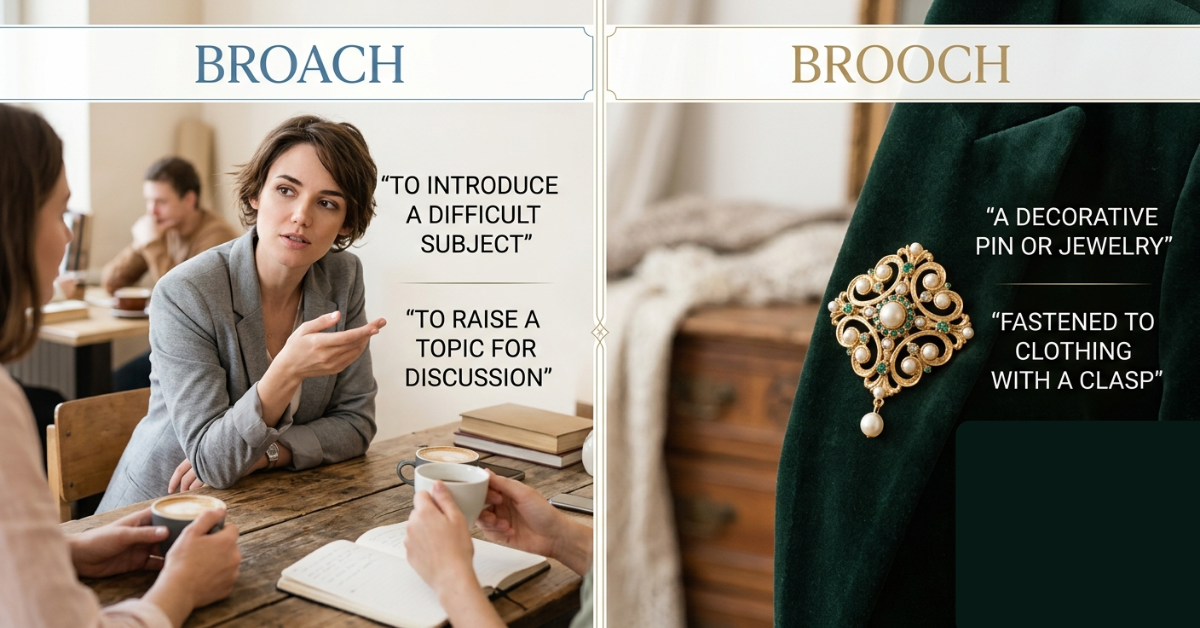
| Meaning | To introduce or raise a topic | A decorative jewelry pin |
| Pronunciation | Brohch | Brohch |
| Common Usage | Conversations, meetings, discussions | Fashion, accessories, jewelry |
| Example | She broached the subject carefully. | She wore a beautiful diamond brooch. |
The easiest way to remember the difference is this:
- Broach = Bring up a topic
- Brooch = Beautiful jewelry
What Does “Broach” Mean?
The word broach is most commonly used as a verb. It means to introduce, raise, or begin discussing a subject—especially one that might be sensitive or difficult.
Examples
- He finally broached the topic of retirement.
- I don’t know how to broach the conversation.
- She carefully broached the issue during the meeting.
- When should we broach the budget discussion?
In many situations, broach suggests approaching a conversation tactfully rather than abruptly.
Common Phrases
- Broach a subject
- Broach an issue
- Broach a question
- Broach the topic
- Broach a concern
What Does “Brooch” Mean?
A brooch is a decorative piece of jewelry attached to clothing with a pin or clasp.
People wear brooches on jackets, dresses, coats, scarves, hats, or lapels to add style or symbolism.
Examples
- Her grandmother gave her a gold brooch.
- The antique brooch featured emerald stones.
- She pinned the floral brooch to her blazer.
- Vintage brooches have become fashionable again.
Unlike broach, brooch is always a noun.
Pronunciation: Why Are They Confusing?
One reason these words are mixed up is that they’re pronounced almost exactly the same.
Broach: /broʊtʃ/
Brooch: /broʊtʃ/
Because the pronunciation is identical, writers often accidentally choose the wrong spelling.
This makes them homophones—words that sound alike but have different meanings and spellings.
Broach vs Brooch: Side-by-Side Comparison
| Broach | Brooch |
| Means to introduce a topic | Means decorative jewelry |
| Usually a verb | Always a noun |
| Used in discussions | Used in fashion |
| Broach an issue | Wear a brooch |
| Conversation-related | Clothing accessory |
Examples in Everyday Sentences
Using “Broach”
- She wasn’t sure how to broach the difficult conversation.
- The manager broached the idea of remote work.
- We need to broach this issue before it becomes bigger.
- Nobody wanted to broach the subject.
Using “Brooch”
- The silver brooch belonged to her grandmother.
- She wore a butterfly brooch on her coat.
- The pearl brooch completed the outfit.
- Antique brooches often become family heirlooms.
Common Mistakes People Make
Many writers accidentally replace one word with the other because of their identical pronunciation.
Incorrect
- She wore a beautiful broach on her dress.
- I need to brooch the topic with my boss.
Correct
- She wore a beautiful brooch on her dress.
- I need to broach the topic with my boss.
The spelling changes the meaning entirely.
Memory Trick to Remember the Difference
A simple memory device can help you avoid confusion.
Think of “Broach”
Broach = Bring up
Both words start with Br.
If you’re introducing a conversation, choose broach.
Think of “Brooch”
Brooch = Ornament
Notice the double “O” in brooch.
Imagine the two O’s as gemstones on a piece of jewelry.
That visual cue makes it much easier to remember.
Origins of the Words
Understanding their origins helps explain why they’re different.
Broach
The word comes from Old French and originally referred to a pointed tool used for piercing. Over time, its meaning expanded to include introducing or opening a discussion.
Brooch
Brooch also has Old French roots and originally referred to a pointed ornament or clasp used to fasten clothing.
Although they share historical origins, their meanings evolved in separate directions.
When Should You Use Broach?
Use broach whenever you’re talking about communication or discussions.
Examples include:
- Raising an issue
- Introducing a subject
- Beginning a conversation
- Discussing sensitive matters
- Bringing up concerns
When Should You Use Brooch?
Use brooch whenever you’re referring to jewelry or clothing accessories.
Examples include:
- Vintage brooch
- Diamond brooch
- Floral brooch
- Pearl brooch
- Gold brooch
- Wedding brooch
Broach vs Brooch in Professional Writing
In business emails, academic writing, or workplace communication, choosing the correct word reflects attention to detail.
For example:
Correct
“I’d like to broach an important topic during tomorrow’s meeting.”
Using brooch instead would completely change the meaning and make the sentence incorrect.
Similarly, fashion articles should always use brooch when referring to decorative pins.
Similar Commonly Confused Words
If you’ve mixed up broach and brooch, you might also encounter these confusing word pairs:
- Affect vs Effect
- Compliment vs Complement
- Principal vs Principle
- Stationary vs Stationery
- Counsel vs Council
- Bear vs Bare
- Accept vs Except
- Peak vs Peek vs Pique
Learning these pairs together can strengthen your overall writing accuracy.
Practical Tips to Remember the Difference
- Think Broach = Bring up.
- Think Brooch = Beautiful accessory.
- If the sentence involves talking, use broach.
- If the sentence involves clothing or jewelry, use brooch.
- Read the sentence aloud and ask whether it’s about conversation or fashion.
These quick checks can help you choose the correct spelling every time.
Key Takeaways
- Broach means to introduce or raise a topic.
- Brooch is a decorative jewelry pin.
- Both words sound alike but have different meanings.
- Broach is mainly used as a verb.
- Brooch is always a noun.
- Context is the easiest way to determine which spelling is correct.
Frequently Asked Questions
Is it broach or brooch a topic?
The correct phrase is broach a topic. Broach means to introduce or begin discussing a subject, especially one that may be sensitive.
Is brooch pronounced like broach?
Yes. Broach and brooch are pronounced the same, which is why they are often confused in writing.
What is a brooch?
A brooch is a decorative pin or ornament worn on clothing. It is commonly used as a fashion accessory or family heirloom.
Can broach be used as a noun?
Although it has some specialized technical meanings, broach is most commonly used as a verb meaning to introduce a topic in modern English.
Why do people confuse broach and brooch?
People confuse them because they are homophones. They sound identical but have different spellings, meanings, and grammatical functions.
How can I easily remember Broach vs Brooch?
Remember this simple trick: Broach = Bring up a conversation, while Brooch = Beautiful jewelry. Associating each word with its primary use makes the distinction easy to recall.
Conclusion
Understanding Broach vs Brooch is easier once you focus on context rather than pronunciation. Although these words sound the same, their meanings couldn’t be more different. Broach belongs in conversations, meetings, and discussions, while brooch belongs in jewelry boxes, fashion collections, and accessories.
By remembering that broach means to introduce a subject and brooch refers to a decorative pin, you’ll avoid one of English’s most common spelling mistakes. Keep these simple distinctions in mind, practice with real-world examples, and you’ll use both words confidently in your writing.
Author

linguaezone.com@gmail.com
Related Posts

Kill Two Birds With One Stone Alternative: 50 Better Options
- 0
- 1,569 word
Have you ever paused before saying “kill two birds with one stone” because it sounded too violent or simply didn’t fit the...
Read out all
Happy Sabbath Meaning: A Complete Guide to Its Significance
- 0
- 1,632 word
Have you ever received the message “Happy Sabbath” and wondered what it truly means? Is it simply another way of saying “have...
Read out all
I’m So Proud of You in Other Words: 120+ Heartfelt Alternatives
- 0
- 1,562 word
Have you ever wanted to tell someone you’re proud of them but felt like saying “I’m so proud of you” sounded repetitive?...
Read out all
How Do You Spell Happy Anniversary? Correct Spelling Guide
- 0
- 1,221 word
Have you ever paused before writing an anniversary card and wondered, “How do you spell happy anniversary?” You’re not alone. Whether you’re...
Read out all
Waiting for Your Response Email: Best Examples & Tips
- 0
- 1,483 word
Have you ever sent an important email and found yourself wondering whether you should follow up or simply wait? Whether you’re communicating...
Read out all
Great Asset to the Team: Meaning, Examples & Tips
- 0
- 1,494 word
Have you ever wanted to compliment a coworker but struggled to find words that sound professional and sincere? One of the most...
Read out all