
- 0
- 2,403 words
The English language contains many words that look unfamiliar but have clear and useful meanings once they are explained. One such word is apposed. Although it is not commonly used in everyday conversations, it appears in formal writing, grammar, biology, anatomy, and other specialized fields. Understanding the word apposed can help readers interpret complex sentences, improve their vocabulary, and communicate more accurately.
The word is particularly interesting because its meaning depends on the context in which it appears. In general, apposed describes two things that have been placed next to each other, brought together, or positioned in close contact. It can also describe structures that are aligned or placed side by side for a particular purpose.
This article explores the meaning of apposed, its origin, grammatical function, practical applications, common examples, and differences between apposed and similar English words.
What Does Apposed Mean?
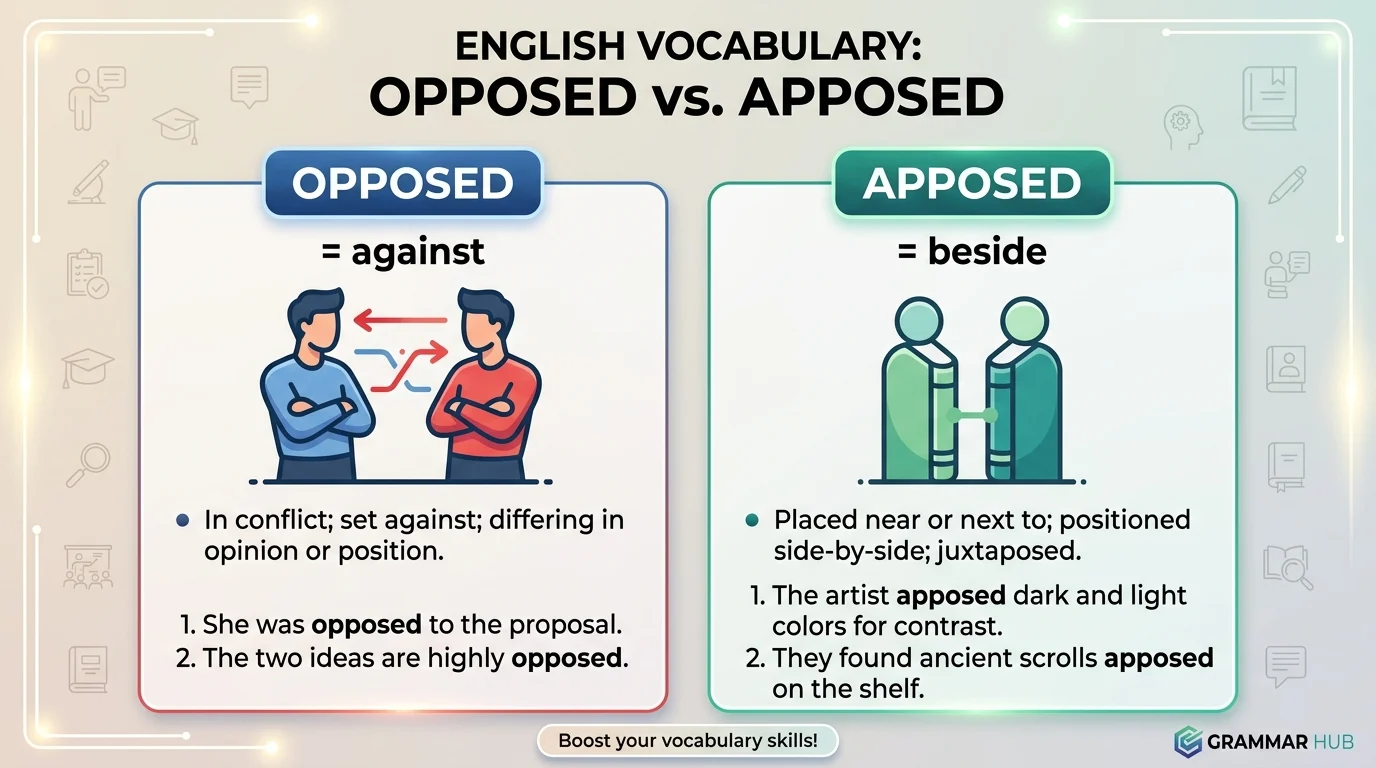
The word apposed is the past tense and past participle of the verb appose. It generally means to place something beside or against another thing, often so that the two objects are close together or directly aligned.
In simple terms, when two objects are apposed, they are positioned next to each other or brought into contact.
For example, a sentence might say, “The two surfaces were apposed carefully.” This means that the surfaces were positioned close together or placed against each other.
The word can be used in both general and technical contexts. In everyday English, people are more likely to use expressions such as “placed side by side,” “positioned together,” or “brought into contact.” However, apposed can communicate the same idea in a concise and formal way.
The term is especially useful when describing physical structures, anatomical features, or components that must fit together precisely.
The Origin and History of Apposed
The word apposed comes from the verb appose, which is related to the Latin word apponere. This Latin term means to place beside or put near something. The historical roots of the word help explain its modern meaning.
Over time, appose developed into a formal English verb used to describe the act of placing one object next to another. Its past-tense form, apposed, became useful for describing the resulting position or arrangement.
Words related to appose appear in several areas of English vocabulary. For instance, the word juxtaposed describes things placed close together, often to highlight their differences. Similarly, the word juxtaposition refers to the act or arrangement of placing things side by side.
Although these words are related in meaning, they are not always interchangeable. Apposed often emphasizes physical contact, close alignment, or a specific relationship between structures. Juxtaposed can refer to objects or ideas placed near one another without necessarily touching.
Understanding this distinction helps readers recognize why apposed is sometimes preferred in scientific and technical writing.
How Apposed Is Used in a Sentence
Apposed functions as the past tense or past participle of the verb appose. Its precise grammatical role depends on the structure of the sentence.
1. Apposed as a Verb
When used as a verb, apposed describes an action that has already taken place.
For example:
- The two pieces of material were apposed before the final inspection.
- The researcher apposed the samples to examine their interaction.
- The edges were apposed carefully during the procedure.
In these examples, the word describes the placement of one object against or beside another. The surrounding words clarify what was placed together and why.
2. Apposed in Passive Sentences
Apposed frequently appears in passive constructions, especially in formal or scientific writing.
For example:
“The two surfaces were apposed under controlled conditions.”
In this sentence, the focus is on the surfaces and their resulting position rather than on the person performing the action.
Passive constructions are common in research papers, laboratory reports, technical documents, and medical descriptions because they emphasize processes and observations.
3. Apposed as a Descriptive Word
Apposed can also describe the position of two structures.
For example:
“The apposed edges created a continuous boundary.”
Here, apposed helps describe the relationship between the edges. It explains that they were placed together or brought into close contact.
This descriptive use is particularly common in technical contexts, where precise wording is important.
Apposed in Biology and Anatomy
One of the most important contexts for understanding apposed is biology and anatomy. In these fields, the word can describe structures that lie against each other or are positioned in close contact.
Living organisms contain many structures that must align correctly to perform their functions. The term apposed can help describe these relationships.
For example, biological tissues may have surfaces that are apposed to one another. When these surfaces come into contact, their alignment may influence how the tissues interact.
In anatomy, apposed structures can refer to parts of the body that are positioned against one another. Depending on the particular structure, this relationship may be important for movement, protection, healing, or normal physiological function.
In botany, apposed may describe plant structures that are placed close together or aligned along a shared surface. The precise meaning depends on the structure being discussed.
The term should not automatically be interpreted as meaning that two structures are permanently attached. Apposed generally describes their position or contact, while attachment may require additional information.
Apposed in Medical and Scientific Writing
Medical and scientific writing often relies on terminology that describes the position, shape, and relationship of physical structures. Apposed is useful because it provides a concise way to communicate that two surfaces or structures are close together.
For example, a technical report might state that two tissue surfaces were apposed during an examination. This indicates a particular spatial relationship without requiring a lengthy explanation.
The word may also appear in descriptions of wounds, tissue surfaces, or anatomical relationships. In these situations, the surrounding sentence determines whether the term refers to direct contact, close positioning, or alignment.
However, apposed does not always mean that a wound has completely healed or that two structures have fused. Contact between surfaces and successful biological healing are different concepts.
For readers who encounter apposed in a medical report, the best approach is to examine the entire sentence and identify which structures are being described. If the term appears in a personal medical document, a qualified healthcare professional can explain its significance in that specific context.
Apposed vs. Opposed: Understanding the Difference
One of the most common sources of confusion is the difference between apposed and opposed. Although the words look similar, they have different meanings.
Apposed generally refers to things placed beside or against each other.
Opposed usually means positioned against something in a contrasting direction, resisting something, or being in disagreement with it.
Consider these examples:
- “The two surfaces were apposed.” This means the surfaces were brought together or placed in contact.
- “The two teams opposed each other.” This means the teams competed against one another.
- “The proposal was opposed by several members.” This means several members disagreed with the proposal.
The difference is important because substituting one word for the other can change the meaning of a sentence.
Apposed focuses on placement or proximity, while opposed often communicates resistance, conflict, or a contrasting position.
When deciding which word to use, consider whether the sentence describes physical alignment or disagreement. If it describes two surfaces being brought together, apposed may be appropriate. If it describes opposition or resistance, opposed is usually the correct choice.
Apposed vs. Juxtaposed
Another useful comparison is between apposed and juxtaposed.
Both terms can describe objects or structures positioned beside each other. However, their emphasis is slightly different.
Apposed often suggests close physical contact or alignment. Juxtaposed generally describes placing things side by side, frequently to make their similarities or differences more noticeable.
For example:
“The two metal surfaces were apposed to create a close fit.”
This sentence emphasizes the relationship between the surfaces.
Now consider:
“The artist juxtaposed bright colors with dark backgrounds.”
In this sentence, juxtaposed emphasizes the arrangement of contrasting visual elements.
The two words may overlap in certain contexts, but their connotations differ. Apposed is often associated with physical structures and technical descriptions, while juxtaposed is widely used in art, literature, design, and analytical writing.
Choosing the correct term makes communication clearer and more precise.
Practical Examples of Apposed
Learning a word becomes easier when it is used in realistic sentences. The following examples demonstrate how apposed can appear in different contexts.
- In engineering: The two components were apposed to check whether their edges aligned correctly.
- In biology: The researcher observed two apposed surfaces under a microscope.
- In anatomy: The report described the position of the apposed structures.
- In material science: The apposed layers were examined to determine how closely they fitted together.
- In a laboratory: The samples were apposed before the next stage of testing.
- In technical writing: The document explained how the apposed sections formed a continuous surface.
- In a general description: The edges were apposed carefully to reduce the gap between them.
- In manufacturing: The two parts were apposed during assembly to evaluate their fit.
These examples show that apposed is most useful when a writer needs to communicate a specific spatial relationship. It is less common in casual conversation, where simpler expressions are usually more natural.
Common Mistakes When Using Apposed
Although apposed has a straightforward central meaning, readers and writers can make several mistakes when interpreting or using it.
Confusing Apposed With Opposed
This is perhaps the most frequent error. Apposed usually refers to placement or contact, whereas opposed often describes disagreement or resistance.
Checking the intended meaning before choosing the word can prevent confusion.
Assuming Apposed Means Permanently Attached
Two surfaces may be apposed without being permanently connected. The word describes their position, not necessarily the strength or permanence of their attachment.
For example, two sheets of paper can be apposed while remaining separate objects.
Using Apposed in Every Situation
Although apposed is grammatically valid in appropriate contexts, it may sound overly technical in ordinary conversation.
Instead of saying, “The two chairs were apposed,” a speaker would usually say, “The two chairs were placed next to each other.”
The more technical expression should be used when it improves precision rather than simply making a sentence sound complicated.
Ignoring Context
The exact interpretation of apposed can depend on the subject being discussed. A scientific report may use the word differently from a general description of physical objects.
Readers should consider the surrounding sentence, the field of study, and the relationship between the structures mentioned.
Synonyms and Related Words
Several English words can express meanings similar to apposed, although each has its own nuances.
- Adjacent: Located next to something.
- Abutting: Touching or directly meeting another surface or boundary.
- Aligned: Arranged in a straight line or in a corresponding position.
- Contiguous: Sharing a boundary or being in direct contact.
- Juxtaposed: Placed side by side, often for comparison.
- Positioned: Placed in a particular location.
- Contacting: Touching or making physical contact with something.
- Placed together: A straightforward expression describing objects brought into proximity.
These alternatives can make writing more accessible when a specialized term is unnecessary.
For example, adjacent may be suitable when two objects are near each other but do not necessarily touch. Abutting is often appropriate when two surfaces meet directly. Aligned emphasizes correct positioning, while apposed can emphasize close contact between structures.
The best synonym depends on the relationship that the writer wants to communicate.
Why Learning the Word Apposed Matters
Expanding vocabulary is not only about learning uncommon words. It is also about understanding when a particular word communicates an idea more accurately than its alternatives.
Apposed is a useful example because it appears in specialized descriptions where spatial relationships matter. A student studying biology may encounter the word in a textbook. Someone reading a technical report may see it used to describe components or surfaces. A person improving their English vocabulary may come across it while exploring unfamiliar terminology.
Learning the word helps readers understand these materials without repeatedly stopping to search for definitions.
It also encourages greater awareness of differences between similar words. Understanding the distinction between apposed, opposed, and juxtaposed can improve reading comprehension and written communication.
However, vocabulary should always serve clarity. In everyday writing, simple alternatives are often more effective. In scientific or technical writing, apposed can be the better choice when it accurately describes the relationship between two structures.
Frequently Asked Questions About Apposed
What is the simple meaning of apposed?
Apposed means placed beside or against something, usually in close contact or alignment. It is the past tense and past participle of the verb appose.
Is apposed a real English word?
Yes. Apposed is a recognized English word, although it is less common than everyday alternatives such as placed together, aligned, or positioned next to each other.
What is the difference between apposed and opposed?
Apposed generally describes objects or surfaces placed together. Opposed usually describes disagreement, resistance, or things positioned against each other in a contrasting relationship.
Is apposed commonly used in everyday conversation?
No. The word is more common in formal, scientific, medical, anatomical, and technical writing. Everyday speakers generally prefer simpler expressions.
Can apposed describe two objects that touch?
Yes. Apposed can describe two surfaces or structures brought into close contact. The exact meaning depends on the context, and the word does not necessarily imply permanent attachment.
What are some synonyms for apposed?
Depending on the sentence, possible alternatives include adjacent, aligned, abutting, contiguous, juxtaposed, and placed together. These words have slightly different meanings, so they should not be substituted automatically.
Conclusion
The word apposed describes the placement of one thing beside or against another, often emphasizing close contact or alignment. Derived from the verb appose, it is most commonly encountered in formal, scientific, anatomical, and technical contexts.
Understanding apposed also requires recognizing how it differs from related terms. Unlike opposed, which frequently indicates disagreement or resistance, apposed focuses on positioning. Unlike juxtaposed, which often highlights the comparison between neighboring objects or ideas, apposed can emphasize a close physical relationship.
Although it is not a word that most people need in everyday conversation, it is valuable for anyone reading technical documents, studying science, or developing a more precise English vocabulary.
Ultimately, the best way to understand apposed is to remember its central idea: two things placed beside or against each other in a particular relationship. With this definition and the examples provided above, readers can recognize the word more easily and use it appropriately whenever the context calls for it.
Author

blowouttaper.co.uk@gmail.com
Related Posts
Damnit or Dammit: Which Spelling Is Correct and When Should You Use It?
- 0
- 2,614 words
English contains many words and expressions that people use every day without thinking much about their spelling. However, some words create confusion...
Read out all
Reevaluation: Meaning, Importance, Benefits, and How to Reevaluate Decisions Effectively
- 0
- 2,568 words
Introduction to Reevaluation Reevaluation is an important process that involves examining something again to determine whether it is still accurate, effective, valuable,...
Read out all
City vs Town: Understanding the Key Differences Between a City and a Town
- 0
- 3,042 words
When people compare a city vs town, they often think about population size, buildings, transportation, and lifestyle. Although cities and towns are...
Read out all
What Is a Palindrome? Meaning, Examples, Types, and Fun Facts
- 0
- 2,218 words
Have you ever come across a word that looks exactly the same when you read it forward and backward? Words like “level,”...
Read out all
UploadBlog Post: A Complete Guide to Creating, Publishing, and Managing Quality Blog Content
- 0
- 2,854 words
Introduction to UploadBlog Post In the digital world, blogging has become an effective way to share knowledge, express ideas, build an online...
Read out all
fintechzoom.io: A Complete Guide to Financial News, Market Insights, and Digital Finance
- 0
- 2,322 words
Introduction to fintechzoom.io The financial world is changing rapidly as technology transforms the way people save, invest, trade, and manage their money....
Read out all