
- 0
- 1,558 word
Have you ever stopped mid-sentence and wondered whether to write all are or all is? If so, you are not alone. This tiny grammar choice confuses many writers because the word all can point to either one complete thing or several separate things.
That is why this topic matters. Once you understand how all works in a sentence, you can choose the right verb quickly and confidently. In this guide, you will learn the difference between all is and all are, see real examples, avoid common mistakes, and remember the rule with ease.
What Does “All” Mean in Grammar?
First, it helps to understand what all actually does. In grammar, all can act as a determiner, pronoun, or adverb. However, when it appears as part of the subject, it usually means the whole amount or the entire group.
Because of that, the verb must match the meaning behind all, not just the word itself. In other words, grammar depends on what all refers to.
For example:
- All is well.
- All are ready.
At first glance, both may look similar. However, each sentence refers to something different, so each one uses a different verb.
When to Use “All Is”
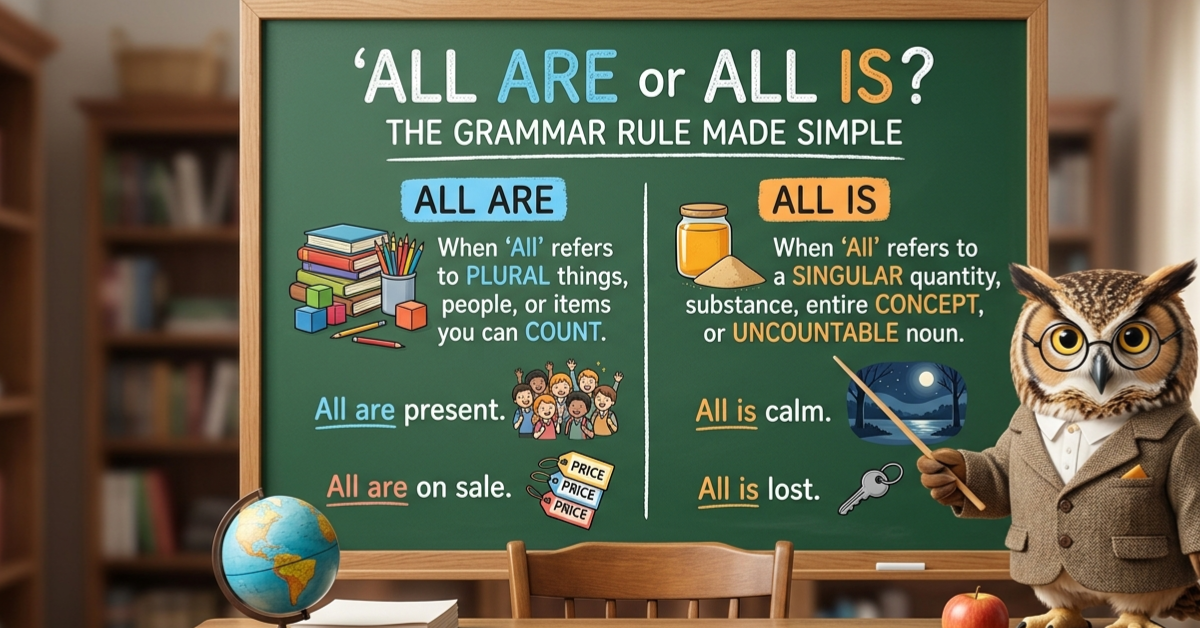
Use all is when all refers to one complete thing, an overall situation, or an uncountable noun. This form works when you talk about a whole condition rather than several individual items.
Examples of “All Is”
- All is calm.
- All is ready.
- All is forgiven.
- All is lost.
- All is under control.
- All is fine now.
Notice something important here. These sentences describe a single state or total condition. They do not point to many separate people or objects.
“All Is” with Uncountable Nouns
You should also use all is with uncountable nouns. These nouns name things you do not normally count one by one.
Examples include:
- water
- money
- information
- furniture
- food
- work
For example:
- All the water is gone.
- All the money is spent.
- All the information is correct.
- All the furniture is new.
Even though these nouns may describe a large amount, English treats them as singular. Therefore, the verb stays singular too.
Common Fixed Expressions
Some phrases almost always use all is because English speakers use them as fixed expressions.
Examples:
- All is well.
- All is fair in love and war.
- All is forgiven.
- All is not lost.
These phrases sound natural because they refer to a general condition, not to separate items.
When to Use “All Are”
Use all are when all refers to several people, animals, or objects. In this case, the subject is plural, so the verb must also be plural.
Examples of “All Are”
- All are welcome.
- All are invited.
- All are present.
- All are ready.
- All are excited.
- All are accounted for.
Here, all stands for multiple people or things, so the sentence needs are.
“All Are” with Plural Nouns
This rule becomes even clearer when all comes before a plural noun.
Examples:
- All the students are here.
- All the books are on the table.
- All the chairs are occupied.
- All the guests are arriving now.
- All the flowers are blooming.
Because the noun is plural, the verb must agree with it. As a result, are becomes the correct choice.
The Easiest Way to Decide
When you feel unsure, do not focus only on the word all. Instead, ask yourself a better question:
Does “all” refer to one whole thing or to many separate things?
That simple question usually gives you the answer.
- One whole thing → all is
- Several things or people → all are
For example:
- All the cake is gone.
- All the cakes are gone.
The first sentence talks about one cake as a whole. The second sentence talks about several cakes. Because the meaning changes, the verb changes too.
All Is vs. All Are: A Quick Comparison
| All Is | All Are |
| Refers to one complete thing | Refers to several people or objects |
| Uses a singular verb | Uses a plural verb |
| Often appears with uncountable nouns | Often appears with countable plural nouns |
| Example: All is well | Example: All are welcome |
This comparison makes the rule easier to see at a glance. Even so, context still matters more than the word all itself.
Why Both Forms Can Be Correct
Many learners assume one form must always be right, but that is not true. English grammar follows meaning, and subject-verb agreement depends on how the subject functions in the sentence.
Compare these two sentences:
- All is quiet in the house.
- All are quiet in the house.
The first sentence sounds like one overall condition. The second suggests that several people are quiet. Since the meanings differ, both can work in the right context.
That is why the phrase all are or all is creates so much confusion. The correct form depends entirely on what you want to say.
Common Mistakes to Avoid
Even confident writers make mistakes with this rule. Fortunately, you can avoid them once you know what to watch for.
1. Choosing the Verb by the Word Alone
Some people see all and immediately choose are because it looks plural. However, that shortcut often causes errors.
Wrong:
- All is welcome.
Correct:
- All are welcome.
Here, all refers to several people, so the plural verb is necessary.
2. Forgetting About Uncountable Nouns
Another common mistake happens with uncountable nouns. These nouns often sound like they should take a plural verb, but they do not.
Wrong:
- All the furniture are new.
Correct:
- All the furniture is new.
Furniture is treated as singular in English, so the verb must stay singular too.
3. Ignoring the Meaning of the Sentence
Sometimes the sentence sounds fine at first, but the meaning reveals the error.
Wrong:
- All are lost.
Correct, depending on meaning:
- All is lost.
- All are lost.
The first sentence means everything is lost. The second means several people or things are lost. Meaning decides the verb.
Special Cases You Should Know
Now that you know the main rule, let’s look at a few special situations. These often appear in everyday English.
“All of”
Adding of does not change the rule. The noun that follows still controls the verb.
Examples:
- All of the milk is gone.
- All of the students are here.
- All of the advice is helpful.
- All of the tickets are sold.
Again, singular nouns take is, while plural nouns take are.
With Pronouns
You will also see this rule with pronouns.
Examples:
- All of us are ready.
- All of them are here.
- All of it is broken.
- All of this is true.
In each case, the pronoun tells you whether the subject is singular or plural.
Practical Tips to Get It Right
To avoid errors, follow these simple steps:
- Identify what all refers to.
- Check whether the noun is singular, plural, or uncountable.
- Match the verb to the meaning, not just to the word all.
- Read the full sentence aloud to hear what sounds natural.
- Replace all with the actual noun if you are still unsure.
For example:
- All is well → Everything is well.
- All are invited → The guests are invited.
This quick substitution often makes the correct verb obvious.
Real-World Usage Examples
Here are a few more natural examples from everyday writing and speech:
- All is ready for the meeting.
- All are waiting outside.
- All the data is saved.
- All the children are asleep.
- All is quiet after the storm.
- All the plates are clean.
These examples show how flexible the rule is. At the same time, they also show how reliable it becomes once you understand the subject.
Key Takeaways
- All can take either a singular or plural verb.
- Use all is for one complete thing, a general condition, or an uncountable noun.
- Use all are for multiple people or countable objects.
- The meaning of the sentence matters more than the word all.
- Replacing all with the real noun often makes the answer clear.
Frequently Asked Questions
Is “all are” correct?
Yes, all are is correct when all refers to several people or things. For example, “All the guests are here” is correct.
Is “all is” correct?
Yes, all is is correct when all refers to one whole condition or an uncountable noun. For example, “All is well” is correct.
Which is more common: all are or all is?
Both forms are common. The right choice depends on the meaning of the sentence, not on which phrase appears more often.
Why do people say “all is well”?
People say all is well because the phrase refers to one overall condition. It means that everything is fine.
Can “all” be singular and plural?
Yes. That is exactly why this grammar rule causes confusion. The verb changes based on what all represents in the sentence.
How can I remember the rule easily?
Try replacing all with the noun it stands for. If the replacement is singular, use is. If it is plural, use are.
Conclusion
The difference between all are or all is becomes much easier once you focus on meaning. Use all is when you talk about one whole thing or an uncountable noun. Use all are when you refer to several people or objects.
So, the next time you write a sentence with all, pause for a moment and check what it really means. That small habit will improve your grammar, strengthen your writing, and help your sentences sound natural every time.
Author

linguaezone.com@gmail.com
Related Posts

Kill Two Birds With One Stone Alternative: 50 Better Options
- 0
- 1,569 word
Have you ever paused before saying “kill two birds with one stone” because it sounded too violent or simply didn’t fit the...
Read out all
Happy Sabbath Meaning: A Complete Guide to Its Significance
- 0
- 1,632 word
Have you ever received the message “Happy Sabbath” and wondered what it truly means? Is it simply another way of saying “have...
Read out all
I’m So Proud of You in Other Words: 120+ Heartfelt Alternatives
- 0
- 1,562 word
Have you ever wanted to tell someone you’re proud of them but felt like saying “I’m so proud of you” sounded repetitive?...
Read out all
How Do You Spell Happy Anniversary? Correct Spelling Guide
- 0
- 1,221 word
Have you ever paused before writing an anniversary card and wondered, “How do you spell happy anniversary?” You’re not alone. Whether you’re...
Read out all
Waiting for Your Response Email: Best Examples & Tips
- 0
- 1,483 word
Have you ever sent an important email and found yourself wondering whether you should follow up or simply wait? Whether you’re communicating...
Read out all
Great Asset to the Team: Meaning, Examples & Tips
- 0
- 1,494 word
Have you ever wanted to compliment a coworker but struggled to find words that sound professional and sincere? One of the most...
Read out all