Have you ever come across the phrase curtesy vs courtesy and wondered which one is correct? You’re not alone. Many English learners and even native speakers get confused between these two similar-looking words. The truth is, one is widely used in modern English, while the other belongs to legal history and is rarely used today.
In this guide, we’ll break down curtesy vs courtesy, explain their meanings, and show you how to use the correct term confidently in everyday writing.
Curtesy vs Courtesy: What’s the Real Difference?
The main confusion between curtesy vs courtesy comes from their similar spelling. However, they are not interchangeable.
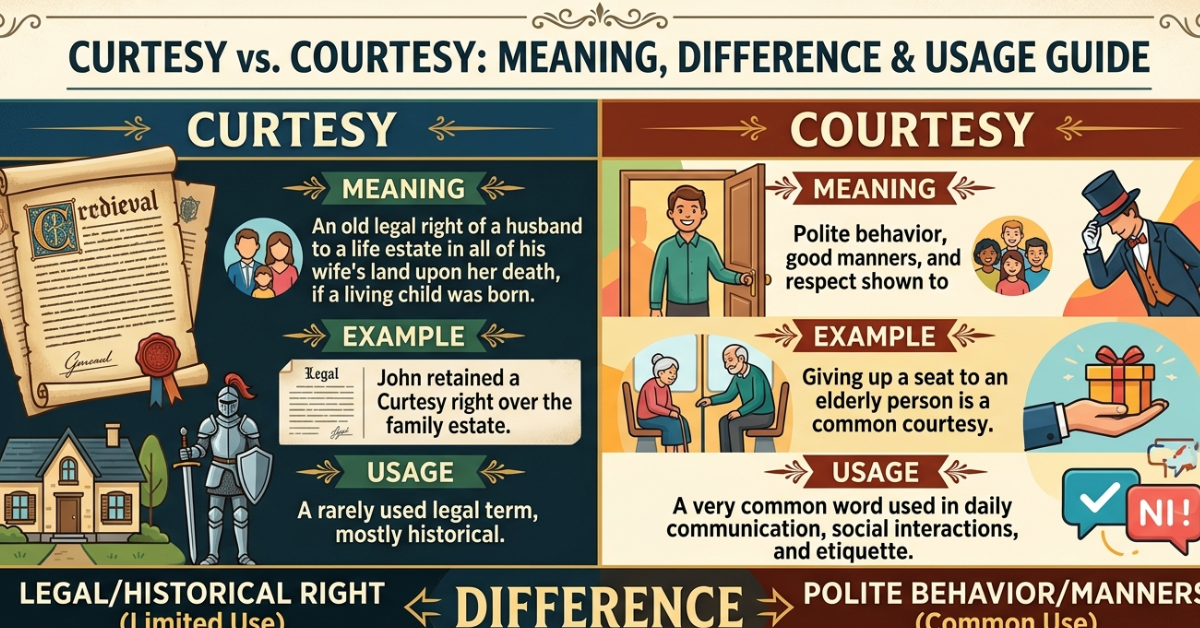
- Courtesy → A modern English word meaning politeness, respect, or good manners
- Curtesy → An old legal term related to a husband’s rights to his deceased wife’s property (rarely used today)
So, in most everyday situations, courtesy is the correct word you want.
What Does Courtesy Mean?
Courtesy refers to polite behavior and respectful actions toward others. It is commonly used in both spoken and written English.
Examples of courtesy in daily life:
- Saying “thank you” and “please”
- Holding the door open for someone
- Respecting others’ opinions in conversation
In simple terms, courtesy means showing kindness and good manners.
Is “Curtesy” a Real Word?
Yes, curtesy is technically a real word, but it is not used in modern everyday English.
It comes from old English law and refers to a historical legal right a widower had over his wife’s property after her death, if they had children together.
Today, you might only see curtesy in:
- Legal history books
- Academic discussions about old property laws
For all practical communication, it is outdated.
Why People Confuse Curtesy vs Courtesy
The confusion happens because:
- The spelling looks almost identical
- Pronunciation sounds very similar
- Auto-correct sometimes does not catch the mistake
- Many people have never seen “curtesy” in context
As a result, curtesy vs courtesy becomes a common grammar search online.
How to Use Courtesy Correctly in Sentences
Here are some simple examples to help you use courtesy correctly:
- She showed great courtesy to the guests.
- It is a courtesy to greet your neighbors.
- The airline offered free drinks as a courtesy service.
Notice how it always relates to politeness or respectful behavior.
Quick Tips to Remember the Difference
- Think: Courtesy = Courtesy of kindness
- If you’re talking about manners, always choose courtesy
- If you see “curtesy,” remember it’s historical and rarely needed
- In exams, emails, or daily writing, stick to courtesy
Curtesy vs Courtesy in Modern English Usage
In modern usage, curtesy vs courtesy is no longer a balanced comparison. One is active and widely used, while the other is almost obsolete.
Writers, students, and professionals should always use courtesy unless specifically discussing legal history.
FAQs About Curtesy vs Courtesy
1. What is the correct word: curtesy or courtesy?
Courtesy is the correct word in modern English.
2. Is curtesy still used today?
Rarely. It is mostly found in legal history contexts.
3. What does courtesy mean?
Courtesy means polite behavior, respect, and good manners.
4. Can I use curtesy in writing?
Only if you are referring to historical legal terms. Otherwise, avoid it.
5. Why do people confuse curtesy vs courtesy?
Because the spelling and pronunciation are very similar.
Conclusion
Understanding curtesy vs courtesy is actually quite simple once you know the difference. While “curtesy” is a historical legal term, “courtesy” is the correct and commonly used word in everyday English.
If you want to write clearly and professionally, always choose courtesy. It reflects politeness, respect, and good communication—skills that matter in both personal and professional life.