×
Walkthrough or Walk-Through: Meaning & Usage Guide
In

Have you ever paused while writing and wondered whether it should be walkthrough or walk-through? You’re not alone—this is one of those English language choices that looks small but often confuses even fluent writers.

The difference may seem minor, but the way you write it can change clarity, tone, and even correctness in formal writing. In this guide, you’ll learn exactly what walkthrough or walk-through means, when to use each form, and how professionals apply them in real-world contexts like gaming, education, software, and real estate.

By the end, you’ll be able to use both forms confidently and naturally without second-guessing yourself.

What Does “Walkthrough or Walk-Through” Mean?

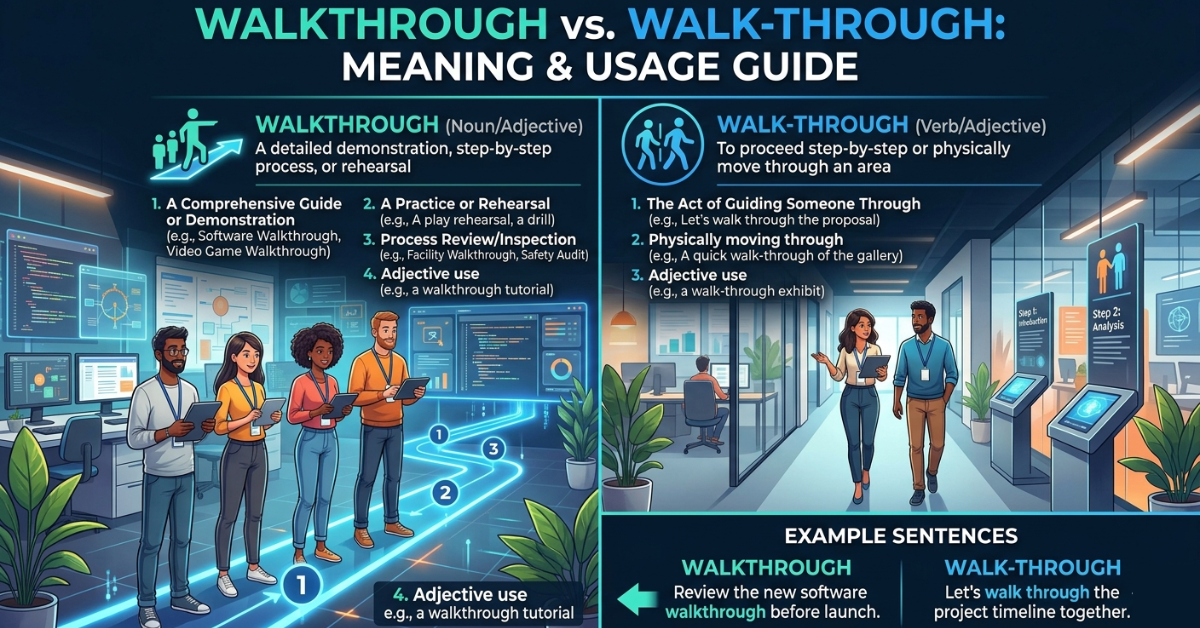
At its core, walkthrough or walk-through refers to a guided explanation or step-by-step demonstration of a process, place, or system.

  • A walkthrough (one word) is most commonly used as a noun.
  • A walk-through (hyphenated) is often used as a descriptive form or adjective, especially in more formal or technical writing.

Simple meaning:

A walkthrough is a detailed guide that helps someone understand how something works by showing each step in order.

For example:

  • A gaming walkthrough shows how to complete levels.
  • A software walkthrough explains how to use an app.
  • A real estate walkthrough guides you through a property before buying or renting.

Walkthrough vs Walk-Through: What’s the Difference?

The confusion around walkthrough or walk-through comes mainly from English hyphenation rules, which have evolved over time.

1. Walkthrough (One Word)

This is now the most common modern usage, especially in digital and informal contexts.

You’ll often see it in:

  • Gaming guides
  • YouTube tutorials
  • Blogs and tech websites
  • Educational content

Example:

“I followed a complete walkthrough to finish the game level.”

2. Walk-Through (Hyphenated)

This form is more traditional and is often used when the phrase acts like an adjective before a noun.

Example:

“We attended a walk-through session of the new software.”

Key takeaway:

  • Walkthrough = noun (most common today)
  • Walk-through = descriptive or formal usage

When Should You Use Walkthrough or Walk-Through?

Understanding context is the key to mastering walkthrough or walk-through.

Use “walkthrough” when:

  • Referring to a guide or tutorial
  • Talking about step-by-step instructions
  • Writing in modern digital content

Examples:

  • Game walkthrough
  • Software walkthrough
  • Exam walkthrough

Use “walk-through” when:

  • Describing an event or session
  • Using it as an adjective before a noun
  • Writing in formal or technical documentation

Examples:

  • Walk-through inspection
  • Walk-through presentation
  • Walk-through training session

Real-World Uses of Walkthroughs

The concept of walkthrough or walk-through appears in many industries. Let’s explore how it’s used in everyday life.

 Gaming Industry

Game walkthroughs are extremely popular on platforms like YouTube and gaming blogs. Players use them to:

  • Solve difficult levels
  • Find hidden items
  • Complete missions faster

 Software & Technology

Companies like Microsoft often include product walkthroughs to help users understand features.

These help users:

  • Learn software step-by-step
  • Reduce learning curve
  • Improve user experience

 Real Estate

A property walk-through is done before buying or renting a home.

It helps buyers:

  • Inspect condition of property
  • Identify repairs
  • Confirm features

 Education & Training

Teachers and trainers use walkthroughs to:

  • Explain assignments
  • Demonstrate processes
  • Guide learners step-by-step

Common Mistakes People Make

Even though walkthrough or walk-through is simple, mistakes are common.

Mistake 1: Using hyphen everywhere

Many people overuse “walk-through” in modern writing where “walkthrough” is more natural.

Mistake 2: Mixing forms randomly

Switching between both forms in one document creates inconsistency.

Mistake 3: Using it incorrectly as a verb

“Let’s walkthrough the process” is incorrect. The correct form is:

  • “Let’s walk through the process.”

Practical Tips for Using It Correctly

Here are some easy tips to master walkthrough or walk-through:

  • Use walkthrough for modern writing and digital content.
  • Use walk-through for formal documents or structured descriptions.
  • When in doubt, choose walkthrough—it is more widely accepted today.
  • Always check if the word is acting as a noun or adjective.

Example Sentences for Clarity

Here are practical examples to solidify understanding:

  • I watched a complete walkthrough before playing the game.
  • The manager conducted a walk-through inspection of the building.
  • This app includes a guided walkthrough for new users.
  • We scheduled a walk-through session before launching the product.

Key Takeaways

  • Walkthrough or walk-through both refer to guided explanations.
  • “Walkthrough” is the modern, preferred noun form.
  • “Walk-through” is more formal and often used as an adjective.
  • Context determines which version is correct.
  • Consistency matters more than strict rule-following in most modern writing.

Frequently Asked Questions (FAQs)

1. What is the correct spelling: walkthrough or walk-through?

Both are correct, but “walkthrough” is more commonly used in modern writing, especially online and in tech contexts.

2. Is walkthrough one word or two?

“Walkthrough” is generally written as one word when used as a noun, while “walk-through” appears in formal or descriptive contexts.

3. Can I say “walkthrough the process”?

No, that is incorrect. You should say “walk through the process” when using it as a verb phrase.

4. Where is walkthrough commonly used?

It is widely used in gaming, software tutorials, education, and real estate inspections.

5. What is the difference between walkthrough or walk-through in writing?

The difference lies in grammar usage: one is a noun (walkthrough), and the other is a hyphenated adjective (walk-through).

6. Is walk-through outdated?

Not completely, but it is less common in modern digital writing compared to “walkthrough.”

Conclusion

Understanding walkthrough or walk-through is not just about spelling—it’s about using language in a way that feels natural, accurate, and context-aware. While both forms are correct, modern usage strongly favors “walkthrough” in most cases.

Once you recognize the difference, you’ll notice it everywhere—from software guides to gaming tutorials and even real estate inspections. The key is consistency and context.

If you apply the tips above, you’ll never hesitate again when choosing between walkthrough or walk-through in your writing.

Leave a Reply

Your email address will not be published. Required fields are marked *

Author

khatrialiraza31@gmail.com

Related Posts

Kill Two Birds With One Stone Alternative: 50 Better Options
In

Kill Two Birds With One Stone Alternative: 50 Better Options

Have you ever paused before saying “kill two birds with one stone” because it sounded too violent or simply didn’t fit the...

Read out all

Happy Sabbath Meaning: A Complete Guide to Its Significance
In

Happy Sabbath Meaning: A Complete Guide to Its Significance

Have you ever received the message “Happy Sabbath” and wondered what it truly means? Is it simply another way of saying “have...

Read out all

I'm So Proud of You in Other Words: 100+ Heartfelt Alternatives
In

I’m So Proud of You in Other Words: 120+ Heartfelt Alternatives

Have you ever wanted to tell someone you’re proud of them but felt like saying “I’m so proud of you” sounded repetitive?...

Read out all

How Do You Spell Happy Anniversary? Correct Spelling Guide
In

How Do You Spell Happy Anniversary? Correct Spelling Guide

Have you ever paused before writing an anniversary card and wondered, “How do you spell happy anniversary?” You’re not alone. Whether you’re...

Read out all

Waiting for Your Response Email: Best Examples & Tips
In

Waiting for Your Response Email: Best Examples & Tips

Have you ever sent an important email and found yourself wondering whether you should follow up or simply wait? Whether you’re communicating...

Read out all

Great Asset to the Team: Meaning, Examples & Tips
In

Great Asset to the Team: Meaning, Examples & Tips

Have you ever wanted to compliment a coworker but struggled to find words that sound professional and sincere? One of the most...

Read out all