
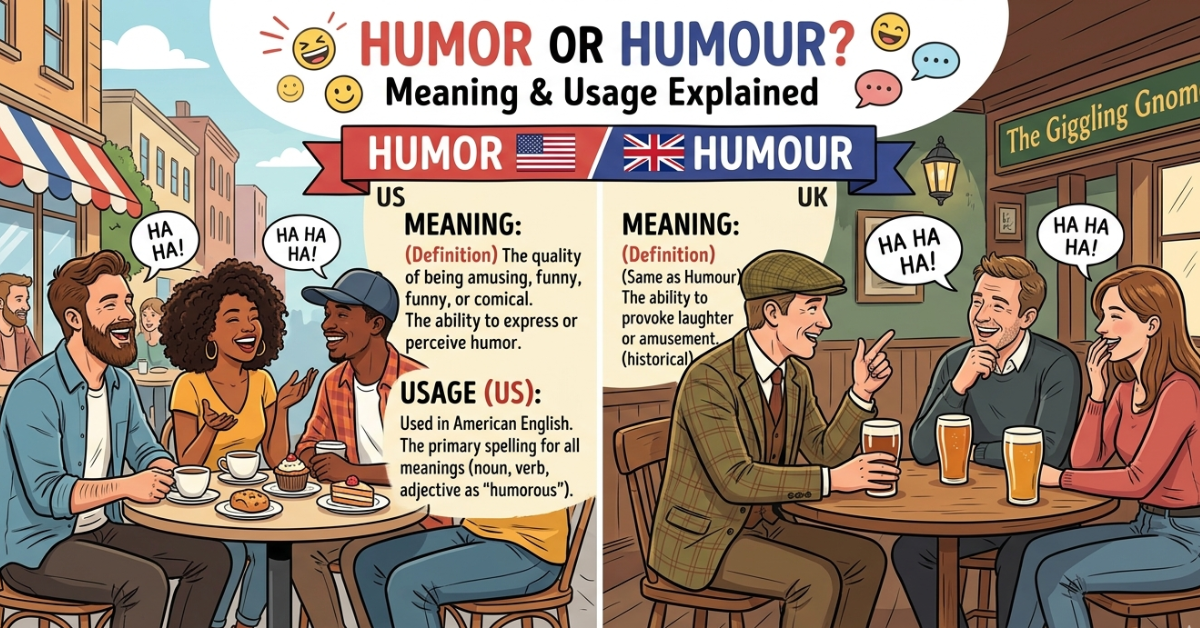
Humor or Humour: Meaning & Usage Explained
- 0
- 684 words
Have you ever paused while writing and wondered whether it should be humor or humour? You’re not alone—this small spelling difference often confuses even fluent English speakers.
The debate around both words comes down to regional English variations, not meaning. In this guide, you’ll learn what the word actually means, why two spellings exist, and how to use each correctly in real-life writing.
By the end, you’ll clearly understand the meaning, along with practical examples that make everything simple and memorable.
Meaning of Humor or Humour
At its core, both words refer to the same concept: the quality of being funny, entertaining, or amusing.
The phrase doesn’t represent two different meanings—it simply reflects spelling differences between English dialects.
In everyday use, the word can describe:
- A funny situation or joke
- A person’s ability to make others laugh
- A light or playful mood
- The interpretation of something in a funny way
So, whether you read “humor” or “humour,” the definition remains unchanged.
American vs British English Difference
The distinction between the two spellings is rooted in geography and language evolution.
- “Humor” → Used in American English
- “Humour” → Used in British English, Canadian English, Australian English, and other Commonwealth countries
This difference applies to many similar words, such as:
- Color (US) vs Colour (UK)
- Flavor (US) vs Flavour (UK)
- Honor (US) vs Honour (UK)
So, when people ask about, they’re really asking which English style they should follow.
Why Spelling Differs in English
English has evolved differently across regions due to historical reforms and linguistic simplification.
American English, influenced by Noah Webster, simplified many spellings to make them more phonetic and efficient. British English retained more traditional forms derived from Latin and French.
That’s why words like exist in two accepted forms today.
Humor or Humour Meaning in Context
To fully understand the meaning, it helps to see how the word functions in real sentences.
Examples:
- She has a great sense of humor/humour.
- The movie was full of dark humor/humour.
- His humor/humour made the presentation enjoyable.
In all cases, the meaning stays consistent—only the spelling changes based on regional preference.
Common Mistakes People Make
A frequent confusion arises when writers mix both spellings in a single document.
You might also wonder, is it when writing for global audiences. The safest approach is consistency:
- Use humor if your audience is primarily American
- Use humour if your audience is British or international Commonwealth readers
Switching between the two in the same text is considered a writing error in formal contexts.
Practical Tips for Correct Usage
Here are simple ways to avoid confusion:
- Choose one spelling style based on your audience
- Stick to a dictionary standard (US or UK)
- Use grammar tools set to your preferred English variant
- Be consistent across all content pieces
These small habits make your writing look professional and polished.
Key Takeaways
- Humor and humour mean the same thing
- The difference is purely regional spelling
- American English uses “humor,” British English uses “humour”
- Consistency matters more than choice
FAQs
1. What is the difference between humor or humour?
There is no difference in meaning. The only distinction is spelling based on American (humor) and British (humour) English.
2. Is it humor or humour in British English?
In British English, the correct spelling is “humour.” It follows traditional English spelling conventions.
3. What does humor or humour meaning refer to?
It refers to the quality of being funny, amusing, or entertaining in speech, writing, or behavior.
4. Can I mix humor or humour in one article?
It is not recommended. Mixing both spellings can make writing inconsistent and less professional.
5. Which is more correct: humor or humour?
Both are correct depending on your chosen English variant. Neither is wrong.
Conclusion
Understanding is less about grammar rules and more about recognizing English variations. Once you know the difference between American and British spelling, choosing the right form becomes effortless.
In the end, the meaning stays the same—only the spelling changes. If you stay consistent with your audience’s preference, your writing will always feel clear, natural, and professional.
Author
britsx85@gmail.com
Related Posts
Walkthrough or Walk-Through: Meaning & Usage Guide
- 0
- 954 words
Have you ever paused while writing and wondered whether it should be walkthrough or walk-through? You’re not alone—this is one of those...
Read out all
Calve or Calf: Meaning, Difference & Usage Explained
- 0
- 847 words
Have you ever paused mid-sentence wondering whether to write calve or calf? You’re not alone. These two words look similar, sound somewhat...
Read out all
Totalling vs Totaling: Spelling Explained Simply
- 0
- 736 words
Have you ever stopped mid-sentence and wondered whether it should be totalling or totaling? You’re not alone. This small spelling difference confuses...
Read out all
No Later Than or Then: Which One Is Correct?
- 0
- 875 words
Have you ever written a sentence like “Submit the form no later than Friday or then Friday” and suddenly paused, unsure if...
Read out all
Get Past or Get Passed: The Clear Grammar Difference
- 0
- 765 words
Have you ever felt unsure about whether to use get past or get passed in a sentence? This is a very common...
Read out all
Recieve or Receive? The Correct Spelling Guide
- 0
- 936 words
Have you ever typed recieve and stopped to wonder whether it looks right? You are not alone. This spelling mistake is extremely...
Read out all