
×
Patience vs Patients: Meaning & Differences Explained
In

The confusion between patience vs patients is more common than you might think, especially for English learners and even native speakers. These two words sound identical but carry completely different meanings, which often leads to writing mistakes and misunderstandings.

In simple terms, patience vs patients comes down to one being a quality and the other being people. Understanding the meaning clearly can instantly improve your grammar, writing clarity, and communication skills.

Let’s break it down in a way that actually sticks.

What is Patience vs Patients?

Before diving deeper, it’s important to see how these words differ at a basic level.

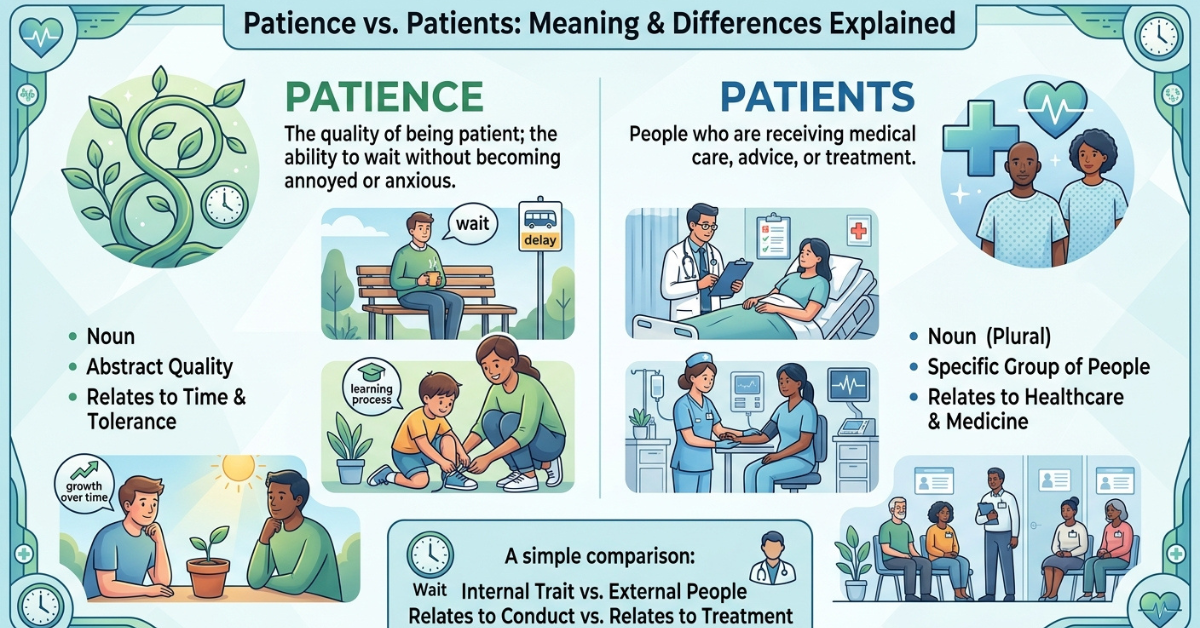
  • Patience: A noun that describes the ability to stay calm and wait without getting frustrated.
  • Patients: A plural noun referring to people receiving medical care.

Even though they sound the same, patience vs patients changes meaning entirely based on context.

Patience vs Patients Meaning Explained

The meaning often confuses learners because of pronunciation. However, their usage is very distinct:

1. Patience (Quality or Trait)

Patience refers to emotional control and calm behavior in difficult situations.

Example:

  • She showed great patience while teaching children.

2. Patients (People)

Patients are individuals who are receiving treatment from doctors or hospitals.

Example:

  • The doctor checked on all his patients in the ward.

So, when we compare meaning, one is abstract (a quality), and the other is concrete (a group of people).

Key Differences Between Patience vs Patients

Understanding the distinction helps avoid writing errors. Here’s a simple breakdown:

1. Meaning

  • Patience = Calmness or tolerance
  • Patients = Medical recipients

2. Usage

  • Patience is used in emotional or behavioral contexts
  • Patients is used in healthcare or medical settings

3. Type of Word

  • Patience = Abstract noun
  • Patients = Countable plural noun

Common Mistakes in Patience vs Patients

Many people mix these words in writing. Here are common errors:

  • Incorrect: The doctor needs more patience in the hospital (incorrect if referring to people)
  • Correct:  The doctor has many patients in the hospital
  • Incorrect:  She is treating her patients with calm patience (confusing usage)
  • Correct: She is treating her patients with care and patience

Knowing the correct meaning helps you avoid these mistakes easily.

Easy Trick to Remember the Difference

If you still get confused, try this simple memory trick:

  • Patience = “A” for Attitude (calm mindset)
  • Patients = “E” for Everyone in Emergency care

Another way:

  • If it’s about emotions → patience
  • If it’s about hospitals → patients

This mental shortcut makes patience vs patients much easier to remember.

Why People Confuse Patience vs Patients

The main reason is pronunciation. Both words sound almost identical, which makes spelling tricky in fast writing or speech-to-text tools.

Other reasons include:

  • Lack of vocabulary practice
  • Overreliance on autocorrect
  • Similar sentence structures in English

Understanding the meaning removes this confusion permanently.

FAQs About Patience vs Patients

1. What is the main difference between patience vs patients?

Patience is a quality of being calm, while patients are people receiving medical care.

2. Why do people confuse patience vs patients?

Because both words sound the same but have completely different meanings and spellings.

3. Can patience vs patients be used in the same sentence?

Yes, but only when context involves both calmness and medical care.

4. Is patience singular and patients plural?

Patience is uncountable (singular concept), while patients is a plural noun.

5. What is the easiest way to remember patience vs patients meaning?

Think of patience as a mental quality and patients as hospital visitors.

Conclusion

Understanding patience vs patients is simple once you break it down into meaning and context. One represents a valuable human quality, while the other refers to individuals in medical care. Learning the correct meaning helps improve your grammar, writing accuracy, and communication skills.

Next time you use these words, take a second to think—are you talking about calmness or people? That small check will save you from one of the most common English mistakes.

Leave a Reply

Your email address will not be published. Required fields are marked *

Author

britsx85@gmail.com

Related Posts

Peace vs Piece: Meaning, Difference & Easy Tips to Remember
In

Peace vs Piece: Meaning, Difference & Easy Tips to Remember

English can be tricky, especially when two words sound exactly the same but mean totally different things. One of the most confusing...

Read out all
Pail vs Pale: Meaning, Differences & Easy Guide
In

Pail vs Pale: Meaning, Differences & Easy Guide

The confusion between pail vs pale is more common than you might think. These two words look almost identical, sound similar in...

Read out all
Overdo vs Overdue: Meaning, Difference & Examples
In

Overdo vs Overdue: Meaning, Difference & Examples

Confused between overdo vs overdue? You’re not alone—these two words look similar, but they have completely different meanings and uses. Many English...

Read out all
Oar vs Ore: Meaning, Differences & Easy Guide Explained
In

Oar vs Ore: Meaning, Differences & Easy Guide Explained

The confusion between oar vs ore is more common than you might think. Even native English speakers sometimes mix them up because...

Read out all
Naval vs Navel: Meaning, Difference & Easy Guide
In

Naval vs Navel: Meaning, Difference & Easy Guide

English words can sometimes be confusing, especially when they look almost identical but carry completely different meanings. One such commonly mixed-up pair...

Read out all
Muscle vs Mussel: Key Differences Explained Simply
In

Muscle vs Mussel: Key Differences Explained Simply

If you’ve ever seen the words muscle vs mussel, you’re not alone in wondering why they sound identical but mean completely different...

Read out all