
- 0
- 1,655 word
Clear voice recording in a noisy fitness studio starts with a wireless microphone worn close to the instructor, enough headroom for shouted cues, and noise control that reduces competing music and room sound without making speech unnatural. Among workout video equipment, audio is often the first part of the setup to become difficult once loudspeakers, ventilation, reflected sound and constant movement all happen at the same time.
For gym vlog audio and online classes, simply turning the microphone gain up is rarely the answer. Secure the mic where it won’t rub against clothing, test it during the largest movements in the routine, and set levels using the loudest coaching voice you’re likely to use. Getting those basics right usually matters more than trying to repair distant or clipped audio afterwards.
Keep the microphone close to the voice
Distance is one of the biggest factors in voice clarity.
A camera-mounted microphone may be several metres away from an instructor. At that distance, it records not only the voice but also the room, music and reflections from the walls.
A wearable microphone changes that balance. Because it remains close to the speaker, the instructor’s voice is stronger relative to the surrounding studio noise.
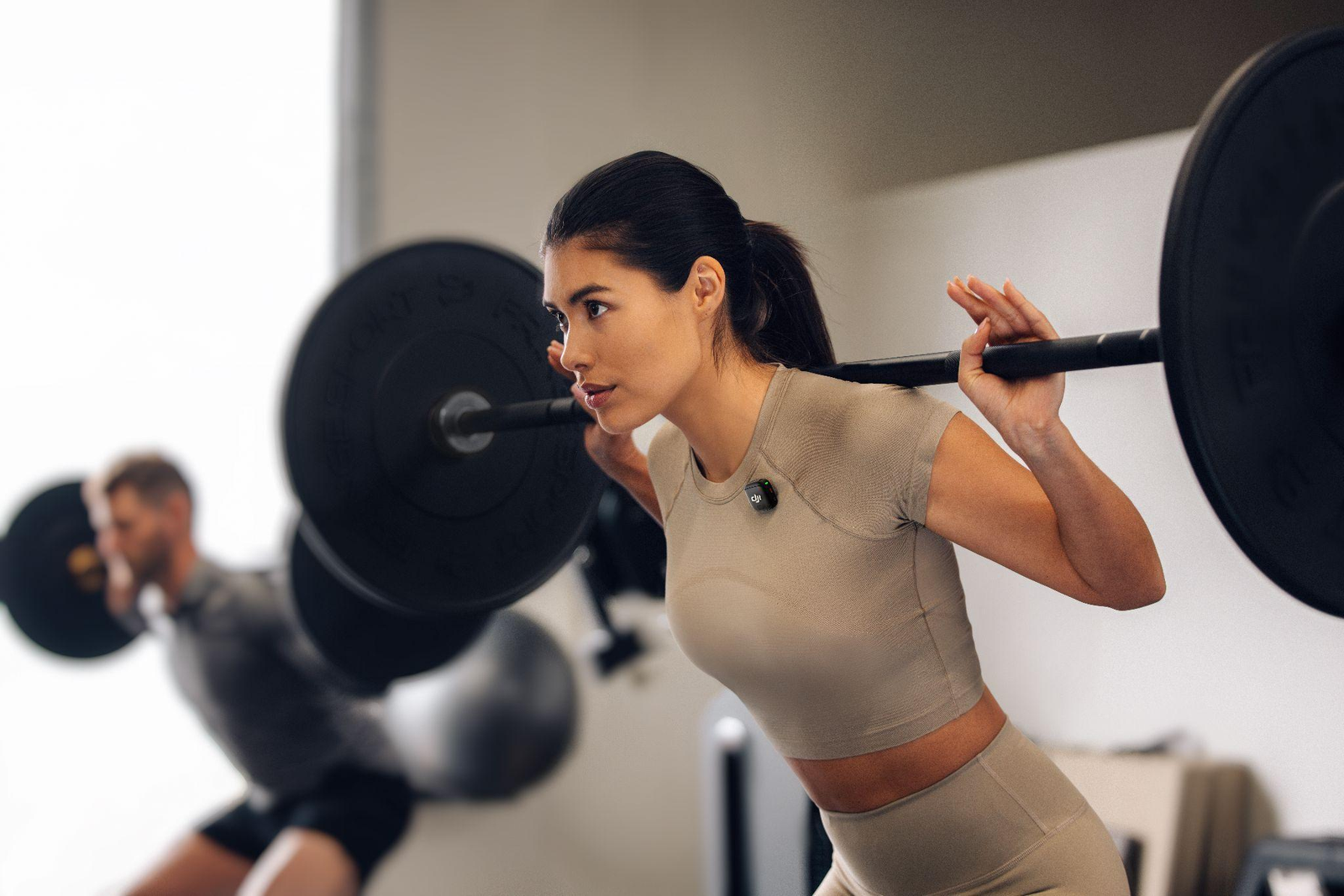
When positioning a wireless microphone, clip the transmitter securely around the upper chest area rather than too low on a loose shirt. The microphone should remain clear of fabric that could brush across it during squats, presses or arm movements.
Before recording a full workout, perform several of the largest movements in the routine. A microphone position that works perfectly while standing still may create clothing noise once the instructor starts moving.
Do not simply turn the music down in post
If the instructor and studio music are captured together on one distant microphone, editing has limited ability to separate them cleanly.
It is much better to make the voice clear at the recording stage.
If the video is being produced specifically for online classes, one option is to keep the studio playback at a practical level while recording the instructor with a close wireless mic. Music can then be balanced more carefully during editing, provided the creator has the appropriate rights to use it.
For live class recordings, where the studio speakers must remain loud, microphone placement and noise reduction become even more important.
However, noise cancellation should not be treated as a way to remove every sound in the room. The goal is intelligible speech, not an unnaturally isolated voice.
Leave room for shouted instructions
Fitness instructors rarely speak at one constant volume.
A warm-up explanation may be conversational, while countdowns such as “three, two, one” or motivational cues can suddenly become much louder. If the recording level has been set too high, these peaks can clip and sound harsh.
Set levels using the loudest voice the instructor is likely to use, not only their normal speaking volume.
Automatic limiting or gain-control features can provide additional protection, but they work best as a safeguard rather than a substitute for a sensible starting level.
A short test should include normal explanation, energetic coaching and several loud cues. Listening back with headphones before the main recording can prevent an entire session from being captured at the wrong level.
Clothing and movement matter
A fitness microphone needs to stay in place through repeated movement.
Avoid clipping it to the loose edge of a top where it can swing or strike the fabric. A stable section of clothing closer to the centre of the upper body generally produces more predictable sound.
Magnetic attachment can be especially useful with fitted workout clothing, where a conventional clip may be awkward to place. It gives you more flexibility to position the mic around the upper chest, but the exact position should still be tested through the full range of movement.
Wind protection is not usually necessary in a closed studio, but it may become useful for outdoor boot camps or training sessions where air movement hits the microphone directly.
Sweat is another practical consideration. Avoid positioning audio equipment where it will be unnecessarily soaked, and follow the manufacturer’s care instructions rather than assuming that a small wearable transmitter is waterproof.
Why DJI Mic Mini 2 works well for active fitness instructors
For an instructor recording workouts alone, the main advantage of DJI Mic Mini 2 is that it stays unobtrusive while you move.
The transmitter weighs approximately 11 g, excluding the magnetic clip and magnet. Combined with the magnetic attachment, that low weight makes it easier to place the mic on fitted workout tops or other clothing where a conventional clip may be awkward, without adding much pull during repeated body movement.
Active noise cancellation can be useful for fitness recording when loud music, ventilation and reflected room sound compete with the instructor’s voice. DJI Mic Mini 2 provides two levels: Basic for quieter indoor spaces and Strong for noisier environments. In a fitness studio, test both and use the lighter processing that still keeps speech clear.
It is still worth testing both modes. If the studio is relatively quiet, aggressive processing may not be necessary. In a louder class, Strong noise cancellation can help shift attention back towards the instructor’s voice.
Automatic limiting for shouted cues
Another useful Mic Mini 2 feature for fitness recording is automatic limiting.
When enabled, the system automatically reduces the level when the audio input becomes too high, helping prevent clipping. This is particularly relevant when an instructor moves rapidly between calm explanation and energetic cues.
The receiver also provides five-level gain adjustment and a safety-track option. This gives creators more control when setting levels before the workout begins and provides additional protection against unexpected peaks.
For a solo trainer, these features solve a more important problem than extreme transmission range. In most studio recordings, the camera is relatively close to the instructor; maintaining usable audio while moving and changing volume is the greater priority.
Battery life for long recording days
DJI rates a Mic Mini 2 transmitter for up to 11.5 hours of operation and the receiver for up to 10.5 hours under its specified test conditions. With the charging case, total operating time can reach up to 48 hours.
Those figures are measured under controlled conditions and should not be interpreted as guaranteed runtime in every setup. Features in use and recording conditions can affect actual battery performance.
For fitness creators, the more practical benefit is that a transmitter can comfortably cover a typical workout recording session without requiring constant battery management.
Mic Mini 2 can also connect to compatible cameras, smartphones, tablets and PCs, while selected DJI cameras support direct OsmoAudio connection without a separate receiver.
When DJI Mic 3 makes more sense
For most solo instructors, Mic Mini 2 offers the simpler balance of low weight, noise control and long operating time.
DJI Mic 3 becomes more relevant when production becomes more complex.
Its receiver can work with up to four transmitters, which is useful for classes involving several instructors or trainer-and-participant demonstrations. DJI Mic 3 also supports dual-file 32-bit float internal recording, integrated timecode and adaptive gain control.
The Automatic gain mode is designed to help prevent clipping, while Dynamic mode adjusts gain for more consistent loudness. Two noise-cancelling levels and three voice-tone presets provide further control over how speech is captured.
These capabilities are valuable for multi-camera productions, programs involving several speakers or fitness content that will receive more detailed post-production. For a straightforward single-instructor workout, they may be more than is necessary.
Test the complete workout, not just the microphone
A fitness microphone setup should be tested under realistic conditions.
Play the studio music at its actual level. Have the instructor move through jumping, floor exercises and overhead movements. Record normal explanations and the loudest coaching voice. Then listen for clipping, clothing noise and moments where the background music overwhelms speech.
For most solo fitness creators, DJI Mic Mini 2 fits the job well because its light transmitter, magnetic attachment, two-level noise cancellation and automatic limiting address the practical problems of recording while moving in a noisy studio.
DJI Mic 3 becomes more relevant when the production involves several instructors, separate audio tracks or more advanced post-production.
Whichever system is used, clear fitness audio begins with the same principles: keep the microphone close, secure it carefully, leave enough headroom for loud cues and test the setup while actually moving. Those decisions usually make a greater difference than simply increasing recording volume.
Frequently Asked Questions
Where should a fitness instructor wear a wireless microphone?
Place it around the upper chest on a stable part of the clothing where it stays clear of fabric that can brush against the mic. For high-movement classes, test squats, overhead reaches and floor work before recording. A magnetic mount can help with fitted workout clothing when a conventional clip is awkward, provided the position stays secure through the full routine.
Should you use active noise cancellation in a fitness studio?
Use it when music, ventilation and room reflections compete with the instructor’s voice, but compare the available levels before the full session. Stronger processing is not automatically better if it makes speech sound less natural. Choose the lightest setting that keeps cues intelligible in the actual room.
What should yoga instructors look for in a wireless microphone?
For yoga instructors, a light transmitter, secure placement, low clothing noise and natural speech usually matter more than aggressive noise reduction. Because a class can include floor work, twists and inversions, test the mounting position through a complete sequence. Magnetic attachment can be useful on fitted clothing if it remains secure during movement.
Do fitness instructors need a sweat-resistant microphone?
Sweat exposure is a real consideration, but do not assume a wearable transmitter is sweat resistant or waterproof unless the manufacturer explicitly states a protection rating. Position the microphone where it will not be unnecessarily soaked, follow the care instructions after class and choose a mounting position that stays secure without rubbing against clothing.
Author

hyderghumro3@gmail.com
Related Posts

Messonde: Exploring the Meaning, Features, Uses, and Growing Interest in Messonde
- 0
- 2,143 words
In today’s rapidly changing digital world, new words, names, platforms, and concepts frequently attract attention. One term that may leave people curious...
Read out all
Emsella: How the Emsella Chair Helps With Bladder Leaks
- 0
- 1,171 word
You laugh at a joke, you sneeze, you pick up your child — and you feel a small leak. You tell yourself...
Read out all
Which Backpack Features Are Worth Paying for on Cyber Monday
- 0
- 832 words
A backpack can look like a good deal until you realize the features you paid for rarely come into play. An extra...
Read out all
Finding Courage, Hope, and Strength in Uncertain Times
- 0
- 949 words
Life is full of unexpected moments. Some days bring happiness and new opportunities, while others challenge our patience and confidence. There are...
Read out all
Martian Mallow: The Fascinating Story Behind the Vintage Lip Smacker and Its 1990s Nostalgia
- 0
- 2,440 words
Introduction Some products become memorable because of their quality, while others earn a special place in people’s memories through their unusual names,...
Read out all
Amcoder: A Complete Guide to the Software Engineering Practice Platform
- 0
- 2,354 words
Introduction Technology continues to transform the way people learn, work, and communicate. Programming has become one of the most valuable skills in...
Read out all