×
Story vs Storey: Meaning, Difference & Usage Explained
In

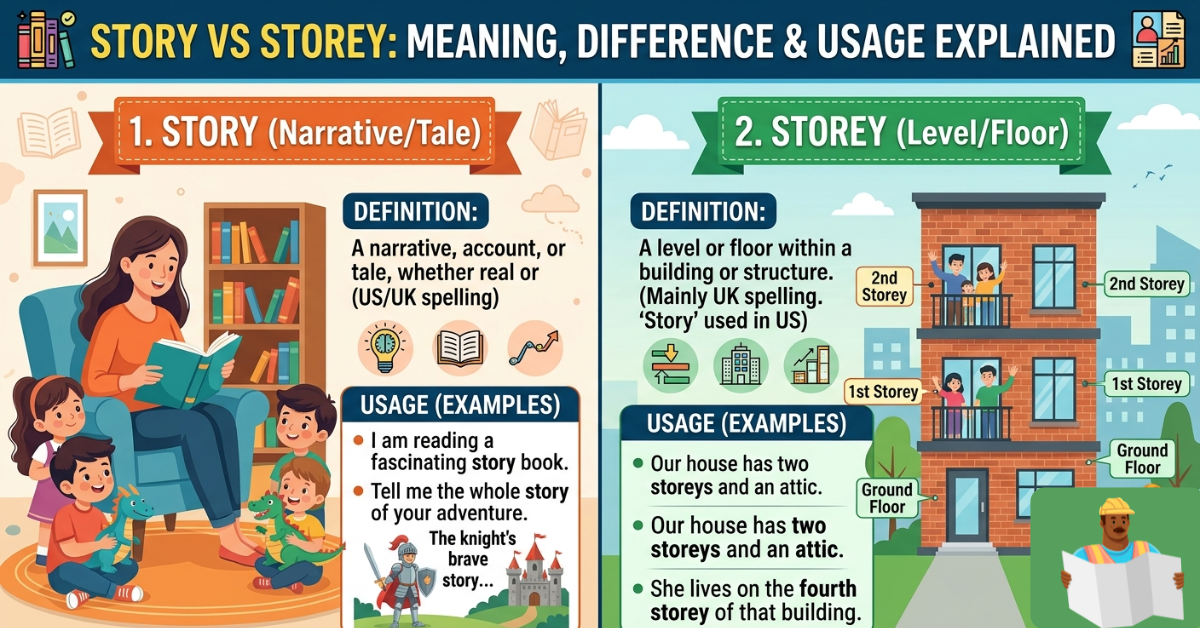
If you’ve ever paused while writing and wondered “Is it story or storey?”, you’re not alone. The confusion between story vs storey is one of the most common spelling doubts in English, especially because both words look almost identical but mean very different things.

In simple terms, one refers to a tale or narrative, while the other refers to levels in a building. But there’s more to it than just that.

Let’s break it down in a clear, practical way so you’ll never mix them up again.

What Does “Story” Mean?

The word “story” is widely used in everyday English, especially in American and international writing.

Meaning of Story:

A story refers to:

  • A narrative or tale (fiction or non-fiction)
  • An account of events
  • A description of something that happened or is imagined

Examples:

  • She told me a beautiful story about her childhood.
  • The news story went viral within hours.
  • Every person has a unique story to share.

In short, “story” is all about storytelling, imagination, or reporting events.

What Does “Storey” Mean?

Now let’s talk about the British spelling, storey, which is often where confusion starts.

Meaning of Storey:

A storey refers to:

  • A level or floor in a building

Examples:

  • The building has five storeys.
  • She lives in a second storey apartment.
  • A multi-storey parking building is being constructed nearby.

So, while “story” is about narratives, “storey” is purely architectural.

Story vs Storey: Key Differences Explained

To make things even clearer, here’s a simple breakdown of story vs storey:

Feature Story Storey
Meaning A tale or narrative A level in a building
Usage Writing, speaking, media Architecture, buildings
English Type American & general English British English
Plural Form Stories Storeys

This distinction is the heart of understanding story vs storey without confusion.

Why Do People Get Confused?

The confusion mainly happens because:

  • They are homophones in some accents
  • Both words look almost identical
  • English has regional spelling differences
  • Context is not always clear for learners

For example, someone might read “a 10-storey building” and mistakenly think it refers to a “10-story building” (which would actually mean a 10-level building in American English spelling).

Easy Trick to Remember the Difference

Here’s a simple memory hack:

  • Story = Storytelling (think: books, movies, news)
  • Storey = Structure (think: stairs, floors, buildings)

Another quick tip:

  • If you can “read it or tell it,” it’s a story
  • If you can “walk on it,” it’s a storey

American vs British English Usage

One of the biggest reasons for confusion in story vs storey is regional spelling differences.

American English:

  • Uses story for both meanings sometimes (but usually “story” = narrative and building context is also “story”)

British English:

  • Clearly separates:
    • story = narrative
    • storey = building level

So, if you’re writing for an international audience, be mindful of which English standard you’re following.

Common Examples in Real Life

Here’s how you’ll see both words used in daily life:

Story (Narrative Use):

  • Short stories in books
  • Instagram stories
  • News stories
  • Personal experiences

Storey (Building Use):

  • Multi-storey malls
  • 3-storey houses
  • High-rise storey apartments

Understanding real-world usage helps reinforce story vs storey naturally.

Common Mistakes to Avoid

Many learners accidentally:

  • Use “storey” when writing about a tale
  • Use “story” when describing building floors in British English
  • Mix both in formal writing

To avoid mistakes:

  • Always check context first
  • Think: Is this about writing or architecture?

FAQs About Story vs Storey

1. What is the main difference between story and storey?

“Story” refers to a narrative, while “storey” refers to a floor in a building.

2. Is “storey” British or American English?

“Storey” is British English. American English uses “story” for most cases.

3. Can “story” ever mean a building floor?

Yes, in American English, “story” can also refer to a building level.

4. What is the plural of storey?

The plural is storeys.

5. How do I remember story vs storey easily?

Think: story = something you read; storey = something you stand on.

Conclusion

Understanding story vs storey is simple once you connect each word to its context. One belongs to the world of imagination and narration, while the other belongs to architecture and buildings.

If you’re writing for global readers, always consider whether you’re using British or American English to stay consistent. With a little practice, you’ll never confuse them again.

Want to improve your grammar even more? Start paying attention to everyday usage—you’ll be surprised how quickly it becomes natural.

Leave a Reply

Your email address will not be published. Required fields are marked *

Author

britsx85@gmail.com

Related Posts

Leak vs Leek: Meaning, Difference & Easy Guide
In

Leak vs Leek: Meaning, Difference & Easy Guide

Have you ever seen the words leak and leek and wondered why they look almost identical but mean completely different things? This...

Read out all
Knead vs Need: Meaning, Difference & Usage Guide
In

Knead vs Need: Meaning, Difference & Usage Guide

English can be tricky, especially when two words sound the same but mean completely different things. One such confusing pair is Knead...

Read out all
Jam vs Jamb: Meaning, Difference & Usage Explained
In

Jam vs Jamb: Meaning, Difference & Usage Explained

The confusion around jam vs jamb is more common than you might think, especially among English learners and even native speakers. At...

Read out all
Incite vs Insight: Meaning, Difference & Usage Explained
In

Incite vs Insight: Meaning, Difference & Usage Explained

Have you ever stumbled while writing and wondered whether to use incite vs insight? You’re not alone. These two words sound similar...

Read out all
Idle vs Idol: Meaning, Difference & Usage Guide
In

Idle vs Idol: Meaning, Difference & Usage Guide

The confusion between idle vs idol is more common than you might think, especially in spoken and written English where both words...

Read out all
Hanged vs Hung: Meaning, Grammar & Usage Explained
In

Hanged vs Hung: Meaning, Grammar & Usage Explained

The confusion between hanged vs hung often troubles English learners and even native speakers. Many people mix them up because both forms...

Read out all