
- 0
- 644 words
Have you ever typed suite vs sweet and paused, wondering why two words that sound almost identical mean completely different things? You’re not alone. This is one of the most common English spelling confusions, especially for learners, writers, and even native speakers.
Understanding suite vs sweet is important because using the wrong word can completely change your meaning. One refers to rooms or sets, while the other is about taste or affection. In this guide, we’ll break everything down in a simple, clear, and practical way so you never mix them up again.
Suite vs Sweet: Key Differences
The confusion comes from pronunciation—they sound very similar but have totally different meanings and uses.
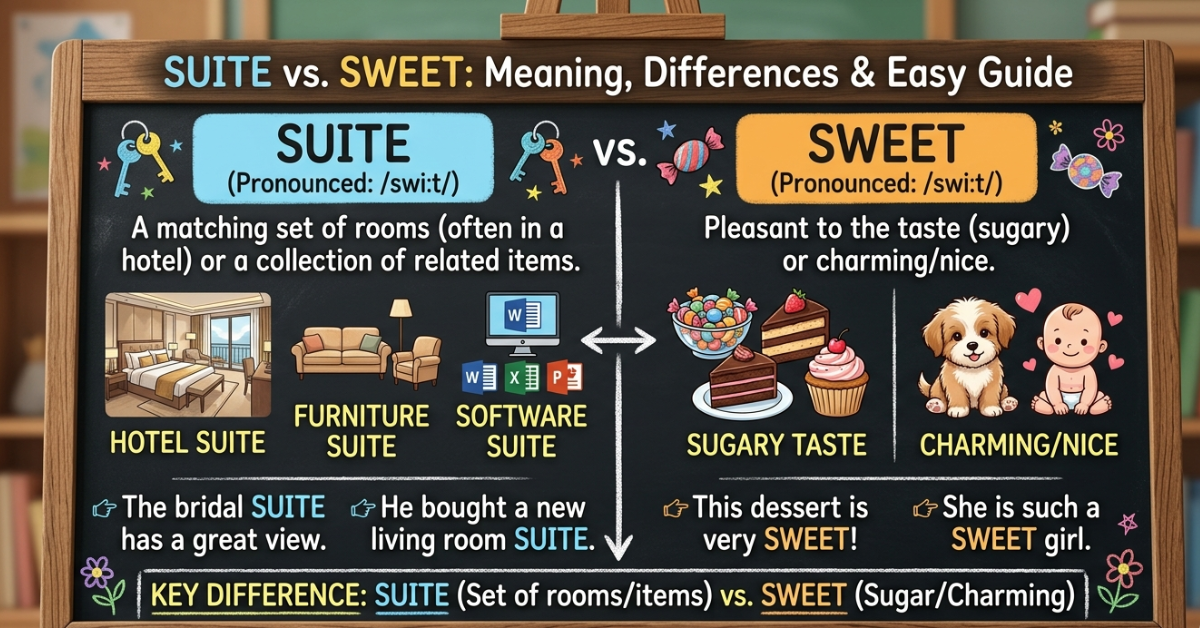
What does “Suite” mean?
A suite refers to a set, collection, or connected group of items. It is most commonly used in hospitality, music, and software.
Examples of “suite”:
- A hotel suite with multiple rooms
- A software suite like design or office tools
- A musical suite consisting of related pieces
Think of “suite” as something grouped together or luxurious space.
What does “Sweet” mean?
Sweet is usually related to taste, flavor, or personality. It can describe food or someone’s kind behavior.
Examples of “sweet”:
- A sweet dessert like cake or candy
- A sweet person who is kind and caring
- A sweet moment or memory
Think of “sweet” as something pleasant, sugary, or emotionally warm.
Suite vs Sweet: Simple Usage Guide
To make things easier, here’s a quick breakdown:
- Suite = Rooms, sets, or collections
- Sweet = Taste, kindness, or pleasant feelings
Easy Memory Trick:
- “Suite” has a “u” for “unit” (a group or set)
- “Sweet” has “ee” like eating sweets
Common Mistakes People Make
Many learners confuse in writing and texting. Here are some common errors:
- “I booked a sweet in the hotel” (wrong)
- “I booked a suite in the hotel” (correct)
- “That cake looks like a suite dessert” (wrong)
- “That cake looks like a sweet dessert” (correct)
Small spelling mistakes can change the entire meaning of a sentence.
Real-Life Examples
Here are some practical sentences to help you understand better:
Suite examples:
- We stayed in a luxury hotel suite during our vacation.
- The designer software suite includes editing tools and templates.
Sweet examples:
- She gave me a sweet smile.
- This chocolate cake is extremely sweet.
Why People Confuse Suite vs Sweet
There are three main reasons:
- Similar pronunciation – both sound nearly identical
- Fast typing errors – especially on mobile keyboards
- Lack of context understanding – meaning depends on sentence use
Once you understand context, the confusion disappears quickly.
Quick Comparison Table
| Feature | Suite | Sweet |
| Meaning | Set or group of rooms/items | Taste or pleasant feeling |
| Usage | Hotels, software, music | Food, personality, emotions |
| Category | Noun | Adjective |
| Example | Hotel suite | Sweet candy |
FAQ – Suite vs Sweet
1. What is the main difference in suite vs sweet?
The main difference is meaning—suite refers to a set or group, while sweet refers to taste or kindness.
2. Is suite vs sweet a common English mistake?
Yes, it is one of the most common spelling confusions in English due to similar pronunciation.
3. Can “suite” ever mean something delicious?
No, “suite” is not related to taste. Only “sweet” is used for food or flavor.
4. How can I remember suite vs sweet easily?
Remember: suite = set of rooms, sweet = sugary or kind behavior.
5. Why do people mix up suite vs sweet in writing?
Because they sound almost identical when spoken, especially in fast conversation.
Conclusion
The confusion between suite vs sweet is very common, but once you understand the meanings, it becomes simple to avoid mistakes. “Suite” refers to a set or group, usually in hotels or systems, while “sweet” describes taste or something pleasant and kind.
By practicing with examples and remembering the simple tricks shared above, you’ll never confuse them again. Keep learning and exploring similar word pairs to strengthen your English writing skills.
Author

linguaezone.com@gmail.com
Related Posts
Kill Two Birds With One Stone Alternative: 50 Better Options
- 0
- 1,569 word
Have you ever paused before saying “kill two birds with one stone” because it sounded too violent or simply didn’t fit the...
Read out all
Happy Sabbath Meaning: A Complete Guide to Its Significance
- 0
- 1,632 word
Have you ever received the message “Happy Sabbath” and wondered what it truly means? Is it simply another way of saying “have...
Read out all
I’m So Proud of You in Other Words: 120+ Heartfelt Alternatives
- 0
- 1,562 word
Have you ever wanted to tell someone you’re proud of them but felt like saying “I’m so proud of you” sounded repetitive?...
Read out all
How Do You Spell Happy Anniversary? Correct Spelling Guide
- 0
- 1,221 word
Have you ever paused before writing an anniversary card and wondered, “How do you spell happy anniversary?” You’re not alone. Whether you’re...
Read out all
Waiting for Your Response Email: Best Examples & Tips
- 0
- 1,483 word
Have you ever sent an important email and found yourself wondering whether you should follow up or simply wait? Whether you’re communicating...
Read out all
Great Asset to the Team: Meaning, Examples & Tips
- 0
- 1,494 word
Have you ever wanted to compliment a coworker but struggled to find words that sound professional and sincere? One of the most...
Read out all